Rotational Inertia
Rotational inertia I measures how hard an object is to set turning about an axis.
Part 1 · Hook
Why this matters
Part 2 · Before you start
What this builds on
Part 3 · Prerequisite check
Quick check before you start
1. If r doubles, r² becomes
- 4 times as large
- 2 times as large
- half as large
- the same
Show the answer
(2r)² = 4r².
- Correct: 4 times as large:
- 2 times as large:
- half as large:
- the same:
2. The center of mass of two equal masses is
- halfway between them
- at the heavier one
- at either end
- outside the line joining them
Show the answer
Equal masses balance at the midpoint.
- Correct: halfway between them:
- at the heavier one:
- at either end:
- outside the line joining them:
Part 4 · See it
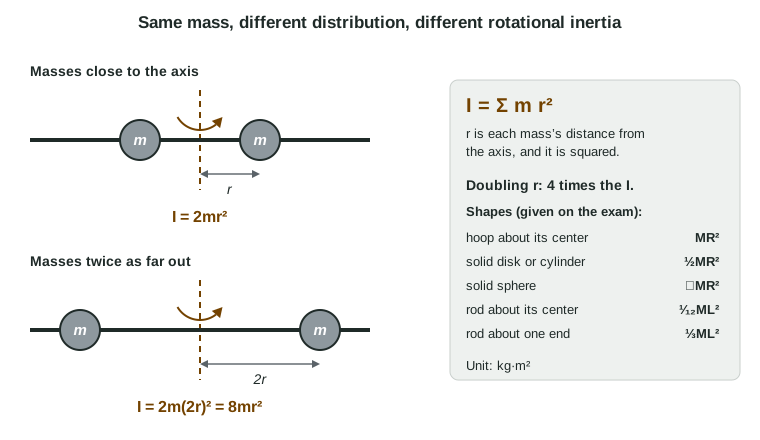
See it first
Part 5 · Step by step
How it works, step by step
- Every bit of mass in a turning object moves in a circle about the axisit resists changes in that motion in proportion to its mass
- Mass farther from the axis moves faster for a given ωit counts more, as the square of its distance
- Adding mr² for every bit of massgives the rotational inertia I = Σmr², in kg·m²
- The same mass is moved farther from the axisI increases (with r²)
- The axis is moved a distance d from the center of massI = I_cm + Md², always larger than I_cm
Part 6 · Key ideas
Key ideas
- Rotational inertia I = Σmr² is the rotational partner of mass: it measures resistance to a change in rotation.
- r is each mass’s distance from the axis, and it is squared: doubling r gives 4 times the I.
- Same mass, different distribution, different I. A hoop (MR²) beats a disk (½MR²) of the same M and R.
- Inertias of disks, rods, hoops and spheres are given on the exam; you do not memorize them.
- Parallel-axis theorem: I = Icm + Md². I is least about the center of mass.
Part 7 · Misconception
A common mistake
The wrong idea: Two objects with the same mass have the same rotational inertia.
What actually happens: Rotational inertia depends on where the mass is. A hoop and a disk of equal mass and radius differ by a factor of 2, and the same rod is 4 times harder to turn about its end than about its middle.
Part 8 · Check yourself
Check yourself
Exam-style questions. Anything you miss goes into your review queue.
Diagram
A rod with three balls
1. What is the rotational inertia of the rod and balls about axis A? Give the value and its unit.
Type a number and its unit.
Show the answer
The middle ball is on axis A (r = 0). I = 2(0.20 kg)(0.40 m)² + 0 = 0.064 kg·m².
- Answer: 0.064 kg·m^2
2. What is the rotational inertia about axis B?
Type a number in kg·m^2.
Show the answer
About B: the near ball has r = 0, the middle ball r = 0.40 m, the far ball r = 0.80 m. I = 0 + (0.40 kg)(0.40 m)² + (0.20 kg)(0.80 m)² = 0.064 + 0.128 = 0.192 kg·m², about 0.19 kg·m².
- Answer: 0.19 kg·m^2
3. Why is the rotational inertia about axis B larger than about axis A, although the mass is the same?
- The mass is, on average, farther from axis B
- Axis B is at the end, where the rod is heavier
- Axis B passes through less of the mass
- Rotational inertia is larger about any axis at an end
Show the answer
I = Σmr². About B the 0.20 kg ball is 0.80 m away, and r² makes that distant mass count four times as much as at 0.40 m. Same mass, spread farther from the axis: larger I.
- Correct: The mass is, on average, farther from axis B: Right: I depends on how far the mass is from the axis, as r².
- Axis B is at the end, where the rod is heavier: The rod is light; its ends are not heavier. The distances to the axis change.
- Axis B passes through less of the mass: Axis B passes through a 0.20 kg ball; axis A through the 0.40 kg ball. What matters is how far the rest is.
- Rotational inertia is larger about any axis at an end: An end axis gives a larger I here because of the distances, not because it is an end.
4. The two end balls are slid in to 0.20 m from the middle. The rotational inertia about axis A becomes
- one quarter as large
- half as large
- the same
- twice as large
Show the answer
Only the end balls contribute about A, each as mr². Halving r multiplies r² by ¼, so I goes from 0.064 to 0.016 kg·m².
- Correct: one quarter as large: Right: r halves, so each r² term is ¼ as large.
- half as large: I depends on r², not r.
- the same: The mass is the same, but it is closer to the axis.
- twice as large: Moving mass toward the axis decreases I.
5. The rotational inertia of an object about an axis depends on
- its mass and how that mass is spread around the axis
- its mass alone
- how fast it is turning
- the forces acting on it
Show the answer
I = Σmr²: each bit of mass counts with the square of its distance from the axis, so both the mass and its distribution matter.
- Correct: its mass and how that mass is spread around the axis: Right: I = Σmr².
- its mass alone: Two objects of the same mass can have very different I.
- how fast it is turning: I is a property of the mass and the axis, not of the motion.
- the forces acting on it: Forces give torques; they do not change I.
6. A thin hoop and a solid disk have the same mass and radius. Which is harder to start spinning about its center, and why?
- The hoop, because all its mass is at the rim
- The disk, because it is solid and has more material
- Neither, because they have the same mass
- The disk, because its mass is closer to the axis
Show the answer
Rotational inertia measures resistance to changes in turning. The hoop’s mass sits at the rim (I = MR²); much of the disk’s mass is near the center (I = ½MR²), so the hoop is harder to spin up.
- Correct: The hoop, because all its mass is at the rim: Right: the hoop’s mass is at r = R, so I = MR² > ½MR².
- The disk, because it is solid and has more material: Same mass: the disk’s mass is spread inward, so its I is smaller.
- Neither, because they have the same mass: Same mass, different distribution, different rotational inertia.
- The disk, because its mass is closer to the axis: Mass close to the axis makes an object easier to spin, not harder.
7. For a given object, about which of these parallel axes is the rotational inertia smallest?
- The axis through its center of mass
- An axis through its edge
- An axis halfway between the center and the edge
- It is the same about each parallel axis
Show the answer
I = I_cm + Md², and Md² is zero only when the axis passes through the center of mass, so that axis gives the smallest I.
- Correct: The axis through its center of mass: Right: I = I_cm + Md² is least when d = 0.
- An axis through its edge: Moving the axis away from the center of mass adds Md².
- An axis halfway between the center and the edge: This still adds Md² with d > 0.
- It is the same about each parallel axis: The parallel-axis theorem shows I grows with d².
Part 9 · Summary
Summary
Part 10 · Up next
What comes next
Part 11 · Connections