Rotational Equilibrium
An object is in rotational equilibrium when the net torque on it is zero, so its angular velocity stays constant; it is in translational equilibrium when the net force is zero.
Part 1 · Hook
Why this matters
Part 2 · Before you start
What this builds on
Part 3 · Prerequisite check
Quick check before you start
1. An object at rest has a net force on it of
- zero
- its weight
- the normal force
- its mass times g
Show the answer
Translational equilibrium: ΣF = 0.
- Correct: zero:
- its weight:
- the normal force:
- its mass times g:
2. Counterclockwise is positive. A force pushing down to the right of a pivot gives a torque that is
- negative
- positive
- zero
- positive or negative, depending on size
Show the answer
Down on the right turns the object clockwise.
- Correct: negative:
- positive:
- zero:
- positive or negative, depending on size:
Part 4 · See it
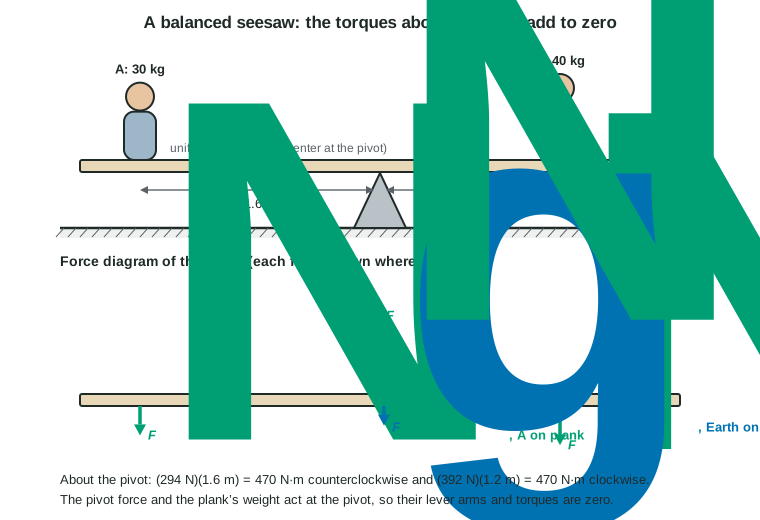
See it first
Part 5 · Step by step
How it works, step by step
- The net torque on an object is zeroits angular velocity does not change (rotational first law)
- The net force on it is also zeroits center of mass does not accelerate
- Both hold and the object starts at restit stays at rest: static equilibrium
- You take torques about the point where an unknown force actsthat force drops out of the torque equation
- One torque in the balance changesthe net torque is no longer zero and the object starts to turn
Part 6 · Key ideas
Key ideas
- Rotational equilibrium: Στ = 0, so ω stays constant. Translational equilibrium: ΣF = 0. They are independent; static objects need both.
- In equilibrium you may take torques about any point. Choose the point where an unknown force acts (a hinge, a support) to remove it.
- A uniform object’s weight acts at its center; it has a torque unless that point is on the axis.
- A hinge force usually has both a horizontal and a vertical part. Do not assume its direction.
- Draw a force diagram first, each force at its point of application.
Part 7 · Misconception
A common mistake
The wrong idea: A hinge or pivot always pushes straight up, and its force must be included in the torque sum.
What actually happens: A hinge can push in any direction that keeps the net force zero, often slanted. Its torque about the hinge itself is zero, which is why the hinge is the best axis to choose.
Part 8 · Check yourself
Check yourself
Exam-style questions. Anything you miss goes into your review queue.
Diagram
A balanced meterstick
1. What is the mass m of the block?
Type a number in kg.
Show the answer
Take torques about the pivot (40 cm). The block, 0.30 m left, turns the stick counterclockwise; the stick’s weight acts at its center (50 cm), 0.10 m right, turning it clockwise. m g(0.30 m) = (0.150 kg) g(0.10 m), so m = 0.050 kg. g cancels.
- Answer: 0.050 kg
2. Use g = 9.8 m/s². What is the size of the force the pivot exerts on the stick?
Type a number in N.
Show the answer
The stick is in translational equilibrium: F_pivot = (0.150 kg + 0.050 kg)(9.8 m/s²) = 1.96 N, about 2.0 N, upward.
- Answer: 2.0 N
3. Which force diagram of the meterstick is correct?
- Pivot force up at 40 cm; the stick’s weight down at 50 cm; the string’s pull down at 10 cm
- Pivot force up at 40 cm; the stick’s weight down at 40 cm; the string’s pull down at 10 cm
- The stick’s weight down at 50 cm; the string’s pull down at 10 cm; nothing at the pivot
- Pivot force up at 40 cm; the stick’s weight down at 0 cm; the string’s pull down at 10 cm
Show the answer
Three forces act on the stick: the pivot’s normal force (up, at 40 cm), Earth’s gravitational force (down, at the center of mass, 50 cm) and the string’s tension (down, at 10 cm).
- Correct: Pivot force up at 40 cm; the stick’s weight down at 50 cm; the string’s pull down at 10 cm: Right: each force at its point of application.
- Pivot force up at 40 cm; the stick’s weight down at 40 cm; the string’s pull down at 10 cm: A uniform stick’s weight acts at its center of mass, the 50 cm mark.
- The stick’s weight down at 50 cm; the string’s pull down at 10 cm; nothing at the pivot: Without an upward force the stick would fall; the pivot pushes up.
- Pivot force up at 40 cm; the stick’s weight down at 0 cm; the string’s pull down at 10 cm: The weight acts at the center of mass, not at an end.
4. The block is moved from the 10 cm mark to the 20 cm mark and the stick is released. What happens?
- The stick tips so its right end goes down
- The stick tips so its left end goes down
- It stays balanced, because no mass changed
- It stays balanced, because the pivot force adjusts
Show the answer
The block’s torque about the pivot falls from mg(0.30 m) to mg(0.20 m); the stick’s own torque, (0.150 kg)g(0.10 m), is unchanged. The net torque is clockwise, so the stick starts to turn with its right end going down.
- Correct: The stick tips so its right end goes down: Right: the block’s counterclockwise torque shrinks while the stick’s clockwise torque stays the same.
- The stick tips so its left end goes down: Moving the block toward the pivot reduces its torque, so the left side loses.
- It stays balanced, because no mass changed: The torque depends on the lever arm, which changed from 0.30 m to 0.20 m.
- It stays balanced, because the pivot force adjusts: The pivot force acts at the axis and gives no torque, so it cannot restore the balance.
5. A student ignores the stick’s mass and finds m = 0. What is wrong with that reasoning?
- The stick’s center of mass is not at the pivot, so its weight exerts a torque
- The pivot force exerts a torque that the student left out
- The stick’s weight acts at the pivot and adds to the block’s
- Torques about a pivot ignore any masses that do not hang from strings
Show the answer
A uniform stick’s weight acts at its center of mass, 50 cm. That point is 0.10 m from the pivot, so the weight exerts a clockwise torque that the block must balance.
- Correct: The stick’s center of mass is not at the pivot, so its weight exerts a torque: Right: the stick’s weight acts 0.10 m from the pivot.
- The pivot force exerts a torque that the student left out: The pivot force acts at the axis, so its torque is zero.
- The stick’s weight acts at the pivot and adds to the block’s: The weight acts at the 50 cm mark, not the pivot.
- Torques about a pivot ignore any masses that do not hang from strings: Every force with a lever arm gives a torque, strings or not.
6. An object stays at rest without turning. Which conditions hold?
- The net force on it is zero and the net torque on it is zero
- The net force is zero; that alone keeps it from turning
- The net torque is zero; that alone keeps it from moving
- The forces on each side of the pivot are equal
Show the answer
Static equilibrium needs both ΣF = 0 (no change in the center of mass’s motion) and Στ = 0 (no change in rotation). Neither condition implies the other.
- Correct: The net force on it is zero and the net torque on it is zero: Right: translational and rotational equilibrium are separate conditions.
- The net force is zero; that alone keeps it from turning: Two equal, opposite forces along different lines give zero net force but a net torque.
- The net torque is zero; that alone keeps it from moving: Zero net torque says nothing about the net force.
- The forces on each side of the pivot are equal: Torques must balance, and equal forces at different lever arms do not.
7. A driver pushes up on one side of a steering wheel and pulls down equally hard on the other side. The wheel
- starts turning while its center stays put
- stays still, because the forces cancel
- moves up and down without turning
- turns and also moves sideways
Show the answer
The two forces are equal and opposite, so the net force is zero and the center stays at rest. Their lines of action are on opposite sides of the axis, so both torques are in the same direction and the net torque is not zero: the wheel starts to turn.
- Correct: starts turning while its center stays put: Right: the net force is zero, but the two torques add.
- stays still, because the forces cancel: The forces cancel, but their torques both point the same way.
- moves up and down without turning: Equal and opposite forces leave the center of mass at rest.
- turns and also moves sideways: With zero net force the center does not accelerate.
8. A uniform plank rests on two supports, one under each end. A painter walks from the middle of the plank toward the right support. Predict how each quantity changes.
| Variable | Change |
|---|---|
| Force from the right support | — |
| Force from the left support | — |
| Sum of the two support forces | — |
Show the answer
Translational equilibrium fixes the total support force at the total weight; rotational equilibrium decides how it splits, shifting load to the support the painter is nearer.
- Force from the right support: increases. Taking torques about the left support, the painter’s lever arm grows, so the right support must push harder.
- Force from the left support: decreases. Taking torques about the right support, the painter’s lever arm shrinks, so the left support pushes less.
- Sum of the two support forces: no change. Net force zero: the two supports together hold the plank’s and painter’s weight, which do not change.
Part 9 · Summary
Summary
Part 10 · Up next
What comes next
Part 11 · Connections