Motion of Orbiting Satellites
For a satellite of small mass orbiting a massive body, total mechanical energy is conserved (gravity is the only force, and it is conservative) and angular momentum about the central body is conserved (gravity exerts no torque about its center).
Part 1 · Hook
Why this matters
Part 2 · Before you start
What this builds on
Part 3 · Prerequisite check
Quick check before you start
1. With U_G = 0 at infinite separation, the gravitational potential energy of two masses a distance r apart is
- −Gm₁m₂/r
- +Gm₁m₂/r
- −Gm₁m₂/r²
- mgh
Show the answer
U_G = −Gm₁m₂/r, negative and approaching zero far away.
- Correct: −Gm₁m₂/r:
- +Gm₁m₂/r:
- −Gm₁m₂/r²:
- mgh:
2. For a satellite in a circular orbit, gravity provides
- the centripetal net force, mv²/r
- a force balanced by centrifugal force
- no force, because it is weightless
- a force along its velocity
Show the answer
GMm/r² = mv²/r.
- Correct: the centripetal net force, mv²/r:
- a force balanced by centrifugal force:
- no force, because it is weightless:
- a force along its velocity:
3. A point object’s angular momentum about a point stays constant when
- no net torque acts about that point
- its speed is constant
- its distance from the point is constant
- no forces act on it
Show the answer
ΔL = τΔt.
- Correct: no net torque acts about that point:
- its speed is constant:
- its distance from the point is constant:
- no forces act on it:
Part 4 · See it
See it first
Part 5 · Step by step
How it works, step by step
- A small satellite orbits a much more massive body, and only gravity actsthe total mechanical energy E = K + U of the system is constant
- Gravity points at the central body’s centerit exerts no torque about that point, so the satellite’s angular momentum L about it is constant
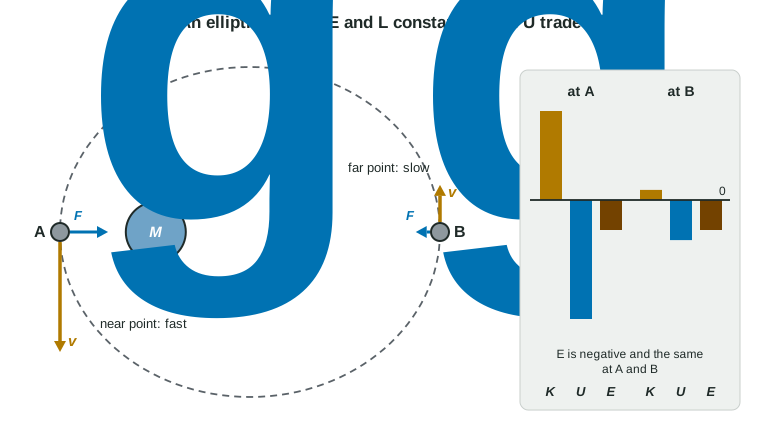
- On an elliptical orbit the satellite moves closer inU becomes more negative and K grows: it speeds up (r v sin θ stays fixed)
- In a circular orbit, GMm/r² = mv²/rK = GMm/(2r), U = −2K and E = −K: a bound orbit has E < 0
- The total energy is raised to zerothe object can just escape: v_esc = √(2GM/r)
Part 6 · Key ideas
Key ideas
- Model: a satellite of much smaller mass than the central body; UG = −GMm/r, zero at infinite separation.
- Circular orbit: E, U, K and L are all constant. v = √(GM/r), K = GMm/(2r), E = −K.
- Elliptical orbit: E and L constant; K and U trade. Fastest at the closest point: rAvA = rBvB where v ⊥ r.
- A bound orbit has E < 0. Escape speed sets E = 0: v = √(2GM/r).
- Name the reason: no torque about the center (L), only a conservative force inside the system (E).
Part 7 · Misconception
A common mistake
The wrong idea: A satellite in orbit is weightless because there is no gravity in space, and a satellite moving faster must be in a higher orbit.
What actually happens: Gravity is what holds it in orbit; it is in free fall around the planet. And higher circular orbits are slower: v = √(GM/r) falls as r grows, even though the total energy is higher.
Part 8 · Check yourself
Check yourself
Exam-style questions. Anything you miss goes into your review queue.
Diagram
A satellite on an elliptical orbit
1. What is the satellite’s speed at B?
Type a number in m/s.
Show the answer
Earth’s pull points toward its center, so it exerts no torque about it and L is constant. At the closest and farthest points the velocity is perpendicular to r, so m r_A v_A = m r_B v_B: v_B = (7.0 × 10⁶)(8.7 × 10³)/(1.4 × 10⁷) = 4.4 × 10³ m/s.
- Answer: 4.4 × 10³ m/s
2. Why is the satellite’s angular momentum about Earth’s center the same at A and at B?
- Earth’s pull on it points at Earth’s center: no torque
- The satellite moves at a constant speed around it
- Gravity does no work on a satellite
- The satellite’s distance from Earth is constant
Show the answer
The only force (Earth’s gravitational force) points along the line to Earth’s center, so its lever arm about that point is zero. With no torque, L about Earth’s center is constant, even though r and v both change.
- Correct: Earth’s pull on it points at Earth’s center: no torque: Right: a force along r has zero lever arm about the center.
- The satellite moves at a constant speed around it: Its speed changes: fast at A, slow at B.
- Gravity does no work on a satellite: On an elliptical orbit gravity does work, changing the speed.
- The satellite’s distance from Earth is constant: The distance changes from 7.0 × 10⁶ m to 1.4 × 10⁷ m.
3. Which quantities for the satellite-Earth system are the same at A and at B?
- Total mechanical energy and angular momentum
- Kinetic energy and gravitational potential energy
- Speed and distance from Earth
- Kinetic energy and angular momentum
Show the answer
Gravity is the only force, and it is conservative, so E = K + U is constant. It exerts no torque about Earth’s center, so L is constant. K and U change, trading with each other.
- Correct: Total mechanical energy and angular momentum: Right: E and L are constant; K and U trade.
- Kinetic energy and gravitational potential energy: K is larger at A and U is more negative there; they trade.
- Speed and distance from Earth: Both change around an elliptical orbit.
- Kinetic energy and angular momentum: L is constant, but K is larger at A.
4. Taking U = 0 at infinite separation, how does the gravitational potential energy at A compare with that at B?
- It is twice as negative at A
- It is half as negative at A
- It is four times as negative at A
- It is the same at A and B
Show the answer
U_G = −GMm/r. At A, r is half as large, so U is twice as large in size and more negative: the satellite is deeper in Earth’s gravitational well.
- Correct: It is twice as negative at A: Right: U = −GMm/r, and r_A is half of r_B.
- It is half as negative at A: U is more negative closer in, not less.
- It is four times as negative at A: U goes as 1/r, not 1/r².
- It is the same at A and B: U depends on the distance from Earth’s center, which changes.
5. With U_G = 0 at infinite separation, a satellite in a bound orbit has total mechanical energy that is
- negative
- positive
- zero
- equal to its kinetic energy
Show the answer
U_G = −GMm/r is negative and larger in size than K for a bound orbit, so E = K + U < 0. To escape, E must be raised to zero or above.
- Correct: negative: Right: it does not have enough energy to reach infinity.
- positive: Positive total energy means the object escapes.
- zero: Zero total energy is exactly the escape condition.
- equal to its kinetic energy: U is negative and adds to K.
6. A satellite moves from a circular orbit of radius r to one of radius 2r around the same planet. Its kinetic energy becomes
- half as large
- twice as large
- one quarter as large
- the same
Show the answer
For a circular orbit K = ½mv² = GMm/(2r), so doubling r halves K (and v falls by √2).
- Correct: half as large: Right: K = GMm/(2r) ∝ 1/r.
- twice as large: A larger orbit is slower: v = √(GM/r).
- one quarter as large: K goes as 1/r, not 1/r².
- the same: The orbital speed depends on r.
7. A comet on a long elliptical orbit moves from its farthest point toward its closest point to the Sun. Predict how each quantity for the comet-Sun system changes.
| Variable | Change |
|---|---|
| The comet’s speed | — |
| Total mechanical energy | — |
| Gravitational potential energy of the comet-Sun system (zero at infinite separation) | — |
Show the answer
E stays constant because only gravity, a conservative force inside the system, acts. Falling inward, U = −GMm/r becomes more negative, so K and the speed increase.
- The comet’s speed: increases. U becomes more negative as it falls inward, so K grows with E fixed.
- Total mechanical energy: no change. Only gravity acts, a conservative force inside the system.
- Gravitational potential energy of the comet-Sun system (zero at infinite separation): decreases. U = −GMm/r becomes more negative as r shrinks.
Part 9 · Summary
Summary
Part 10 · Up next
What comes next
Part 11 · Connections