Defining Simple Harmonic Motion
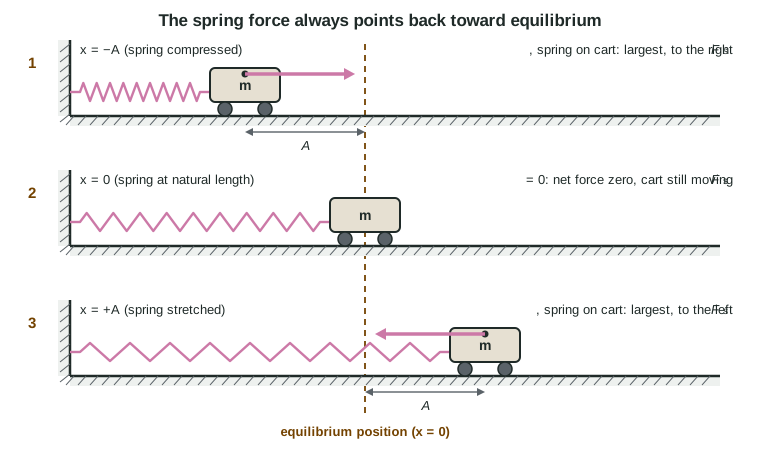
Simple harmonic motion is periodic motion driven by a restoring force proportional to the displacement from equilibrium and opposite to it (F = −kx); the force and acceleration are zero at equilibrium and largest at the amplitude, and a pendulum at small angles is a close match.
Part 1 · Hook
Why this matters
Part 2 · Before you start
What this builds on
Part 3 · Prerequisite check
Quick check before you start
1. A spring with k = 50 N/m is stretched 0.10 m. How large is the force it exerts?
- 5.0 N
- 500 N
- 0.0020 N
- 50 N
Show the answer
Hooke's law: |F| = kΔx = (50 N/m)(0.10 m) = 5.0 N.
- Correct: 5.0 N:
- 500 N:
- 0.0020 N:
- 50 N:
2. An object has zero net force on it. What must be true?
- Its velocity is constant (possibly zero)
- It is at rest
- It is slowing down
- No forces act on it
Show the answer
Zero net force means zero acceleration, so the velocity does not change. The object can be moving.
- Correct: Its velocity is constant (possibly zero):
- It is at rest:
- It is slowing down:
- No forces act on it:
3. A 2.0 kg object has a net force of 6.0 N on it. What is its acceleration?
- 3.0 m/s²
- 12 m/s²
- 0.33 m/s²
- 6.0 m/s²
Show the answer
a = F/m = 6.0 N / 2.0 kg = 3.0 m/s².
- Correct: 3.0 m/s²:
- 12 m/s²:
- 0.33 m/s²:
- 6.0 m/s²:
Part 4 · See it
See it first
Part 5 · Step by step
How it works, step by step
- An object is displaced from its equilibrium positiona restoring force pulls it back toward equilibrium
- The restoring force is proportional to the displacement and opposite to it (F = −kx)the acceleration is largest at the ends and zero at equilibrium
- The object reaches equilibrium moving fastit overshoots, because zero force does not stop it
- On the other side the restoring force reversesthe object slows, stops at the same distance A, and comes back: simple harmonic motion
Part 6 · Key ideas
Key ideas
- Periodic motion repeats in equal time intervals. Simple harmonic motion (SHM) is the special case caused by a restoring force proportional to the displacement: F = −kx.
- The equilibrium position is where the net force is zero. The object moves fastest there, so zero force does not mean zero velocity.
- The amplitude A is the largest displacement from equilibrium: half the distance from one turning point to the other.
- A simple pendulum at small angles is close to SHM: along its arc the restoring force is about mg·θ, proportional to the angle (in radians).
Part 7 · Misconception
A common mistake
The wrong idea: At the turning points the object is at rest, so the force on it is zero; at the middle it is moving fastest, so the force there is largest.
What actually happens: It is the other way round. The force depends on the displacement, not on the speed: it is largest at the turning points (where the object is momentarily at rest) and zero at equilibrium (where it moves fastest).
Part 8 · Check yourself
Check yourself
Exam-style questions. Anything you miss goes into your review queue.
Data table
Force on a glider from a spring
A 0.40 kg glider on a level air track is attached to a spring. A student holds the glider at several positions and reads the force the spring exerts on it with a force sensor. Position is measured from where the spring is relaxed; + is to the right.
| Position x (m) | Force from spring F (N) |
|---|---|
| −0.10 | +2.4 |
| −0.05 | +1.2 |
| 0 | 0 |
| +0.05 | −1.2 |
| +0.10 | −2.4 |
1. Which feature of the data shows that the glider, once released, will move in simple harmonic motion?
- The force is proportional to the displacement and points the opposite way
- The force is zero at the position where the spring is relaxed
- The force keeps getting more negative as the glider is moved farther to the right
- The force has the same size at equal distances on either side
Show the answer
SHM needs a restoring force proportional to the displacement from equilibrium and opposite to it: F = −kx. Doubling x doubles F, and the sign is always opposite to x.
- Correct: The force is proportional to the displacement and points the opposite way: Right: this is the definition of the restoring force in SHM, F = −kx.
- The force is zero at the position where the spring is relaxed: A zero force at equilibrium is true of any oscillation; it does not show the force grows in proportion to the displacement.
- The force keeps getting more negative as the glider is moved farther to the right: True of the data, but it says nothing about proportion or about the left side: a force that pointed left everywhere would never pull the glider back from the left. SHM needs F proportional to x and opposite to it.
- The force has the same size at equal distances on either side: Symmetry alone allows forces that are not proportional to x (for example a force that grows as x²).
2. What is the spring constant of the spring? Give the value and its unit.
Type a number and its unit.
Show the answer
From any row, k = |F|/|x| = 2.4 N / 0.10 m = 24 N/m. Every row gives the same value, which is what makes the force proportional to x.
- Answer: 24 N/m
3. The glider is pulled to x = +0.080 m and released. What is its acceleration at the moment of release? Take + to the right, include the sign, and give the unit.
Type a number and its unit.
Show the answer
F = −kx = −(24 N/m)(0.080 m) = −1.92 N. a = F/m = −1.92 N / 0.40 kg = −4.8 m/s², toward equilibrium.
- Answer: -4.8 m/s^2
4. When the oscillating glider passes x = 0 moving to the right, what is the net force on it?
- Zero, even though the glider is moving fast
- To the right, in the direction it is moving
- To the left, because it will soon turn around
- Its largest value, because its speed is largest
Show the answer
At x = 0 the spring is relaxed, so the spring force is zero; gravity and the normal force cancel on the level track. Zero net force means zero acceleration at that instant, not zero velocity.
- Correct: Zero, even though the glider is moving fast: Right: x = 0 is the equilibrium position, where the net force is zero.
- To the right, in the direction it is moving: This is the "a force is needed to keep it moving" idea. The glider keeps moving at x = 0 with no net force at that instant.
- To the left, because it will soon turn around: The force points left only once the glider is to the right of x = 0 and the spring is stretched.
- Its largest value, because its speed is largest: This mixes up force with speed. The force depends on the displacement, which is zero here.
5. The block hanging from the vertical spring is pulled down and released. When it is at its lowest point, what is the direction of the net force on it?
- Upward, toward the equilibrium position
- Downward, because its weight pulls down
- Zero, because it is momentarily at rest
- Downward, in the direction it was moving
Show the answer
Below equilibrium the spring is stretched more than at equilibrium, so its upward pull is larger than the weight. The net force points up, toward equilibrium, as a restoring force should.
- Correct: Upward, toward the equilibrium position: Right: the spring force exceeds the weight below equilibrium.
- Downward, because its weight pulls down: The weight is there, but the spring's upward pull is larger at the lowest point.
- Zero, because it is momentarily at rest: At rest for an instant does not mean zero net force; this is where the net force is largest.
- Downward, in the direction it was moving: The net force does not follow the motion; it follows the displacement, pointing back toward equilibrium.
6. A cart on a horizontal spring oscillates between x = −A and x = +A. Where is the size of its acceleration greatest?
- At x = −A and x = +A
- At x = 0
- At x = −A/2 and x = +A/2
- The same size at each position along the track
Show the answer
The net force is −kx, so its size is largest where |x| is largest, at the turning points. By Newton's second law the acceleration is largest there too, even though the speed is zero.
- Correct: At x = −A and x = +A: Right: largest displacement, largest restoring force, largest acceleration.
- At x = 0: At x = 0 the net force is zero, so the acceleration is zero; this is where the speed is greatest.
- At x = −A/2 and x = +A/2: The force at ±A/2 is half its value at ±A.
- The same size at each position along the track: A constant acceleration would need a constant force; the spring force changes with x.
Part 9 · Summary
Summary
Part 10 · Up next
What comes next
Part 11 · Connections