Rolling
An object rolling without slipping has v_cm = Rω, and its kinetic energy is ½Mv² + ½Iω².
Part 1 · Hook
Why this matters
Part 2 · Before you start
What this builds on
Part 3 · Prerequisite check
Quick check before you start
1. A ball is released from rest and slides without friction down a ramp of height h. Its speed at the bottom is
- √(2gh)
- 2gh
- gh
- √(gh)
Show the answer
mgh = ½mv².
- Correct: √(2gh):
- 2gh:
- gh:
- √(gh):
2. A wheel with I = 0.50 kg·m² turns at 4.0 rad/s. Its rotational kinetic energy is
- 4.0 J
- 2.0 J
- 8.0 J
- 1.0 J
Show the answer
½Iω² = ½(0.50)(16).
- Correct: 4.0 J:
- 2.0 J:
- 8.0 J:
- 1.0 J:
3. Kinetic friction on a sliding object
- dissipates mechanical energy as thermal energy
- does no work
- always adds energy
- acts only on rolling objects
Show the answer
Sliding surfaces convert kinetic energy to thermal energy.
- Correct: dissipates mechanical energy as thermal energy:
- does no work:
- always adds energy:
- acts only on rolling objects:
Part 4 · See it
See it first
Part 5 · Step by step
How it works, step by step
- An object rolls without slippingits center moves one circumference per turn, so v_cm = Rω
- It both moves and spinsits kinetic energy is ½Mv² + ½Iω²
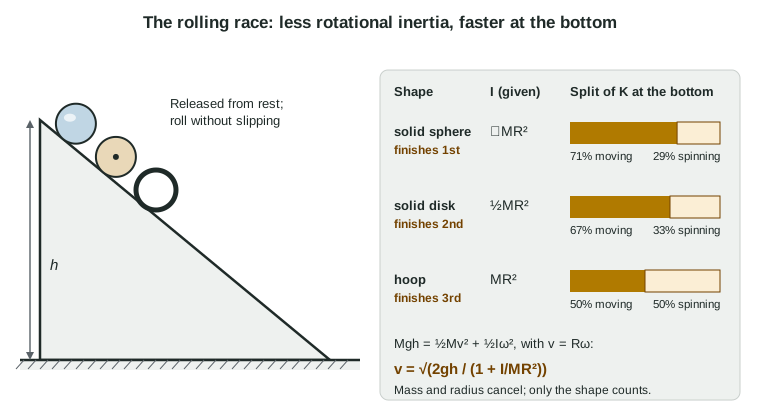
- It rolls down a ramp from restMgh is shared between moving and spinning: v = √(2gh/(1 + I/MR²))
- Its mass sits farther from its center (larger I/MR²)more energy goes into spinning, so it moves more slowly
- The contact point slides (skidding)v_cm ≠ Rω, kinetic friction dissipates energy, and the motion changes until rolling sets in
Part 6 · Key ideas
Key ideas
- Rolling without slipping: vcm = Rω and Δxcm = RΔθ.
- Total kinetic energy = ½Mvcm² + ½Iω².
- Static friction makes a rolling object spin but does no work: mechanical energy is conserved.
- Rolling race: v = √(2gh/(1 + I/MR²)). Mass and radius cancel; smaller I/MR² wins (sphere, disk, hoop). A frictionless sliding block beats them all.
- Slipping: vcm ≠ Rω; kinetic friction dissipates energy and changes vcm and ω until they match.
Part 7 · Misconception
A common mistake
The wrong idea: A heavier or bigger ball rolls down a ramp faster, and every object rolling from the same height arrives with the same speed √(2gh).
What actually happens: Mass and radius cancel, but shape does not. Each rolling object splits Mgh between moving and spinning, so it arrives slower than √(2gh), and the one with mass nearest its center (smallest I/MR²) arrives first.
Part 8 · Check yourself
Check yourself
Exam-style questions. Anything you miss goes into your review queue.
Diagram
Three shapes race down a ramp
1. In what order do the three objects reach the bottom?
- Sphere, then disk, then hoop
- Hoop, then disk, then sphere
- A three-way tie: they have the same mass and radius
- Disk, then sphere, then hoop
Show the answer
Each loses the same Mgh, shared as ½Mv² + ½Iω². With v = Rω, v = √(2gh/(1 + I/MR²)). The smaller I/MR² (sphere ⅖ < disk ½ < hoop 1), the faster the object.
- Correct: Sphere, then disk, then hoop: Right: the smaller I/MR², the larger the share of energy in moving along.
- Hoop, then disk, then sphere: The hoop puts the most energy into spinning, so it is slowest.
- A three-way tie: they have the same mass and radius: Same M and R, but different mass distributions and so different I.
- Disk, then sphere, then hoop: The sphere has a smaller I/MR² (⅖) than the disk (½), so it is faster.
2. Use g = 9.8 m/s². What is the disk’s speed at the bottom?
Type a number in m/s.
Show the answer
Mgh = ½Mv² + ½(½MR²)(v/R)² = ¾Mv², so v = √(4gh/3) = √(4 × 9.8 × 0.80/3) = 3.23 m/s, about 3.2 m/s.
- Answer: 3.2 m/s
3. At the bottom, what fraction of the hoop’s kinetic energy is rotational?
- One half
- One third
- Two sevenths
- Zero
Show the answer
With v = Rω, the hoop’s rotational kinetic energy ½(MR²)ω² = ½Mv² equals its translational kinetic energy, so each is half the total.
- Correct: One half: Right: for a hoop, ½Iω² = ½(MR²)(v/R)² = ½Mv².
- One third: That is the disk’s share: ½Iω² = ¼Mv² out of ¾Mv².
- Two sevenths: That is the solid sphere’s share.
- Zero: A rolling hoop spins, so part of its kinetic energy is rotational.
4. A second solid sphere with twice the mass and twice the radius rolls down the same ramp. Compared with the first sphere, its speed at the bottom is
- the same
- larger, because it is heavier
- smaller, because it has more rotational inertia
- smaller, because its radius is larger
Show the answer
For any solid sphere I/MR² = ⅖, so v = √(10gh/7) depends only on h and g. Mass and radius cancel; only the shape matters.
- Correct: the same: Right: v = √(2gh/(1 + I/MR²)) has no M or R in it.
- larger, because it is heavier: Mass cancels: twice the mass needs twice the energy for the same speed and gets twice the Mgh.
- smaller, because it has more rotational inertia: Its I is larger, but so is its mass; the ratio I/MR² is still ⅖.
- smaller, because its radius is larger: R cancels through v = Rω.
5. A frictionless block, released from the top at the same moment, slides down beside them. Where does it finish?
- First, ahead of all three
- Last, because nothing makes it spin
- Tied with the sphere
- Between the disk and the hoop
Show the answer
A sliding block with no friction turns all of Mgh into ½Mv², reaching v = √(2gh) ≈ 4.0 m/s. Every rolling object shares its energy with rotation and is slower.
- Correct: First, ahead of all three: Right: all its Mgh becomes translational kinetic energy.
- Last, because nothing makes it spin: Not spinning means none of its energy goes into rotation, so it is fastest.
- Tied with the sphere: The sphere puts 2/7 of its energy into spinning; the block puts none.
- Between the disk and the hoop: With no rotation it beats every rolling object.
6. For a ball of radius R rolling without slipping, the speed of its center is
- v_cm = Rω
- v_cm = ω/R
- v_cm = 2Rω
- v_cm = 0
Show the answer
In one revolution (2π rad) the ball rolls forward one circumference (2πR), so Δx_cm = RΔθ and v_cm = Rω.
- Correct: v_cm = Rω: Right: in one turn the center moves forward one circumference, 2πR.
- v_cm = ω/R: Units do not match: ω/R is not a speed.
- v_cm = 2Rω: 2Rω is the speed of the top of the ball, not the center.
- v_cm = 0: The center moves forward as the ball rolls.
7. A wheel rolls without slipping down a ramp. The static friction force from the ramp
- spins it up but does no work on it
- dissipates energy, so less arrives at the bottom
- points down the ramp and speeds up the center
- is zero, because the wheel is not slipping
Show the answer
On the ramp, static friction points up the slope at the contact point. Its torque about the center increases ω. The contact point is momentarily at rest, so the friction does no work: mechanical energy (translational + rotational + gravitational) is conserved.
- Correct: spins it up but does no work on it: Right: static friction acts at a point at rest, so it dissipates nothing.
- dissipates energy, so less arrives at the bottom: Static friction acts at a point that is not sliding; no energy is dissipated.
- points down the ramp and speeds up the center: It points up the ramp: it slows the center and spins the wheel up.
- is zero, because the wheel is not slipping: On a slope it is needed to make the wheel turn faster as it speeds up.
Part 9 · Summary
Summary
Part 10 · Up next
What comes next
Part 11 · Connections