Conditions around every organism keep changing: day turns to night, summer to winter, wet ground dries out, a predator appears. Organisms that detect these changes and respond to them survive and reproduce better than those that do not. This page covers the responses the exam expects you to know: how animals move toward good conditions, how plants grow toward light and time their flowers, how internal clocks and seasonal changes work, how animals signal to each other, and why some animals help others at a cost to themselves.
Stimulus and response
A stimulus is a change that a receptor can detect: light, temperature, a chemical, a touch, a sound. A response is what the organism does as a result. You met this pattern with feedback loops (topic 4.4) and cell signaling (topic 4.1): a receptor detects the change, a signal travels, and target cells respond.
Responses to the environment come in two broad kinds:
- Behavior: what an animal does. A pill bug walks until it finds moist ground; a bird sings; a bee dances.
- Physiological responses: changes in how the body works. A tree drops its leaves, a plant makes flowers, a ground squirrel lowers its metabolic rate for the winter.
Both kinds are traits, shaped by genes and the environment (topic 5.5). Individuals whose responses fit their surroundings leave more offspring, so over many generations the responses we see tend to match the conditions each species lives in.
Moving toward good conditions: taxis and kinesis
A taxis is movement aimed toward or away from a stimulus. A moth flying toward a lamp shows positive phototaxis; bacteria swimming up a sugar gradient show chemotaxis. The animal senses the direction of the stimulus and steers.
A kinesis is a change in how fast an animal moves, or how often it turns, as conditions change, with no steering at all. Pill bugs (small land crustaceans also called isopods) lose water quickly in dry air. On dry ground they walk fast and keep walking; on moist ground they slow down and stop. Nobody aims them at the moisture, yet after a few minutes most of them are on the moist side, because that is where they stop moving. A kinesis gathers animals in good conditions just as well as a taxis, by a different mechanism.
Biologists test these responses in a choice chamber: a dish with two sides that differ in one condition (moist and dry, light and dark), with animals released in the middle and counted on each side over time. A good design has a control dish with the same condition on both sides, several dishes, and the same temperature and light everywhere else.
Worked example: is a choice-chamber result more than chance? In five dishes with a light side and a dark side, 50 beetles were counted after 10 minutes: 34 on the dark side and 16 on the light side.
Step 1. Null hypothesis. The beetles have no preference, so we expect 25 on each side.
Step 2. Chi-square (topic: chi-square skill). χ² = Σ(o − e)²/e = (34 − 25)²/25 + (16 − 25)²/25 = 81/25 + 81/25 = 6.48.
Step 3. Compare. There are two categories, so df = 1, and the critical value at p = 0.05 is 3.84. Because 6.48 > 3.84, we reject the null hypothesis: the beetles are not spread at random, and the data support a preference for the dark side.
Step 4. Mechanism. The test says only that the distribution is not random. Whether the beetles steered toward the dark (taxis) or just slowed down there (kinesis) needs other data, such as tracking how individuals move on each side.
Plants respond too: tropisms
Plants cannot walk, but they grow toward or away from a stimulus that comes from one direction. These growth responses are tropisms.
- Phototropism: shoots bend toward light. The tip of the shoot detects light from one side. The plant hormone auxin moves to the shaded side, and cells there elongate more than cells on the lit side, so the shoot curves toward the light. Cover just the tip with an opaque cap and the shoot grows straight up.
- Gravitropism: roots grow down and shoots grow up, even in the dark.
- Thigmotropism: a pea tendril that touches a support grows around it.
The common mistake is to think the lit side grows faster. It is the opposite: the shaded side elongates more and pushes the tip over.
Day length as a calendar: photoperiodism
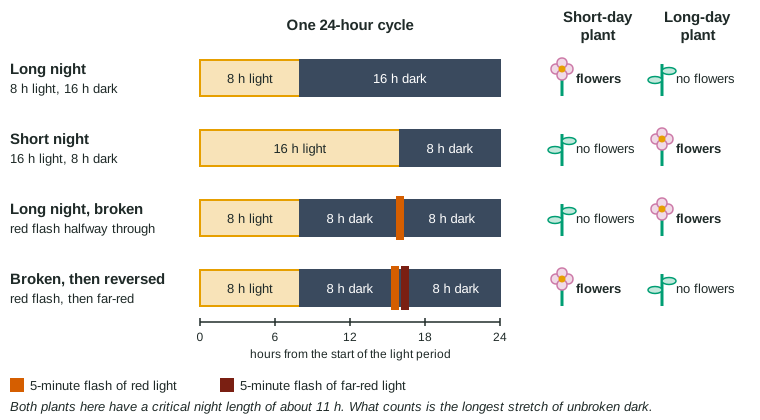
Temperature changes from day to day, but the length of the day changes the same way every year, so it is a reliable calendar. A response to the relative lengths of day and night is photoperiodism. Flowering is the classic example, and growers use it to time crops.
- Short-day plants (poinsettias, chrysanthemums) flower when the night is longer than a critical length, as in autumn.
- Long-day plants (spinach, many grasses) flower when the night is shorter than a critical length, as in early summer.
- Day-neutral plants flower when they reach a certain size, whatever the day length.
The names suggest the plants measure the day, but experiments show they measure the night (Figure 1). Give a short-day plant a long night, but switch a light on for five minutes in the middle of it, and the plant does not flower: its longest unbroken dark period is now too short. Interrupting the day with a period of darkness has no such effect.
The light detector is phytochrome, a pigment-protein in leaves. It switches between two forms. Red light (about 660 nm) converts it to its active form, called Pfr; far-red light (about 730 nm, just beyond what we see as red) converts it back to the inactive form, Pr. During a long night, active phytochrome slowly reverts to the inactive form. A red flash in the night switches it on again, and a far-red flash right after switches it back off, so the plant responds to whichever flash came last. The leaf then sends a signal through the plant that switches on flowering genes in the shoot tips.
| Short-day plant | Long-day plant | |
|---|---|---|
| Flowers when the night is | longer than its critical length | shorter than its critical length |
| Season it flowers in | late summer or autumn | late spring or early summer |
| A red flash in the middle of a long night | stops flowering | causes flowering |
| Far-red right after the red flash | flowering restored | no flowering |
Animals use day length too. Lengthening days in spring raise reproductive hormones in many birds and mammals, and caged migratory birds become restless at the time their wild relatives would leave, even with plenty of food.
Internal clocks: circadian rhythms
Many activities follow a cycle of about 24 hours: sleep and waking, leaf movements, hormone release. These circadian rhythms are run by an internal biological clock, a set of genes and proteins whose levels rise and fall in a loop. The test of a clock is to remove the cues: a hamster kept in constant darkness still runs on its wheel once a day, but its period drifts slightly away from 24 hours, for example starting a little later each day. Light each morning resets the clock to the real day, which is why travel across time zones causes jet lag until the clock catches up.
Getting through hard seasons
- Hibernation: a ground squirrel in winter lowers its body temperature to a few degrees above freezing and its metabolic rate to a few percent of normal. The squirrel actively turns down its metabolism, and as it cools its cells run their reactions even more slowly and use less ATP, so stored fat lasts the whole winter, when there is no food.
- Torpor is a shorter version, such as a hummingbird cooling down for one night. Estivation is a similar inactive state through a hot, dry season, as in some desert frogs and lungfish.
- Dormancy in seeds and buds stops growth until conditions return, often triggered by day length or cold.
- Seasonal migration: animals move between places used in different seasons. Arctic terns breed in the Arctic summer and spend the southern summer near Antarctica. Day length triggers the hormone changes that start migration; birds find their way using the sun, the stars and Earth's magnetic field.
Animal communication
A signal is anything one animal does that changes another's behavior. Signals travel by four channels:
- Visual: color patches, postures, displays. A male fiddler crab waves his one giant claw.
- Auditory: calls and songs carry far and work in the dark or in dense forest.
- Chemical: pheromones, chemicals released by one animal that change the behavior or physiology of others of its species. Ants lay trail pheromones from food to the nest; a female moth releases a pheromone that males detect from far away.
- Tactile: touch, such as grooming in primates.
The honeybee waggle dance combines touch and movement in the dark hive. A forager that found food runs a straight "waggle" line on the vertical comb. The angle of that line from straight up equals the angle of the food from the direction of the sun, and the longer the waggle run lasts, the farther away the food is. Nestmates follow the dancer and then fly out in that direction.
Innate and learned behavior
Innate behavior appears complete the first time an animal meets the right cue, with no practice. A spider raised alone spins a normal web. A fixed action pattern is an innate sequence that runs to the end once triggered: a male stickleback fish attacks almost any object with a red underside, even a crude model, because a red belly is the cue for a rival male. Learned behavior changes with experience.
| Kind | What happens | Example |
|---|---|---|
| Fixed action pattern (innate) | A set sequence, triggered by a simple cue, runs to completion | Stickleback attacks a red-bellied model |
| Habituation (learned) | The animal stops responding to a repeated stimulus that has no consequence | Birds ignore a scarecrow after a few days |
| Imprinting (learned in a short early window) | A young animal learns a lasting attachment during a brief sensitive period | Goslings follow the first moving object they see after hatching |
| Classical conditioning (learned) | A neutral stimulus becomes linked with one that already causes a response | A dog salivates at a bell that always comes before food |
| Operant conditioning (learned) | An action is linked with its result, reward or punishment | A toad stops catching a bee after being stung |
Most real behavior mixes both: a songbird has an innate template for its species' song but must hear adults sing during a sensitive period to sing it correctly.
Cooperation and kin selection
Some behavior helps others. Wolves hunt together and share the kill; both helpers and helped can gain. Harder to explain is altruism: behavior that costs the helper and benefits another. A ground squirrel that gives an alarm call when a hawk appears draws the hawk's attention to itself.
The answer is in shared alleles. For any allele you inherited from your parents, a full sibling has, on average, a one-in-two chance of carrying a copy from the same parent. If an alarm call saves several sisters, more copies of the caller's alleles, including any that favor calling, may survive than if it had stayed quiet. Selection of this kind, through relatives, is kin selection, and counting an individual's own offspring plus the extra offspring of relatives it helps gives its inclusive fitness. A testable prediction follows: alarm calls should be more common when relatives are nearby, which is what field studies of ground squirrels found. Worker bees, which do not reproduce but raise their sisters, are an extreme case.
Courtship
Courtship behaviors, such as the display of a peacock's tail, the song of a male bird or a gift of food, lead to mating. They let animals recognize their own species, and they let one sex, often the females, choose among possible mates. Because choosy mates favor certain displays, courtship traits are shaped by sexual selection (topic 7.2) and can become very elaborate.
Common mistakes
- "Plants bend toward light because the lit side grows faster." The shaded side, with more auxin, elongates more.
- "Short-day plants measure the day." They measure the unbroken night.
- "Animals in a choice chamber chose the moist side." With a kinesis they did not choose; they slowed down there.
- "Altruism helps the species." Kin selection works through shared alleles in relatives, not through the good of the species.
- "Innate means unchangeable by the environment." Many innate behaviors need the right cue, and learning builds on innate templates.