Every living thing needs two things from its surroundings: energy, to power its cells, and matter, the atoms it builds its body from. In an ecosystem these two behave very differently. Energy arrives from the sun, passes from organism to organism, and leaves as heat: it flows through one way. Matter stays on Earth and is used again and again: it cycles. This page follows both, from sunlight to top predators and from the air to proteins and back.
Communities and ecosystems
A community is all the populations of different species living and interacting in one place: the trees, insects, birds, fungi and bacteria of a forest. An ecosystem is the community plus its nonliving surroundings, such as sunlight, water, soil, air and temperature. A pond, a rotting log and the open ocean are all ecosystems; what makes each one a system is that energy flows and matter cycles among its living and nonliving parts.
Who eats whom: producers, consumers, decomposers
- Producers (autotrophs, topic 3.5) make organic molecules from inorganic ones. Most capture light by photosynthesis: plants on land, algae and cyanobacteria in water. At deep-sea hydrothermal vents, where no light reaches, bacteria and archaea use chemosynthesis: they get energy by oxidizing chemicals such as hydrogen sulfide and use it to build sugars from CO₂. Tube worms, clams and crabs there all depend on these producers.
- Consumers (heterotrophs) eat other organisms. Primary consumers, or herbivores, eat producers. Secondary consumers eat herbivores, and tertiary consumers eat secondary consumers. Carnivores eat animals; omnivores eat both plants and animals.
- Decomposers, mostly bacteria and fungi, break down dead bodies, fallen leaves and wastes (together called detritus) and release their atoms as simple substances such as CO₂, ammonium and phosphate. Detritivores such as earthworms and millipedes eat detritus and break it into pieces, speeding decomposition.
Each feeding step is a trophic level: producers are level 1, primary consumers level 2, and so on. A food chain is one path, such as grass → grasshopper → shrew → owl, with arrows pointing from the food to the eater, the direction energy moves. Real communities are tangled: the shrew also eats beetles, and owls also eat mice. All the linked food chains form a food web. Some animals feed at more than one level; a bear that eats berries and salmon is both a primary and a higher consumer.
How much energy enters: primary productivity
The rate at which producers capture energy and store it in organic matter is primary productivity, usually given in kilojoules (or grams of carbon) per square meter per year.
- Gross primary productivity (GPP): all the energy producers capture.
- Net primary productivity (NPP): what is left after the producers' own cellular respiration. NPP = GPP − respiration by producers.
NPP is what matters to everything else, because it is stored in new leaves, roots, wood and algal cells that consumers and decomposers can eat. Plants typically spend about half of their GPP on their own respiration. Tropical rain forests and coral reefs have high NPP per square meter; deserts and the open ocean have low NPP per square meter, although the ocean is so large that its total is huge. Biomass is the mass of living matter at a level or in an area; NPP is the rate at which new biomass is made.
Energy losses at each step
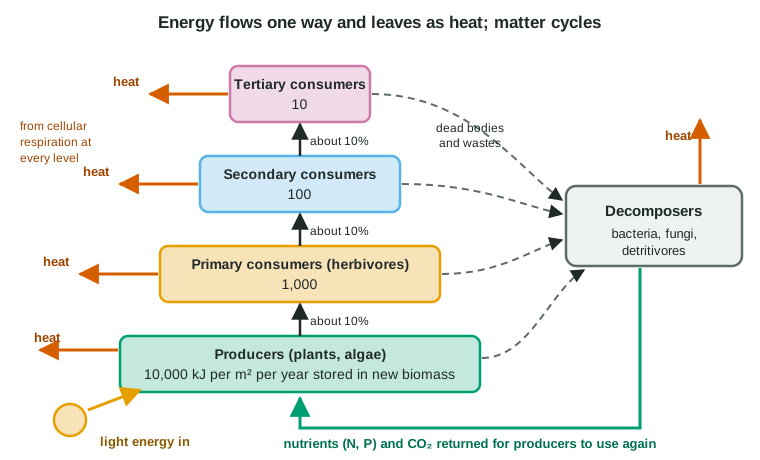
Follow the energy in the plants a herbivore could eat. Much of it is never eaten: leaves fall and roots die, and that energy goes to decomposers. Of what is eaten, some cannot be digested (cellulose, for many animals) and leaves in feces, again to decomposers. Of what is absorbed, most is used in cellular respiration to power the animal's muscles, nerves, pumps and repair, and that energy leaves as heat (topic 3.4: no conversion is complete). Only the remainder is stored in new body tissue: growth and offspring. That stored energy is all the next level can get.
The percentage of one level's stored energy that ends up stored at the next is the trophic efficiency. A useful rule of thumb is 10% (the 10% rule); real values run from below 1% to about 20%. Drawn as stacked bars, the energy at each level makes an energy pyramid that always narrows upward (Figure 1). Three things follow:
- Top predators are few. A hectare of grassland can feed many mice but only a fraction of one hawk.
- Food chains are short, usually four or five levels, because by then too little energy is left to support another population.
- Eating lower on the food chain feeds more people: grain eaten directly supplies roughly ten times more energy than the same grain fed to cattle first.
Worked example: energy through a meadow. A meadow's plants capture 20,000 kJ per m² per year (GPP) and use 11,000 in their own respiration. Grasshoppers store 900 kJ per m² per year in new tissue, and the spiders that eat them store 72.
Step 1. NPP. 20,000 − 11,000 = 9,000 kJ per m² per year is stored by the plants.
Step 2. Plants to grasshoppers. 900 ÷ 9,000 × 100 = 10%.
Step 3. Grasshoppers to spiders. 72 ÷ 900 × 100 = 8%.
Step 4. Where did the rest go? Of the 9,000 kJ in plants, 8,100 did not end up in grasshopper tissue: uneaten plants and feces went to decomposers, and grasshopper respiration released heat. Notice the units: these are rates per year, so the comparison is fair across levels.
A pyramid of biomass (the mass present at one moment) usually narrows upward too, but not always. In the open ocean, tiny algae may weigh less at any moment than the animals that eat them, because the algae divide quickly and are eaten almost as fast as they grow. Their yearly production is still far larger, so the energy pyramid is never upside down.
Endotherms and ectotherms: different energy budgets
You met endotherms and ectotherms in topic 2.2. An endotherm (a bird or mammal) keeps its body warm with heat from its own metabolism; an ectotherm (a lizard, fish or insect) gets most of its heat from its surroundings. This changes the energy budget sharply.
| Endotherm (e.g., a mouse) | Ectotherm (e.g., a lizard) | |
|---|---|---|
| Main source of body heat | Its own cellular respiration | The surroundings (sun, warm rocks) |
| Metabolic rate at rest, same temperature | Several times higher | Lower |
| Food needed per day | Much more | Much less |
| Share of absorbed energy stored as new tissue | Small (often 1-3%) | Larger (often 10% or more) |
| In cold surroundings | Metabolic rate rises to make more heat | Body cools, metabolism slows |
So a food chain that runs through endotherms loses energy faster than one through ectotherms. A kilogram of lizards can be supported on far less food than a kilogram of mice. The trade-off is that endotherms stay active in the cold, at night and in winter.
Matter cycles: biogeochemical cycles
The atoms in your body have been in rocks, oceans, air and other organisms before. Each element moves through a biogeochemical cycle, passing between living things and nonliving reservoirs, the places it is stored, such as the air, the oceans, soil and rock. Changes to any part of a cycle can change how much of an element living things can reach, and so can change population sizes and the whole ecosystem.
The carbon cycle
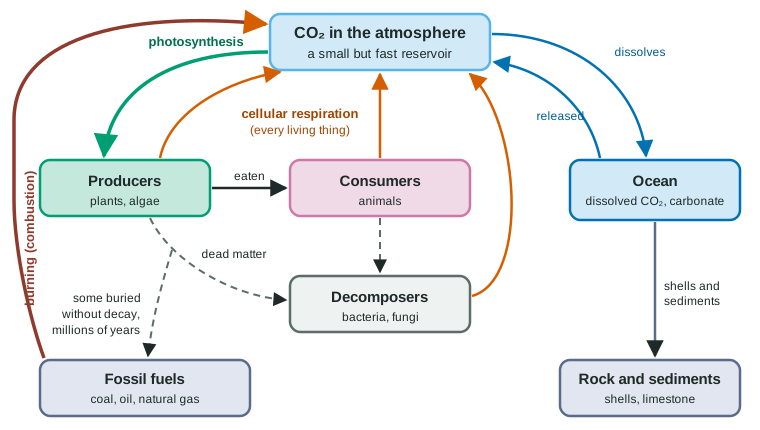
Photosynthesis takes CO₂ from the air (or water) and builds it into sugars. Producers, consumers and decomposers all return CO₂ by cellular respiration (Figure 2). The ocean dissolves CO₂ from the air and releases it again, and sea creatures build carbon into shells that settle as sediments and, over millions of years, limestone. Some dead plants and plankton were buried without decaying and slowly became fossil fuels: coal, oil and natural gas. Burning them returns that ancient carbon to the air in a few centuries.
Carbon dioxide is a greenhouse gas: it lets sunlight through but absorbs some of the heat Earth's surface gives off, keeping the planet warmer (the greenhouse effect). Measurements of CO₂ in the air show two patterns: a yearly rise and fall, as northern forests take up CO₂ in summer and release it in winter, and a steady climb, because burning fossil fuels and clearing forests add carbon faster than plants and oceans take it up (topic 8.7 covers the effects).
The nitrogen cycle
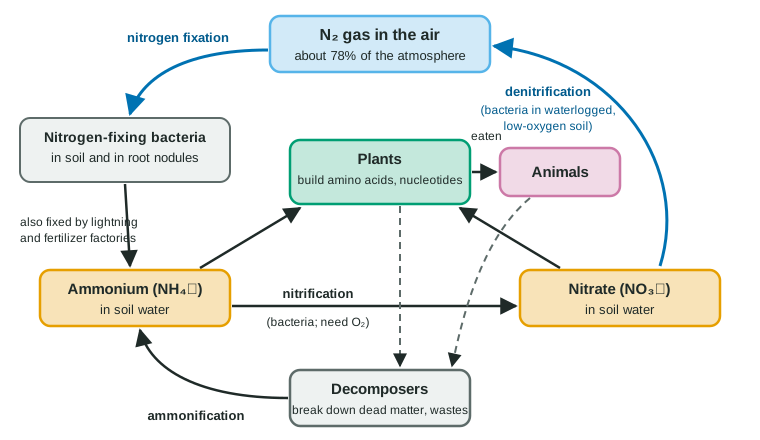
Every amino acid and nucleotide contains nitrogen (topic 1.2). The air is 78% N₂, but its triple bond is so strong that plants and animals cannot use it. Bacteria do almost all the converting (Figure 3):
- Nitrogen fixation: nitrogen-fixing bacteria turn N₂ into ammonium (NH₄⁺, closely related to ammonia, NH₃). Some live free in soil; others, such as Rhizobium, live in root nodules of beans, peas and clover, a mutualism in which the plant supplies sugar (topic 2.10). Lightning and fertilizer factories also fix nitrogen.
- Nitrification: nitrifying bacteria, which need oxygen, turn ammonium into nitrite and then nitrate (NO₃⁻).
- Assimilation: plant roots take up ammonium and nitrate and build amino acids and nucleotides; animals get nitrogen by eating.
- Ammonification: decomposers break down proteins in dead matter and wastes and release ammonium.
- Denitrification: in waterlogged, low-oxygen soil, denitrifying bacteria use nitrate in place of oxygen and release N₂ back to the air.
Farmers use this cycle when they plant beans or clover one year and corn the next: the nodule bacteria leave the soil richer in nitrogen.
The phosphorus and water cycles
Phosphorus is in ATP, DNA and phospholipids. Unlike carbon and nitrogen, it has no important gas form, so the air is not a reservoir. Rain and roots slowly break down phosphate rock (weathering), releasing phosphate ions; plants take them up; they pass along food chains; decomposers return them; and some washes into the sea, settles into sediments and, over millions of years, becomes rock again. Because it is released so slowly, phosphorus often limits plant and algal growth.
In the water cycle, the sun's heat evaporates water from oceans and land, and plants release water vapor through their leaves (transpiration, topic 1.1). The vapor cools, condenses into clouds and falls as precipitation (rain, snow). It runs off into rivers and the sea or soaks into the ground. Over land, a large share of the rain comes from water that plants transpired upwind.
| Cycle | Main nonliving reservoirs | Into living things by | Back out by |
|---|---|---|---|
| Carbon | Air (CO₂), ocean, rock, fossil fuels | Photosynthesis | Respiration, burning, decomposition |
| Nitrogen | Air (N₂), soil | Fixation by bacteria; roots take up ammonium and nitrate | Ammonification, then denitrification to N₂ |
| Phosphorus | Rock, soil, sediments (no gas) | Roots take up phosphate from weathered rock | Decomposition; settling into sediments |
| Water | Oceans, ice, groundwater, air | Roots take up water; animals drink | Transpiration, evaporation, excretion |
Changes in energy or matter change the ecosystem
Because every level depends on the one below, a change at the base ripples upward. A cloudy year or a drought lowers NPP, and herbivore and predator numbers fall after it. Extra nitrogen or phosphorus does the opposite: producers grow faster, which can feed more consumers, or upset the system entirely, as you will see in topic 8.7. You can change sunlight, efficiencies and the number of levels yourself in the energy flow simulator.
Common mistakes
- "Energy is recycled by decomposers." Decomposers recycle atoms; the energy leaves as heat.
- "Arrows in a food web show who eats whom." They point from the food to the eater: the direction energy moves.
- "The 10% that passes up is lost." The 10% is what passes up; the 90% is what leaves as heat or goes to decomposers.
- "NPP is the energy producers capture." That is GPP; NPP is what is left after their own respiration.
- "Plants get nitrogen from the air." Only nitrogen-fixing bacteria (and lightning, and factories) can use N₂; plants take up ammonium and nitrate from the soil.