Biodiversity is the variety of life. It sounds like something to admire rather than something that does a job, but the exam asks a sharper question: how does variety affect how well an ecosystem keeps working when conditions change? This page covers the three levels of biodiversity, the evidence that diverse ecosystems are more stable, the species whose loss changes everything (keystone and foundation species and ecosystem engineers), and the services that biodiversity provides to people.
Three levels of biodiversity
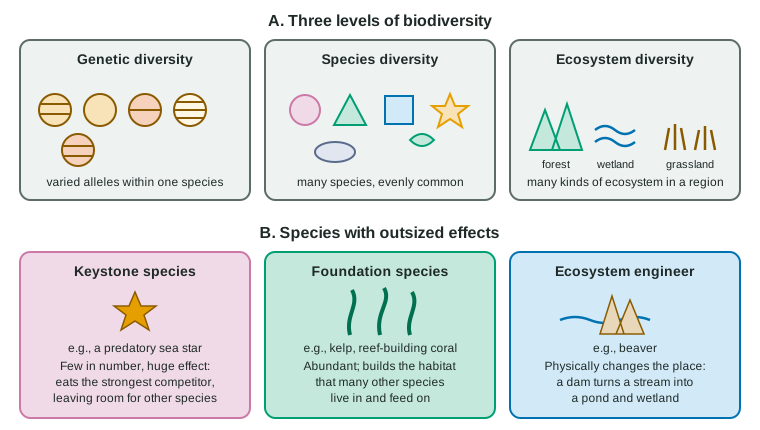
- Genetic diversity: the variety of alleles within a species (topics 5.2 and 7.11). Banded and plain shells in one snail population, or many varieties of rice, are genetic diversity.
- Species diversity: the number of species and how evenly common they are (topic 8.5), measured with richness, relative abundance and Simpson's diversity index.
- Ecosystem diversity: the variety of ecosystems in a region, such as forests, wetlands, grasslands, streams and lakes, each with its own community.
The levels are linked. A landscape with many kinds of ecosystem offers more kinds of niche, so it holds more species; large populations of many species hold more genetic variation.
Diversity and stability
Ecosystem stability is an ecosystem's ability to keep functioning, for example to keep producing plant matter and cycling nutrients, when conditions change. It has two parts: resistance, losing little when a disruption hits, and resilience, recovering quickly afterward.
Field experiments test this directly. In long-running grassland studies, ecologists sowed plots with 1, 2, 4, 8 or 16 plant species, choosing the species for each plot at random from a larger pool, and measured how much plant matter each plot produced year after year. Plots with more species produced more, and in a drought year they lost a smaller share of it and returned to normal sooner.
Why? Species and individuals differ. In a diverse plot, some species are deep-rooted or drought-tolerant; when the others wilt, these keep growing and use the water and light that are left, so the plot as a whole keeps working. A plot of one species has nothing to fall back on. The same logic applies within a species: genetic variation means some individuals resist a new disease or tolerate a hotter summer, so the population survives.
Worked example: a crop with no genetic diversity. In the 1840s, most potatoes grown in Ireland were one variety, propagated by planting pieces of tubers, so the plants were nearly identical genetically. When a water mold (Phytophthora infestans) arrived, almost every plant was susceptible, harvests failed for several years, and about a million people died. Claim: low genetic diversity made the crop unstable. Evidence: the disease spread through field after field across the whole country, because no plants differed enough to resist it. Reasoning: in a genetically varied population, some individuals are likely to carry alleles that resist a disease, so the population as a whole survives; plant breeders later used resistance alleles from wild potato relatives.
Diversity does not guarantee stability, and stability has other causes; but across many studies, more diverse communities tend to fluctuate less and recover faster, which is the pattern the exam expects you to explain.
Keystone species
Some species matter far more than their numbers suggest. A keystone species, named after the central stone that holds an arch together, has an effect on its community much larger than its abundance or biomass. Remove it, and the community changes sharply.
The idea came from the experiment in the hook. On Washington's rocky shores, the predatory sea star eats mussels, which are the strongest competitors for space on the rocks. With the sea stars removed, mussels spread over nearly all the rock and crowded out barnacles, limpets and seaweeds, and the number of species roughly halved (competitive exclusion, topic 8.5). The sea star was not common; its effect came from what it ate.
Sea otters in kelp forests are another classic keystone species. They eat sea urchins, which graze kelp. Where otters were hunted out, urchins multiplied and ate the kelp down to bare rock, and the fish and invertebrates that lived among the kelp disappeared with it: a trophic cascade (topic 8.5) with a keystone at its top.
| Keystone species | Foundation species | Ecosystem engineer | |
|---|---|---|---|
| Why it matters | Its interactions (often as a predator) shape the community | It is abundant or large and forms the habitat | It physically changes the environment |
| Abundance | Often low | High | Varies |
| Examples | Predatory sea star, sea otter | Kelp, reef-building coral, dominant forest trees | Beaver, elephant, earthworm |
| If removed | A strong competitor or grazer takes over; diversity falls | The habitat itself disappears | The habitat it created is lost (a pond drains) |
Foundation species, ecosystem engineers and producers
A foundation species (or dominant species) shapes its community by sheer abundance. Kelp forms underwater forests; reef-building corals build the reef; a few tree species make a forest what it is. Many other species live in, on or among them, so when corals die from unusually warm water, the fish that shelter in the reef decline too, even though the heat did not harm the fish directly.
An ecosystem engineer physically changes the environment. A beaver's dam turns a fast stream into a pond and wetland, creating habitat for frogs, ducks and water plants that could not live there before. Elephants knock over trees and keep savannas open.
Producers deserve a special mention: they capture all the energy every other level depends on (topic 8.2), so a change in the producers, such as the loss of a dominant grass, changes what every consumer can have.
Ecosystem services
People depend on biodiversity for ecosystem services: wild bees and other insects pollinate many crops; wetlands and forest soils filter water and slow floods; mangroves and reefs shield coasts from storms; fisheries, timber and medicines come from wild species; forests and soils store carbon. A more diverse ecosystem tends to deliver these services more reliably, for the same reasons it is more stable.
Comparing diversity with numbers
To compare communities, ecologists calculate Simpson's diversity index, D (topic 8.5). A reef with 30 species but one dominant coral can have a lower D than a reef with 22 evenly common species. The next skill, Simpson's diversity index, works through the formula step by step, and you can practice with the Simpson's diversity tool.
Common mistakes
- "A keystone species is the most common species." Keystone species are defined by their effect relative to their abundance; foundation species are the abundant ones.
- "Biodiversity just means the number of species." It also includes genetic variety and the variety of ecosystems, and evenness matters for species diversity.
- "Removing a predator always increases diversity, because the prey survive." Removing a keystone predator usually lowers diversity, because its prey was a strong competitor.
- "Stable means unchanging." A stable ecosystem changes but keeps functioning and recovers.