Counting species is not enough
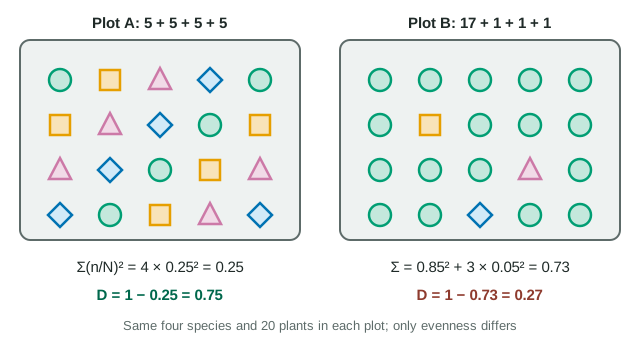
Two meadows each contain the same five wildflowers: clover, yarrow, buttercup, plantain and daisy. In meadow A there are 20 plants of each. In meadow B, 80 of the 100 plants are clover and each other species has just 5. Both have a species richness of 5, but meadow B is plainly less diverse: walk through it and nearly every plant you meet is clover. Species diversity combines richness (how many species) with evenness (how equally individuals are spread among them). Simpson's diversity index measures both at once.
Worked example: calculating Simpson's index
Formula sheet: D = 1 − Σ(n/N)², where n = individuals of one species and N = total individuals of all species.
Data: a pond sample has 6 snails, 3 beetles and 1 leech (N = 10).
- Fractions: 6/10 = 0.6; 3/10 = 0.3; 1/10 = 0.1.
- Squares: 0.36; 0.09; 0.01.
- Sum: Σ(n/N)² = 0.46.
- D = 1 − 0.46 = 0.54.
The two meadows: A: Σ = 5 × 0.2² = 0.20, so D = 0.80. B: Σ = 0.8² + 4 × 0.05² = 0.64 + 0.01 = 0.65, so D = 0.35.
What the number means
(n/N)² is the chance that two individuals picked at random both belong to that species. Adding over all species gives the chance that two random individuals are the same species; subtracting from 1 gives the chance that they are different. So:
| Community | D |
|---|---|
| One species only | 0 |
| Two species, equal numbers | 0.5 |
| Five species, one dominant (80 : 5 : 5 : 5 : 5) | 0.35 |
| Five species, equal numbers | 0.80 |
| Many species, evenly represented | close to 1 |
Because the fractions are squared, common species dominate the sum. One species at 80% contributes 0.64 by itself. A single rare species barely moves D: one plant of a sixth species in meadow A raises D only from 0.800 to 0.804.
Comparing a community over time
A stream bank was surveyed twice, eight years apart, after a fast-growing plant from another continent (species X) began spreading there.
| Species | First survey | Eight years later |
|---|---|---|
| Sedge | 30 | 12 |
| Rush | 25 | 8 |
| Fern | 20 | 6 |
| Mint | 15 | 4 |
| Violet | 10 | 0 |
| Species X | 0 | 70 |
| D | 0.775 | 0.484 |
Richness is 5 both times (violet lost, X gained), yet D fell by about 38%: (0.484 − 0.775) ÷ 0.775 × 100 = −37.5%. The cause is evenness. X makes up 70% of the plants, so two random plants are now usually the same species. Biologically, a fast-spreading competitor took most of the limited light, water and space on the bank, and every native species declined.
Writing about diversity
- Higher D means more diverse: "Meadow A (D = 0.80) is more diverse than meadow B (D = 0.35)."
- Explain with richness and evenness: "Both have five species, but B is dominated by clover."
- Connect to stability carefully: communities with many evenly represented species tend to keep functioning when one species declines, because the loss removes a smaller share of the community. If a disease killed the clover, meadow B would lose 80% of its plants, meadow A 20%.