Energy Flow Through Ecosystems
An ecosystem is a community of organisms together with its nonliving surroundings.
Part 1 · Hook
Why this matters
On an African grassland there are millions of wildebeest and zebras, but only a few thousand lions, and no animal that hunts lions. Why so few? It is not that lions are unlucky or slow to breed. Every time energy passes from grass to a zebra, or from a zebra to a lion, most of it leaves as heat. By the top of a food chain, there is not much energy left to feed anything bigger.
Part 2 · Before you start
What this builds on
Part 3 · Prerequisite check
Quick check before you start
1. In photosynthesis, light energy is converted into
- chemical energy stored in sugar
- heat that warms the leaf
- kinetic energy of water molecules
Show the answer
Photosynthesis uses light to build sugar from carbon dioxide and water; the energy is stored in the sugar's bonds.
- Correct: chemical energy stored in sugar:
- heat that warms the leaf:
- kinetic energy of water molecules:
2. When cells break down sugar in cellular respiration, they release
- carbon dioxide and water, with some of the energy captured as ATP and the rest as heat
- oxygen and sugar
- nitrogen gas and ammonia
Show the answer
Respiration returns carbon dioxide and water; much of the energy leaves as heat because no conversion is complete.
- Correct: carbon dioxide and water, with some of the energy captured as ATP and the rest as heat:
- oxygen and sugar:
- nitrogen gas and ammonia:
3. Why does every energy conversion in a living thing release some heat?
- No conversion is 100% efficient, so some energy always becomes disordered heat (the second law)
- Heat is needed to break every chemical bond
- Cells destroy some energy each time they use it
Show the answer
Energy is conserved, but each transfer turns part of it into heat, which cells cannot use to do work.
- Correct: No conversion is 100% efficient, so some energy always becomes disordered heat (the second law):
- Heat is needed to break every chemical bond:
- Cells destroy some energy each time they use it:
Part 4 · See it
See it first
Part 5 · Step by step
How it works, step by step
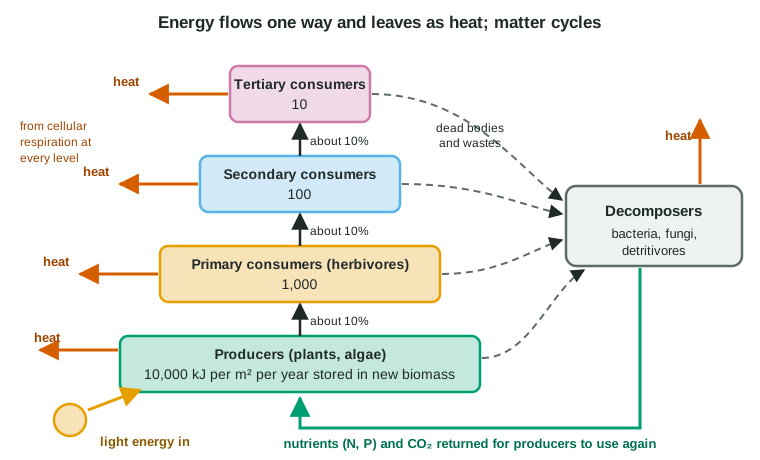
- Producers capture light energy (or, at deep-sea vents, chemical energy) and store it in sugars and other organic molecules.Energy enters the ecosystem, which is gross primary productivity.
- Producers use part of that energy in their own cellular respiration, and it leaves as heat.What remains, net primary productivity, is the energy available to every consumer.
- A primary consumer eats plants, but much plant material is never eaten or passes through undigested, and most absorbed energy fuels the animal's own respiration.Only about 10% of the energy stored at one level ends up stored at the next.
- The same losses happen at every step up the food chain.Each level holds about a tenth of the energy of the one below, so top predators are few, and food chains rarely pass four or five levels.
- Dead bodies and wastes from every level are broken down by decomposers.Carbon returns to the air as CO₂, and nitrogen and phosphorus return to soil and water as simple ions.
- Producers take up those atoms again, while the energy that left as heat cannot be captured to build sugar.Matter cycles through the ecosystem, but energy flows through it one way and must be supplied again by the sun.
Part 6 · Key ideas
Key ideas
- Producers make food by photosynthesis or chemosynthesis. Consumers eat other organisms; decomposers break down dead matter. Each feeding step is a trophic level; linked food chains make a food web.
- GPP is the energy producers capture; NPP = GPP − producer respiration, the energy available to consumers.
- About 10% of the energy at one level is stored at the next (trophic efficiency); the rest becomes heat or goes to decomposers. That is why energy pyramids narrow upward.
- Endotherms burn much of their food to make body heat, so they need more food and add less biomass per meal than ectotherms.
- Matter cycles through biogeochemical cycles: carbon (photosynthesis, respiration, burning fossil fuels), nitrogen (fixation, nitrification, denitrification, all by bacteria), phosphorus (rock weathering, no gas phase) and water (evaporation, transpiration, precipitation).
Part 7 · Misconception
A common mistake
The wrong idea: Energy is recycled in an ecosystem the way nutrients are: decomposers return it to the plants.
What actually happens: Decomposers return atoms, not usable energy. Every organism, decomposers included, releases energy as heat, and producers cannot turn heat into sugar. Energy flows through one way; only matter cycles.
Part 8 · Check yourself
Check yourself
Exam-style questions. Anything you miss goes into your review queue.
Data table
Energy budget of a lake food chain
Ecologists built a model of energy flow in a lake from field measurements, rounded for clarity. Phytoplankton (algae) are eaten by zooplankton, zooplankton by small fish, and small fish by fish-eating birds. Small fish are ectotherms; the birds are endotherms. For each level the table gives the energy taken into the body (absorbed from food, so not counting what leaves in feces; for phytoplankton, the energy captured by photosynthesis), the part released as heat by cellular respiration, and the part stored in new biomass (growth and offspring), which is the energy available to the next level.
| Trophic level | Energy taken in | Released as heat by respiration | Stored in new biomass |
|---|---|---|---|
| Phytoplankton (producers) | 24,000 | 13,800 | 10,200 |
| Zooplankton (primary consumers) | 4,100 | 3,080 | 1,020 |
| Small fish (secondary consumers) | 410 | 328 | 82 |
| Fish-eating birds (tertiary consumers) | 40 | 39.2 | 0.8 |
1. What percentage of the energy captured by the phytoplankton is released as heat by their own respiration? Give your answer to one decimal place.
Type a number in %.
Show the answer
13,800 ÷ 24,000 × 100 = 57.5%. The phytoplankton capture 24,000 kJ (gross primary productivity) and keep 10,200 (net primary productivity).
- Answer: 57.5 %
2. Calculate the trophic efficiency from zooplankton to small fish: the energy stored in new biomass by the small fish as a percentage of the energy stored in new biomass by the zooplankton. Give your answer to one decimal place.
Type a number in %.
Show the answer
82 ÷ 1,020 × 100 = 8.04%, which rounds to 8.0%. Using the energy taken in (410 ÷ 4,100) would give 10%, but trophic efficiency compares what is stored at each level.
- Answer: 8.0 %
3. The small fish store 20% of the energy they take in (82 of 410 kJ), but the birds store 2% (0.8 of 40 kJ). Which best explains the difference?
- The birds are endotherms, so they burn much of their food to make heat that keeps the body warm, and that energy leaves the food chain.
- The birds are at a higher trophic level, and the second law of thermodynamics destroys more energy at each higher level of a chain.
- The birds digest fish less fully than the fish digest zooplankton, so less of the fish they eat is ever absorbed into the body.
- The birds store most of their energy as fat, and the table counts the energy in fat as heat released by cellular respiration.
Show the answer
Endotherms spend most absorbed energy on respiration that produces body heat (39.2 of 40 kJ here), leaving little for growth. Ectotherms like the fish do not pay that cost.
- Correct: The birds are endotherms, so they burn much of their food to make heat that keeps the body warm, and that energy leaves the food chain.: Correct: the cost of endothermy shows up as heat released by respiration.
- The birds are at a higher trophic level, and the second law of thermodynamics destroys more energy at each higher level of a chain.: Energy is never destroyed, and trophic level alone does not explain why one animal stores 20% and another 2%.
- The birds digest fish less fully than the fish digest zooplankton, so less of the fish they eat is ever absorbed into the body.: The comparison already uses energy taken in (absorbed), so differences in digestion are not part of it.
- The birds store most of their energy as fat, and the table counts the energy in fat as heat released by cellular respiration.: Fat is stored biomass and would be counted in the last column, not as heat.
Graph
Carbon dioxide in the air over two years
Monthly mean CO₂ concentration in the air at a monitoring station on a mountain in the Northern Hemisphere, far from cities, over two years. Month 1 is January of year 1 and month 13 is January of year 2. Concentrations are in parts per million (ppm) by volume.
Data table
| Month (1 = January, year 1) | Monthly mean CO₂ |
|---|---|
| 1 | 420 |
| 2 | 420.8 |
| 3 | 421.7 |
| 4 | 423.1 |
| 5 | 423.8 |
| 6 | 423.3 |
| 7 | 422 |
| 8 | 420.1 |
| 9 | 418.6 |
| 10 | 418.6 |
| 11 | 420.1 |
| 12 | 421.4 |
| 13 | 422.4 |
| 14 | 423.2 |
| 15 | 424.1 |
| 16 | 425.5 |
| 17 | 426.2 |
| 18 | 425.7 |
| 19 | 424.4 |
| 20 | 422.5 |
| 21 | 421 |
| 22 | 421 |
| 23 | 422.5 |
| 24 | 423.8 |
4. Which best explains the fall in CO₂ from May to September each year?
- Warm summer air holds less CO₂, so CO₂ moves from the air into the ground.
- In the northern summer, land plants take in CO₂ by photosynthesis faster than respiration releases it.
- Decomposers are most active in summer warmth, and they take CO₂ out of the air as they break down detritus.
- Animals hibernate in summer, so their respiration stops returning CO₂ to the air.
Show the answer
Most land, and so most land plants, is in the Northern Hemisphere. In the growing season, photosynthesis removes more CO₂ than all respiration returns; in winter the balance reverses.
- Warm summer air holds less CO₂, so CO₂ moves from the air into the ground.: The ground is not a sink that fills with summer CO₂; the seasonal change follows plant growth.
- Correct: In the northern summer, land plants take in CO₂ by photosynthesis faster than respiration releases it.: Correct: net uptake by northern plants during the growing season.
- Decomposers are most active in summer warmth, and they take CO₂ out of the air as they break down detritus.: Decomposers release CO₂ by respiration; they do not remove it.
- Animals hibernate in summer, so their respiration stops returning CO₂ to the air.: Hibernation happens in winter, and animal respiration is small next to plant uptake.
5. Using the May value of each year, calculate the yearly rate of increase in CO₂ concentration, in ppm per year. Give your answer to one decimal place.
Type a number in ppm per year.
Show the answer
May of year 2 (month 17) is 426.2 ppm and May of year 1 (month 5) is 423.8 ppm. (426.2 − 423.8) ÷ 1 year = 2.4 ppm per year. Comparing the same month removes the seasonal cycle.
- Answer: 2.4 ppm per year
6. A forest soil is treated with a chemical that blocks nitrification (the conversion of ammonium to nitrate) and does nothing else. Predict the effect on each quantity over the next few weeks.
| Variable | Change |
|---|---|
| Ammonium in the soil | — |
| Nitrate in the soil | — |
| Nitrate washed from the soil into a nearby stream | — |
| Phosphate in the soil | — |
Show the answer
Blocking one step of a cycle makes the substance before it pile up and the substance after it run down, while other cycles are unaffected.
- Ammonium in the soil: increases. Ammonium from decomposers and fixation keeps arriving, but it is no longer converted to nitrate.
- Nitrate in the soil: decreases. No new nitrate is made, while roots and bacteria keep using the nitrate already there.
- Nitrate washed from the soil into a nearby stream: decreases. Less nitrate in the soil means less is carried away in water; ammonium binds to soil particles more than nitrate does.
- Phosphate in the soil: no change. Phosphate comes from weathering and decomposition, not from nitrification, so blocking nitrification does not change it.
7. A 20 g mouse and a 20 g lizard are kept at 20 °C with all the food they want. Over a week the mouse eats food containing 450 kJ and the lizard 40 kJ, and both keep the same body mass. Which claim do these data support?
- The lizard digests its food far better, so it needs less of it to stay the same mass.
- The mouse grows faster than the lizard, so it needs extra food to build new tissue.
- The mouse uses far more energy, most of it for metabolic heat that keeps it warm.
- Both animals use the same energy, but the mouse stores the extra food as fat each week.
Show the answer
Neither animal changed mass, so nearly all the food energy was used, mostly in respiration. The endothermic mouse used over ten times as much, because it makes heat to hold its body temperature well above 20 °C.
- The lizard digests its food far better, so it needs less of it to stay the same mass.: Better digestion cannot explain a ten-fold difference; the lizard simply needs less energy.
- The mouse grows faster than the lizard, so it needs extra food to build new tissue.: Both kept the same mass, so neither added much tissue.
- Correct: The mouse uses far more energy, most of it for metabolic heat that keeps it warm.: Correct: the cost of endothermy.
- Both animals use the same energy, but the mouse stores the extra food as fat each week.: The mouse's mass did not change, so it did not store the extra food as fat.
Part 9 · Summary
Summary
An ecosystem is a community of organisms together with its nonliving surroundings. Producers capture energy by photosynthesis or chemosynthesis; consumers get it by eating other organisms; decomposers break down dead matter. Gross primary productivity is the energy producers capture; net primary productivity, what is left after their own respiration, feeds everything else. At each trophic level most energy is released as heat by cellular respiration or passes to decomposers, so only about 10% is stored at the next level. Energy pyramids therefore narrow upward, top predators are few, and food chains are short. Endotherms spend more of their food on body heat than ectotherms, so they need more food and store less of it. Matter, unlike energy, cycles: carbon through photosynthesis, respiration, the oceans and fossil fuels; nitrogen through fixation, nitrification, ammonification and denitrification by bacteria; phosphorus from rock through living things and back to sediments; and water through evaporation, transpiration and precipitation.
Part 10 · Up next
What comes next
Part 11 · Connections