Responses to the Environment
Organisms detect changes in their environment and respond with behavior and with changes in how their bodies work.
Part 1 · Hook
Why this matters
Poinsettias in a greenhouse stay green all autumn unless the growers do something odd: every evening they pull black cloth over the plants and leave it until morning. After a few weeks of long, unbroken nights the top leaves turn red, just in time for December. One careless worker switching on the lights at midnight can ruin the whole crop. The plant is reading the length of the night, and so are many animals that decide when to breed, migrate or hibernate.
Part 2 · Before you start
What this builds on
Part 3 · Prerequisite check
Quick check before you start
1. A hormone causes a response in a target cell only when that cell
- has a receptor protein that the hormone binds
- is next to the gland that made the hormone
- is dividing at the moment the hormone arrives
Show the answer
Hormones travel everywhere in the body, but only cells with the matching receptor respond.
- Correct: has a receptor protein that the hormone binds:
- is next to the gland that made the hormone:
- is dividing at the moment the hormone arrives:
2. In a feedback loop, the stimulus is
- a change in conditions that a sensor or receptor detects
- the response that brings conditions back
- the set point the body holds
Show the answer
A stimulus is the detected change; the response follows from it.
- Correct: a change in conditions that a sensor or receptor detects:
- the response that brings conditions back:
- the set point the body holds:
3. An animal's metabolic rate is
- how fast it uses energy, often measured as oxygen used per hour
- how fast it digests one meal
- its body temperature
Show the answer
Metabolic rate is the rate of energy use; oxygen consumption tracks it because cellular respiration uses oxygen.
- Correct: how fast it uses energy, often measured as oxygen used per hour:
- how fast it digests one meal:
- its body temperature:
Part 4 · See it
See it first
Part 5 · Step by step
How it works, step by step
- A condition in the environment changes: the nights lengthen, the ground dries, light comes from one side.Receptors detect the change, such as phytochrome in a leaf or moisture receptors on an animal's body.
- The receptor's signal reaches the cells that respond, often through a hormone or the nervous system.Gene expression, growth or activity changes: a shoot tip makes flowers, a pill bug stops walking, a squirrel's metabolic rate drops.
- The response changes what the organism does or how its body works.It ends up in better conditions or saves energy: on moist ground, flowering when pollinators fly, asleep through a winter with no food.
- Individuals whose responses match their surroundings survive and reproduce more.Over generations, alleles behind well-timed responses become common, so most responses we see fit the organism's environment.
- An animal releases a signal: a pheromone, a call, a dance, a display.The signal is a stimulus for other animals, so their behavior changes too: ants follow a trail, bees fly to food, a mate approaches.
- An animal helps a relative at a cost to itself, for example by calling out when a predator comes.The relative, who shares many of its alleles, survives more often, so alleles for helping can spread (kin selection).
Part 6 · Key ideas
Key ideas
- Organisms respond to environmental changes with behavior (what an animal does) and with physiology (how its body works), such as flowering, hibernation and migration.
- Taxis is movement aimed toward or away from a stimulus. In a kinesis an animal only speeds up or slows down, yet it still gathers where it slows down.
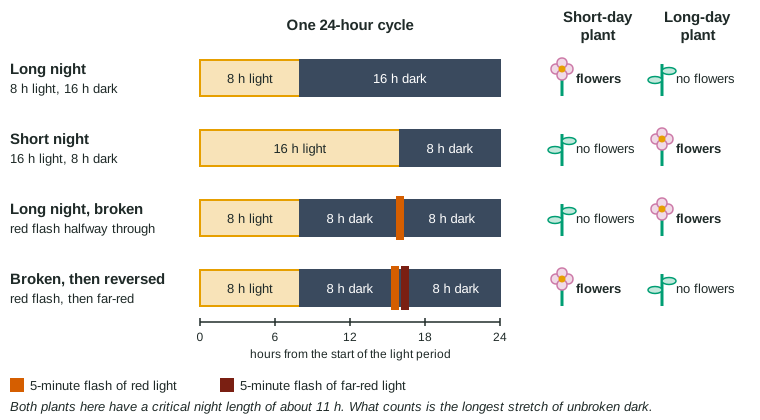
- Plants grow toward or away from light, gravity or touch (tropisms). In photoperiodism a plant measures the night: short-day plants flower when the night is longer than a critical length; red light switches phytochrome on and far-red switches it off.
- Circadian rhythms run on an internal clock of about 24 hours that light resets each day. Hibernation, estivation and migration carry animals through hard seasons.
- Animals communicate with visual, auditory, chemical (pheromones) and tactile signals. Behavior may be innate or learned (habituation, imprinting, conditioning), and helping relatives can be favored by kin selection.
Part 7 · Misconception
A common mistake
The wrong idea: Short-day plants flower when the days are short, so they measure how long the light lasts.
What actually happens: They respond to the length of the unbroken night. A short flash of light in the middle of a long night stops a short-day plant from flowering, even though the day length has not changed.
Part 8 · Check yourself
Check yourself
Exam-style questions. Anything you miss goes into your review queue.
Data table
Pill bugs in a moist-dry choice chamber
A student placed 10 pill bugs (small land crustaceans) in the center of each of ten round dishes and counted the animals on each half every 2 minutes. In five dishes, one half held moist filter paper and the other half dry paper. In five control dishes, both halves held dry paper. All dishes were at 22 °C under the same dim light. In a separate test, single animals were filmed for 5 minutes on all-dry paper or all-moist paper (10 animals each): on dry paper they spent a mean of 85% of the time walking, at 1.4 cm/s; on moist paper, 25% of the time, at 0.8 cm/s. Animals released exactly on the border between moist and dry paper walked into the dry half first as often as into the moist half.
| Time after release (min) | Moist half | Dry half | Control: half 1 | Control: half 2 |
|---|---|---|---|---|
| 2 | 29 | 21 | 26 | 24 |
| 4 | 33 | 17 | 23 | 27 |
| 6 | 37 | 13 | 25 | 25 |
| 8 | 40 | 10 | 27 | 23 |
| 10 | 41 | 9 | 24 | 26 |
1. Which statement best describes the results in the table?
- Most animals were already on the moist half at the first count, and that share stayed about the same through the full 10 minutes of counting.
- The share on the moist half rose from 58% at 2 minutes to 82% at 10 minutes, while the control dishes stayed near half and half.
- The share on the moist half rose over time, and the control dishes showed a similar steady rise in the count on half 1.
- The animals moved onto the moist half in the first 2 minutes and then spread back out evenly between the two halves.
Show the answer
29/50 = 58% at 2 minutes and 41/50 = 82% at 10 minutes on the moist half; the control halves stayed between 23 and 27 of 50, close to 25.
- Most animals were already on the moist half at the first count, and that share stayed about the same through the full 10 minutes of counting.: At 2 minutes the moist half held 29 of 50 (58%), barely more than half, and the count kept rising to 41.
- Correct: The share on the moist half rose from 58% at 2 minutes to 82% at 10 minutes, while the control dishes stayed near half and half.: Correct: a steady rise on the moist half, with no drift in the control dishes.
- The share on the moist half rose over time, and the control dishes showed a similar steady rise in the count on half 1.: Control half 1 went 26, 23, 25, 27, 24: it wandered around 25 with no trend.
- The animals moved onto the moist half in the first 2 minutes and then spread back out evenly between the two halves.: The moist-half count rose at every count, from 29 to 41; it never fell back toward 25.
2. The null hypothesis is that the pill bugs have no preference, so equal numbers are expected on the two halves. Calculate the chi-square value for the moist-dry dishes at 10 minutes. Give your answer to one decimal place.
Type a number.
Show the answer
Expected: 25 on each half. χ² = (41 − 25)²/25 + (9 − 25)²/25 = 256/25 + 256/25 = 10.24 + 10.24 = 20.48, which rounds to 20.5.
- Answer: 20.5
3. Which explanation fits all of the data, including the filmed animals?
- On dry paper the animals keep walking and on moist paper they mostly stop, so they collect on the moist half without steering toward it.
- The animals sense the direction of the moisture and walk straight toward it, which is why the count on the moist half keeps rising at each count.
- The animals learn in the first minutes that the moist half is safer and then return to it from memory each time they leave.
- Animals on the dry half lose water and stop moving, so they are not counted, and the dry-half number shrinks over the 10 minutes.
Show the answer
This is a kinesis: dry conditions raise activity and speed, moist conditions lower them. Animals wander until they happen onto moist paper and then stay. The border test shows no steering toward moisture.
- Correct: On dry paper the animals keep walking and on moist paper they mostly stop, so they collect on the moist half without steering toward it.: Correct: a change in activity, not aimed movement, explains the gathering.
- The animals sense the direction of the moisture and walk straight toward it, which is why the count on the moist half keeps rising at each count.: Steering (a taxis) is ruled out: animals released on the border walked into the dry half first as often as into the moist half.
- The animals learn in the first minutes that the moist half is safer and then return to it from memory each time they leave.: Nothing in the data tests learning, and a simple change in activity already explains the counts.
- Animals on the dry half lose water and stop moving, so they are not counted, and the dry-half number shrinks over the 10 minutes.: The halves add up to 50 animals at every count, so animals on the dry half were counted; they moved over to the moist half.
Data table
Flowering of two plant species under different light and dark cycles
Plants of two species were grown for six weeks in growth chambers at 22 °C under different cycles of light and dark (40 plants per treatment). In two treatments, the 16-hour dark period was interrupted after 8 hours by a 5-minute flash of red light, or by a red flash followed at once by a 5-minute flash of far-red light. The table gives the percentage of plants that formed flower buds.
| Row | Light / dark cycle (hours) | Night interruption | Species A (%) | Species B (%) |
|---|---|---|---|---|
| 1 | 16 / 8 | none | 0 | 95 |
| 2 | 14 / 10 | none | 3 | 88 |
| 3 | 12 / 12 | none | 80 | 8 |
| 4 | 10 / 14 | none | 95 | 0 |
| 5 | 8 / 16 | none | 98 | 0 |
| 6 | 8 / 16 | red flash | 0 | 90 |
| 7 | 8 / 16 | red, then far-red flash | 93 | 5 |
4. Which pair of rows gives the strongest evidence that species A responds to the length of the night rather than the length of the day?
- Rows 1 and 5, because the plants flower with 8 hours of light but not with 16 hours
- Rows 5 and 6, because the day length is the same but breaking the night stops flowering
- Rows 4 and 5, because species A flowers well under both of these long-night light and dark cycles
- Rows 6 and 7, because far-red light given after the red flash restores flowering
Show the answer
Rows 5 and 6 differ in only one way: a 5-minute flash splits the 16-hour night into two 8-hour nights. The day is still 8 hours, yet flowering falls from 98% to 0%. So the plant is measuring the unbroken night.
- Rows 1 and 5, because the plants flower with 8 hours of light but not with 16 hours: Rows 1 and 5 change the day and the night together, so they cannot separate the two.
- Correct: Rows 5 and 6, because the day length is the same but breaking the night stops flowering: Correct: same day length, different unbroken night, very different result.
- Rows 4 and 5, because species A flowers well under both of these long-night light and dark cycles: Both rows have long nights and both flower; they do not separate day from night.
- Rows 6 and 7, because far-red light given after the red flash restores flowering: These rows show that far-red reverses red, which is about the light detector, not about day versus night.
5. Why was the temperature held at 22 °C in every growth chamber?
- Because temperature can also affect flowering, so fixing it isolates the light effect
- Because a constant temperature makes the flowering percentage come out equal in each chamber
- Because 22 °C is the temperature at which phytochrome changes to its active form
- Because a steady temperature lets the plants sense day length from the daily cycle of warming
Show the answer
Temperature is a possible confounding variable: many plants flower differently when warm or cold. Holding it constant means the differences between rows come from the light treatments.
- Correct: Because temperature can also affect flowering, so fixing it isolates the light effect: Correct: it removes temperature as an alternative explanation.
- Because a constant temperature makes the flowering percentage come out equal in each chamber: Holding temperature constant does not make results equal; the light treatments still gave 0% to 98%.
- Because 22 °C is the temperature at which phytochrome changes to its active form: Phytochrome is switched by red and far-red light, not by a particular temperature.
- Because a steady temperature lets the plants sense day length from the daily cycle of warming: With temperature constant there is no daily warming to sense; the plants measured darkness.
6. A short-day plant that flowers on a cycle of 9 hours of light and 15 hours of dark is given a 5-minute flash of red light in the middle of every night. Predict the effect on each quantity, compared with plants without the flash.
| Variable | Change |
|---|---|
| Percentage of plants that form flowers | — |
| Amount of active phytochrome in the leaves just after each flash | — |
| Length of the light period at the start of each day | — |
| Longest stretch of unbroken darkness the plants receive | — |
Show the answer
Short-day plants measure the unbroken night with phytochrome. Red light in the night switches phytochrome on, so the plant reads two short nights and does not flower; the day itself is unchanged.
- Percentage of plants that form flowers: decreases. The flash splits the 15-hour night into two 7.5-hour periods, shorter than the critical night length, so flowering is blocked.
- Amount of active phytochrome in the leaves just after each flash: increases. Red light converts phytochrome to its active form, which had been slowly reverting during the dark.
- Length of the light period at the start of each day: no change. The flash comes in the night; the daytime light period is still 9 hours.
- Longest stretch of unbroken darkness the plants receive: decreases. It falls from 15 hours to about 7.5 hours, because the flash cuts the night in half.
7. Inside a dark hive, a honeybee forager's waggle run on the vertical comb points 60° to the left of straight up. Its waggle runs last longer than those of bees returning from a patch 500 m away. Where is the food?
- 60° to the left of north, and farther than 500 m from the hive
- 60° to the left of the sun's direction, and closer than 500 m
- 60° to the left of the sun's direction, and farther than 500 m
- 60° to the right of the sun's direction, and farther than 500 m
Show the answer
On the comb, straight up stands for the direction of the sun, so the angle of the run from vertical is the angle of the food from the sun. A longer waggle run means a greater distance.
- 60° to the left of north, and farther than 500 m from the hive: The dance is referenced to the sun, not to a compass direction.
- 60° to the left of the sun's direction, and closer than 500 m: Longer waggle runs code for greater distances, so this food is farther than 500 m.
- Correct: 60° to the left of the sun's direction, and farther than 500 m: Correct: angle from vertical gives the angle from the sun; run length gives distance.
- 60° to the right of the sun's direction, and farther than 500 m: A run to the left of vertical means food to the left of the sun's direction, not the right.
8. In winter, a hibernating ground squirrel's body temperature falls from 37 °C to about 4 °C, and its oxygen use falls to about 3% of its active level. Why does this let it survive for months without eating?
- Cold denatures its enzymes, so cellular respiration stops until spring and no stored fuel is used up.
- Cold air holds more oxygen, so each breath supplies enough oxygen for several days of cellular respiration.
- Its cells switch from burning fat to burning glucose, which releases more energy per gram of fuel.
- Its cells' reactions run slowly when cold, so it makes and uses far less ATP and burns its fat slowly.
Show the answer
The squirrel first turns down its metabolism, and as its body cools, reaction rates fall further, so it needs little ATP. Low oxygen use shows that cellular respiration, and so the use of stored fat, has slowed but not stopped.
- Cold denatures its enzymes, so cellular respiration stops until spring and no stored fuel is used up.: Oxygen use is 3% of normal, not zero, so respiration continues slowly; 4 °C slows enzymes rather than denaturing them.
- Cold air holds more oxygen, so each breath supplies enough oxygen for several days of cellular respiration.: The drop in oxygen use reflects lower demand, not a better supply of oxygen.
- Its cells switch from burning fat to burning glucose, which releases more energy per gram of fuel.: Fat stores more energy per gram than glucose, and hibernators live mainly on fat.
- Correct: Its cells' reactions run slowly when cold, so it makes and uses far less ATP and burns its fat slowly.: Correct: a lower metabolic rate stretches the fat store over the whole winter.
Part 9 · Summary
Summary
Organisms detect changes in their environment and respond with behavior and with changes in how their bodies work. Animals move toward or away from a stimulus (taxis) or change their speed and turning (kinesis); plants grow toward or away from light, gravity and touch (tropisms), using the hormone auxin. Many plants time flowering by night length (photoperiodism): short-day plants flower when the unbroken night is longer than a critical length, long-day plants when it is shorter, and phytochrome, switched on by red light and off by far-red, does the measuring. Circadian rhythms follow an internal clock of about 24 hours that light resets. Hibernation, estivation, dormancy and migration carry organisms through hard seasons. Animals communicate with visual, auditory, chemical and tactile signals, such as pheromones and the honeybee waggle dance. Some behavior is innate and some is learned. Cooperation and altruism toward relatives can spread by kin selection, because relatives share alleles, and courtship displays let animals choose mates.
Part 10 · Up next
What comes next
Part 11 · Connections