Why does table salt dissolve in water while chalk does not? Topic 3.10 answered with "like dissolves like" and intermolecular forces. Topic 7.11 put a number on it with Ksp. This page connects both to free energy: a solid dissolves readily when the free energy of dissolution, ΔG°soln, is negative.
Dissolving in three energy steps
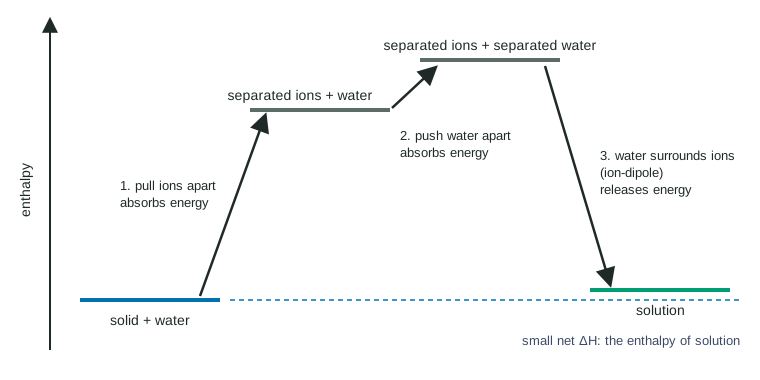
Think of dissolving an ionic solid as three steps (Figure 1), even though they happen together:
- Separate the ions of the solid. The cations and anions attract each other (Coulomb's law), so pulling them apart absorbs energy. The larger the charges and the smaller the ions, the more energy this takes.
- Separate some water molecules to make room. This breaks hydrogen bonds between water molecules and absorbs energy.
- Water surrounds each ion. The partly negative oxygen ends face the cations and the partly positive hydrogen ends face the anions. Forming these ion-dipole attractions releases energy. Small, highly charged ions release the most.
The overall enthalpy of solution, ΔH°soln, is the sum. Steps 1 and 3 are both large, so ΔH°soln is a small difference between big numbers and can have either sign. That is why an ammonium nitrate cold pack cools (ΔH°soln = +25.7 kJ/mol) while a calcium chloride hot pack warms (ΔH°soln = −81.3 kJ/mol).
The entropy of dissolving
Two effects compete:
- The ions disperse. They leave fixed positions in the crystal and spread through the solution. This raises the entropy.
- Water is ordered. Water molecules in the hydration shell around each ion are held in place and lose some of their freedom. This lowers the entropy.
For most salts with singly charged ions (NaCl, NH4NO3) the dispersal wins, and ΔS°soln > 0. For small, highly charged ions (Mg2+, Ca2+, Al3+, CO32−) the strong ion-dipole attractions hold many water molecules tightly, and ΔS°soln can be negative.
Putting it together: ΔG°soln
As for any process, ΔG°soln = ΔH°soln − TΔS°soln, and a solid dissolves readily (to 1 M, the standard state) when ΔG°soln < 0.
Worked example. For NH4NO3, ΔH°soln = +25.7 kJ/mol and ΔS°soln = +108.7 J/(mol·K). Is dissolving favored at 25 °C?
Convert: T = 298 K; ΔS° = 0.1087 kJ/(mol·K).
ΔG° = 25.7 kJ/mol − (298 K)(0.1087 kJ/(mol·K)) = 25.7 − 32.4 = −6.7 kJ/mol.
ΔG° < 0: dissolving is favored even though it absorbs heat. It is entropy-driven: the ions spreading out (TΔS° = 32.4 kJ/mol) outweighs the energy cost (ΔH° = 25.7 kJ/mol).
Calcium chloride is the opposite case: ΔH° = −81.3 kJ/mol and ΔS° = −44.7 J/(mol·K), so ΔG° = −81.3 + 13.3 = −68.0 kJ/mol. It dissolves because of the large release of energy, despite a small entropy loss: it is enthalpy-driven.
Linking to Ksp
For a slightly soluble salt the dissolving equilibrium has the constant Ksp, and the link from topic 9.5 applies: ΔG°soln = −RT ln Ksp. A positive ΔG°soln means Ksp < 1, a slightly soluble salt. For example, ΔG°soln = +30.0 kJ/mol at 298 K gives ln Ksp = −30,000 ÷ (8.314 × 298) = −12.11, so Ksp = 5.5 × 10⁻⁶.
Temperature and solubility
Because the entropy term is multiplied by T, temperature changes ΔG°soln. For a salt that dissolves endothermically with ΔS°soln > 0, heating makes ΔG°soln less positive (or more negative), so the solubility rises. This agrees with Le Châtelier's principle: adding heat favors the endothermic direction.
| Salt | ΔH°soln | ΔS°soln | Driven by |
|---|---|---|---|
| NH4NO3 (cold pack) | +25.7 kJ/mol | +108.7 J/(mol·K) | entropy |
| CaCl2 (hot pack) | −81.3 kJ/mol | −44.7 J/(mol·K) | enthalpy |
| NaCl (table salt) | +3.9 kJ/mol | +43.4 J/(mol·K) | entropy (ΔG° = −9.0 kJ/mol) |