Free Energy of Dissolution
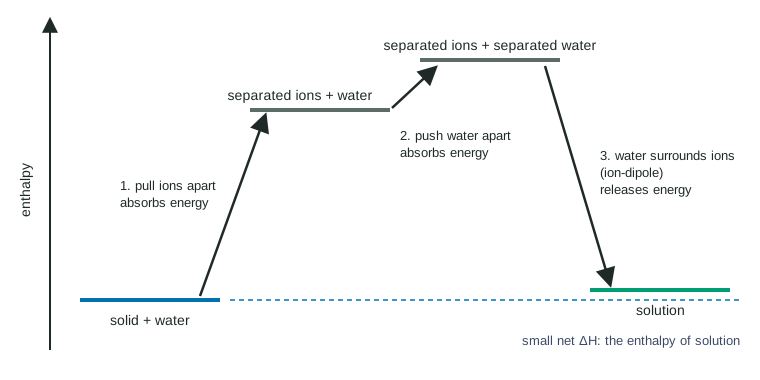
Dissolving a solid absorbs energy to separate solute and solvent particles and releases energy as solute-solvent attractions form.
Part 1 · Hook
Why this matters
Part 2 · Before you start
What this builds on
Part 3 · Prerequisite check
Quick check before you start
1. In water, which end of each water molecule points toward a cation?
- The oxygen end, which is partly negative
- A hydrogen end, which is partly positive
- Either end, at random
- Neither: water does not attract ions
Show the answer
Opposite partial charges attract: δ− oxygen toward the cation.
- Correct: The oxygen end, which is partly negative:
- A hydrogen end, which is partly positive:
- Either end, at random:
- Neither: water does not attract ions:
2. A process has ΔH° > 0 and ΔS° > 0. When is it favored?
- At high temperature
- At low temperature
- At every temperature
- At no temperature
Show the answer
ΔG° = ΔH° − TΔS° becomes negative once TΔS° > ΔH°.
- Correct: At high temperature:
- At low temperature:
- At every temperature:
- At no temperature:
Part 4 · See it
See it first
Part 5 · Step by step
How it works, step by step
- Ions must be pulled apart and water molecules pushed apartthese steps absorb energy (Coulombic attractions and hydrogen bonds are overcome)
- Water then surrounds each ion through ion-dipole attractionsthis step releases energy, and the balance of the three steps is ΔH°soln
- The ions spread out, but water molecules are held in place around themΔS°soln is usually positive, but can be negative for small, highly charged ions
- ΔG°soln = ΔH°soln − TΔS°solna solid dissolves readily when ΔG°soln < 0, whether it is driven by ΔH° or by ΔS°
Part 6 · Key ideas
Key ideas
- Dissolving = separate the solute particles (absorbs energy) + separate the solvent particles (absorbs) + form solute-solvent attractions (releases).
- ΔH°soln is the small difference between large numbers, so it can be positive (cold pack) or negative (hot pack).
- ΔS°soln is usually positive (ions disperse), but small, highly charged ions order the water around them and can make it negative.
- A solid dissolves readily when ΔG°soln = ΔH°soln − TΔS°soln < 0; ΔG°soln = −RT ln Ksp links it to solubility.
Part 7 · Misconception
A common mistake
The wrong idea: A salt dissolves only if dissolving releases heat, because favored processes are exothermic.
What actually happens: Many salts dissolve endothermically (ammonium nitrate cools the water). They dissolve because the ions spreading out makes ΔS°soln large enough that TΔS° > ΔH°, so ΔG°soln < 0.
Part 8 · Check yourself
Check yourself
Exam-style questions. Anything you miss goes into your review queue.
Data table
Dissolving four salts
Standard enthalpy and entropy of solution for four ionic solids in water. Assume the values do not change with temperature.
| Salt | ΔH°soln (kJ/mol) | ΔS°soln (J/(mol·K)) |
|---|---|---|
| NH₄NO₃ | +25.7 | +108.7 |
| NaCl | +3.9 | +43.4 |
| CaCl₂ | −81.3 | −44.7 |
| Salt Z (M²⁺X²⁻) | −9.0 | −120.0 |
1. Calculate ΔG°soln for NH₄NO₃ at 298 K.
Type a number and its unit.
Show the answer
ΔG° = ΔH° − TΔS° = 25.7 − (298)(0.1087) = 25.7 − 32.39 = −6.7 kJ/mol. The subtraction leaves the tenths place, so −6.7 kJ/mol (two significant figures).
- Answer: -6.7 kJ/mol
2. NH₄NO₃ dissolves readily in water and the water gets colder. Which statement explains both observations?
- The ions release energy as water molecules surround them, which makes ΔH° negative and ΔG° negative.
- ΔH°soln > 0, so the water cools, but the ions spreading out makes TΔS° > ΔH°.
- The water gets colder because ΔS° is negative, and a negative ΔS° makes ΔG° negative.
- Dissolving is a physical change, so ΔG° does not apply and the salt dissolves because it is ionic.
Show the answer
Endothermic (the water cools) but entropy-driven: TΔS° = 32.4 kJ/mol outweighs ΔH° = 25.7 kJ/mol.
- The ions release energy as water molecules surround them, which makes ΔH° negative and ΔG° negative.: If ΔH° were negative, the water would warm up. The cooling shows ΔH° > 0.
- Correct: ΔH°soln > 0, so the water cools, but the ions spreading out makes TΔS° > ΔH°.: Right: ΔH°soln > 0 (the water cools), yet ΔG°soln < 0 because the entropy term wins.
- The water gets colder because ΔS° is negative, and a negative ΔS° makes ΔG° negative.: ΔS° is positive here, and a negative ΔS° would make ΔG° less negative, not more.
- Dissolving is a physical change, so ΔG° does not apply and the salt dissolves because it is ionic.: ΔG° applies to physical changes too. Many ionic solids barely dissolve.
3. Which salt’s dissolving is favored mainly because of the enthalpy change, even though the entropy change works against it?
- NH₄NO₃
- NaCl
- Salt Z
- CaCl₂
Show the answer
CaCl₂: ΔG° = −81.3 − 298(−0.0447) = −68.0 kJ/mol. The enthalpy term drives it.
- NH₄NO₃: Its ΔH° is positive (unfavorable); it dissolves because of the entropy term.
- NaCl: Both ΔH° (+3.9) and the entropy term matter, but ΔH° is unfavorable here.
- Salt Z: Its ΔG° is positive at 298 K, so its dissolving is not favored.
- Correct: CaCl₂: Right: ΔH° = −81.3 kJ/mol is strongly favorable and outweighs the unfavorable −TΔS° = +13.3 kJ/mol.
4. Salt Z has small, doubly charged ions. Which explanation of its negative ΔS°soln is best?
- Each small, highly charged ion holds water tightly; that water’s lost freedom outweighs the ions’ spreading.
- The ions of Salt Z stay in the crystal, so they do not disperse through the water.
- The solution is more disordered than the solid, which makes ΔS° negative.
- Dissolving Salt Z releases heat, and releasing heat lowers the entropy of the solution.
Show the answer
Two effects compete: ions dispersing (S up) and water held in hydration shells (S down). For small, highly charged ions the second wins.
- Correct: Each small, highly charged ion holds water tightly; that water’s lost freedom outweighs the ions’ spreading.: Right: strong ion-dipole attractions order the water; that loss of microstates is larger than the ions’ gain.
- The ions of Salt Z stay in the crystal, so they do not disperse through the water.: Some Z does dissolve; the ions that dissolve do spread out. The water ordering is what makes ΔS° negative.
- The solution is more disordered than the solid, which makes ΔS° negative.: This argument would give a positive sign, and "disorder" is not a particle-level reason.
- Dissolving Salt Z releases heat, and releasing heat lowers the entropy of the solution.: ΔH° and ΔS° are separate quantities; the cause here is the ordering of water around the ions.
5. Which step in dissolving an ionic solid releases energy?
- Separating the ions of the crystal from one another
- Water molecules surrounding the separated ions
- Separating water molecules to make room for the ions
- Heating the water before the solid is added
Show the answer
Separating particles absorbs energy; forming attractions releases it.
- Separating the ions of the crystal from one another: Pulling apart oppositely charged ions absorbs energy.
- Correct: Water molecules surrounding the separated ions: Right: forming ion-dipole attractions releases energy.
- Separating water molecules to make room for the ions: Breaking hydrogen bonds between water molecules absorbs energy.
- Heating the water before the solid is added: Heating is not one of the energy steps of dissolving.
6. For a salt, ΔH°soln = +15 kJ/mol and ΔS°soln = +40 J/(mol·K). How does its solubility change as the water is heated from 298 K to 373 K?
- It decreases: ΔH°soln is positive, so heating pushes the salt out of solution.
- It does not change: solubility depends on the salt, not on temperature.
- It increases: TΔS° grows, so ΔG°soln falls from +3.1 to +0.1 kJ/mol.
- It increases: heating makes ΔH°soln negative.
Show the answer
ΔG° = 15 − T(0.040): +3.08 kJ/mol at 298 K, +0.08 kJ/mol at 373 K. Less positive ΔG° means larger K, so more salt dissolves.
- It decreases: ΔH°soln is positive, so heating pushes the salt out of solution.: For an endothermic dissolution, heating favors dissolving (Le Châtelier agrees).
- It does not change: solubility depends on the salt, not on temperature.: Ksp depends on temperature through ΔG° = −RT ln K.
- Correct: It increases: TΔS° grows, so ΔG°soln falls from +3.1 to +0.1 kJ/mol.: Right: for ΔH° > 0 and ΔS° > 0, raising T makes ΔG° less positive, so Ksp grows.
- It increases: heating makes ΔH°soln negative.: ΔH° stays about the same; it is the −TΔS° term that changes with T.
7. Which changes would make ΔH°soln of an ionic solid more negative (more exothermic)? Select ALL that apply.
- Stronger ion-dipole attractions between ions and water
- Weaker attractions between the ions in the crystal
- Stronger attractions between the ions in the crystal
- A higher temperature of the water
Show the answer
ΔH°soln = (energy to separate ions) + (energy to separate water) − (energy released by ion-dipole attractions). Weaker lattice or stronger hydration makes it more negative.
- Correct: Stronger ion-dipole attractions between ions and water: More energy released in the third step.
- Correct: Weaker attractions between the ions in the crystal: Less energy absorbed to separate the ions.
- Stronger attractions between the ions in the crystal: More energy absorbed to separate the ions: ΔH°soln becomes less negative.
- A higher temperature of the water: ΔH°soln barely depends on temperature; the attractions decide it.
Part 9 · Summary
Summary
Part 10 · Up next
What comes next
Part 11 · Connections