Coupled Reactions
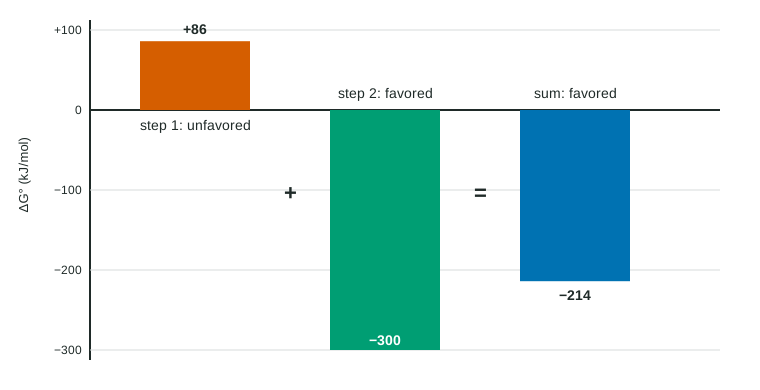
An unfavored reaction can be made to proceed by coupling it to a strongly favored one through a shared intermediate.
Part 1 · Hook
Why this matters
Part 2 · Before you start
What this builds on
Part 3 · Prerequisite check
Quick check before you start
1. When two reactions are added, what happens to their K values?
- They multiply
- They add
- They subtract
- The larger one is kept
Show the answer
Adding reactions multiplies equilibrium constants (topic 7.6).
- Correct: They multiply:
- They add:
- They subtract:
- The larger one is kept:
2. A reaction has ΔG° = +40 kJ/mol. Is it favored?
- No, because ΔG° > 0
- Yes, because ΔG° is large
- Yes, at every temperature
- It cannot be known
Show the answer
A process is favored when ΔG° < 0.
- Correct: No, because ΔG° > 0:
- Yes, because ΔG° is large:
- Yes, at every temperature:
- It cannot be known:
Part 4 · See it
See it first
Part 5 · Step by step
How it works, step by step
- An unfavored reaction has ΔG° > 0it does not proceed to a useful extent on its own
- A second reaction consumes a product of the first (a shared intermediate)the two reactions add into one overall process
- ΔG° is a state functionthe ΔG° values add, and the K values multiply
- The driving reaction is more favored than the driven one is unfavoredthe overall ΔG° is negative and the coupled process is favored
Part 6 · Key ideas
Key ideas
- A coupled reaction pairs an unfavored reaction (ΔG° > 0) with a favored one (ΔG° < 0) through a shared intermediate.
- When reactions add, their ΔG° values add and their K values multiply.
- The overall process is favored if ΔG°(total) < 0. Neither step’s own ΔG° changes.
- Examples: Cu₂S + O₂ (smelting), ATP hydrolysis driving cell reactions.
- External energy (electric current, light) can also drive a process with ΔG° > 0.
Part 7 · Misconception
A common mistake
The wrong idea: Coupling a favored reaction to an unfavored one changes the unfavored reaction’s ΔG° to a negative value.
What actually happens: Each reaction keeps its own ΔG°. Coupling makes them act as one overall process, and it is the sum, ΔG°₁ + ΔG°₂, that is negative.
Part 8 · Check yourself
Check yourself
Exam-style questions. Anything you miss goes into your review queue.
Data table
Getting copper from its ore
Copper can be obtained from the mineral chalcocite, Cu₂S. Data at 298 K:
| Reaction | Equation | ΔG° (kJ/mol) |
|---|---|---|
| 1 | Cu₂S(s) → 2 Cu(s) + S(s) | +86.2 |
| 2 | S(s) + O₂(g) → SO₂(g) | −300.1 |
1. Is Reaction 1 thermodynamically favored at 298 K on its own?
- Yes: it makes three moles of product from one mole of reactant.
- No: ΔG° > 0, so heating Cu₂S by itself does not give copper.
- Yes: decompositions like this are favored at room temperature.
- No: it is favored, but too slow to observe.
Show the answer
ΔG° = +86.2 kJ/mol > 0: not favored on its own.
- Yes: it makes three moles of product from one mole of reactant.: Counting moles of solid does not decide favorability; ΔG° does, and it is positive.
- Correct: No: ΔG° > 0, so heating Cu₂S by itself does not give copper.: Right: ΔG° = +86.2 kJ/mol, so the decomposition is not favored.
- Yes: decompositions like this are favored at room temperature.: Many decompositions are not favored (this one, or water into H₂ and O₂).
- No: it is favored, but too slow to observe.: That would describe kinetic control, which needs ΔG° < 0. Here ΔG° > 0.
2. Calculate ΔG° for the overall reaction Cu₂S(s) + O₂(g) → 2 Cu(s) + SO₂(g).
Type a number and its unit.
Show the answer
Adding Reaction 1 and Reaction 2 cancels S(s), the shared intermediate. ΔG° adds: +86.2 + (−300.1) = −213.9 kJ/mol.
- Answer: -213.9 kJ/mol
3. Why does coupling Reaction 1 with Reaction 2 allow copper to be produced?
- Reaction 2 releases heat that changes ΔG° of Reaction 1 to a negative value.
- Reaction 2 acts as a catalyst for Reaction 1, lowering its activation energy.
- Oxygen makes Cu₂S less stable, so Reaction 1 becomes favored without Reaction 2.
- They share S(s): Reaction 2 uses the S that Reaction 1 makes; total ΔG° < 0.
Show the answer
Coupling requires a common intermediate. When the steps add, ΔG° values add, and the large negative ΔG° of Reaction 2 carries Reaction 1.
- Reaction 2 releases heat that changes ΔG° of Reaction 1 to a negative value.: Coupling does not change ΔG° of either reaction; the ΔG° values add.
- Reaction 2 acts as a catalyst for Reaction 1, lowering its activation energy.: A catalyst cannot make an unfavored reaction favored, and Reaction 2 is not a catalyst.
- Oxygen makes Cu₂S less stable, so Reaction 1 becomes favored without Reaction 2.: Reaction 1 has ΔG° = +86.2 kJ/mol whatever else is present; it is the overall reaction that is favored.
- Correct: They share S(s): Reaction 2 uses the S that Reaction 1 makes; total ΔG° < 0.: Right: a shared intermediate links them, and the sum of ΔG° values is −213.9 kJ/mol.
Model
Using ATP in a cell
Cells store energy in ATP. The first step of breaking down glucose attaches a phosphate group to glucose. Standard free energy changes at pH 7 (the standard state biochemists use), taken here for 37 °C (310 K):
Step A: glucose + phosphate → glucose-6-phosphate + H₂O; ΔG° = +13.8 kJ/mol
Step B: ATP + H₂O → ADP + phosphate; ΔG° = −30.5 kJ/mol
Overall: glucose + ATP → glucose-6-phosphate + ADP
Key: arrows show each step; the number on each is ΔG° in kJ/mol.
4. Calculate ΔG° for the overall coupled reaction, glucose + ATP → glucose-6-phosphate + ADP.
Type a number and its unit.
Show the answer
ΔG°(overall) = ΔG° of Step A + ΔG° of Step B = +13.8 + (−30.5) = −16.7 kJ/mol. The water and phosphate cancel when the steps are added.
- Answer: -16.7 kJ/mol
5. Which statement best explains how the cell makes Step A happen?
- It adds an enzyme that makes ΔG° for Step A negative.
- It raises the temperature to 37 °C, which makes Step A favored on its own.
- It couples Step A to ATP hydrolysis, so the overall ΔG° is negative.
- It removes glucose-6-phosphate, so ΔG for Step A becomes zero.
Show the answer
An unfavored step is driven by pairing it with a strongly favored one through a common intermediate (here, the phosphate group).
- It adds an enzyme that makes ΔG° for Step A negative.: Enzymes speed reactions but cannot change ΔG°. The coupling is what makes the overall process favored.
- It raises the temperature to 37 °C, which makes Step A favored on its own.: Step A has ΔG° = +13.8 kJ/mol at 37 °C; it is still not favored alone.
- Correct: It couples Step A to ATP hydrolysis, so the overall ΔG° is negative.: Right: the coupled process has ΔG° = −16.7 kJ/mol, so it is favored.
- It removes glucose-6-phosphate, so ΔG for Step A becomes zero.: Lowering the product concentration helps a little, but the main driver here is coupling to ATP.
6. If a cell paired Step A with a reaction that had ΔG° = −10.0 kJ/mol instead of ATP hydrolysis (with a suitable shared species), would the overall process be favored?
- Yes: any favored reaction can drive any unfavored one.
- Yes: the two ΔG° values multiply to a negative number.
- No: +13.8 + (−10.0) = +3.8 kJ/mol, still positive.
- No: coupled reactions need ΔG values of exactly equal size.
Show the answer
Coupling works only if ΔG°(driving) + ΔG°(driven) < 0.
- Yes: any favored reaction can drive any unfavored one.: The sum of ΔG° values must be negative. Here it is positive.
- Yes: the two ΔG° values multiply to a negative number.: ΔG° values add when reactions are coupled; K values multiply.
- Correct: No: +13.8 + (−10.0) = +3.8 kJ/mol, still positive.: Right: the driving reaction must be more favored than the driven one is unfavored.
- No: coupled reactions need ΔG values of exactly equal size.: They need not be equal; the driving reaction just has to outweigh the driven one.
7. Reaction 1: X → Y, ΔG° = +25.0 kJ/mol. Reaction 2: Y → Z, ΔG° = −40.0 kJ/mol. Calculate ΔG° for X → Z.
Type a number and its unit.
Show the answer
Y is made in reaction 1 and used in reaction 2, so the reactions add to X → Z. ΔG° = +25.0 + (−40.0) = −15.0 kJ/mol.
- Answer: -15.0 kJ/mol
Part 9 · Summary
Summary
Part 10 · Up next
What comes next
Part 11 · Connections