Drop a strip of zinc into a blue solution of copper(II) ions and a red-brown coating of copper forms on the zinc as the blue fades. You saw this redox reaction in topic 4.9: Zn(s) + Cu2+(aq) → Zn2+(aq) + Cu(s). Electrons pass straight from zinc atoms to copper ions, and the free energy released ends up as a little heat. An electrochemical cell runs the same reaction with the two halves kept apart, so the electrons have to travel through a wire, where they can light a bulb or charge a phone.
Parts of a galvanic cell
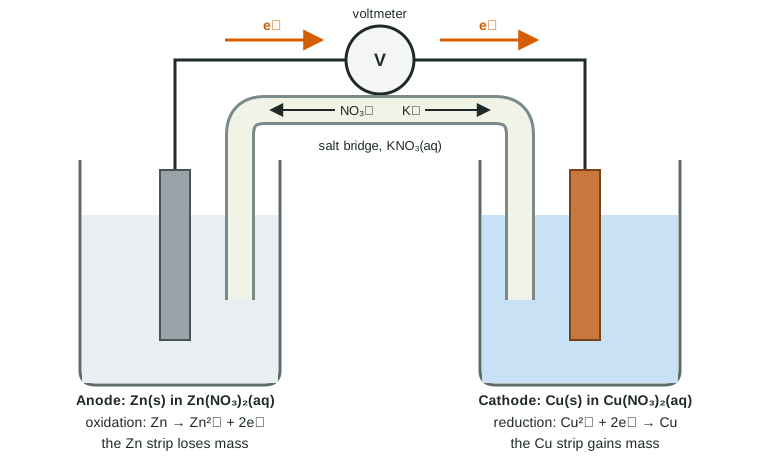
A galvanic cell (also called a voltaic cell) turns a thermodynamically favored redox reaction into an electric current. In Figure 1:
- Each beaker is a half-cell: a metal strip, the electrode, dipping into a solution of its own ions.
- The anode is the electrode where oxidation happens. Here zinc atoms lose electrons: Zn(s) → Zn2+(aq) + 2e−. The zinc strip slowly loses mass.
- The cathode is the electrode where reduction happens. Here copper(II) ions gain electrons: Cu2+(aq) + 2e− → Cu(s). Copper plates onto the strip, which gains mass.
- A wire joins the electrodes. Electrons flow through it from the anode to the cathode. A voltmeter in the wire measures the cell's voltage.
- A salt bridge joins the solutions. It holds a solution of ions that do not react, such as KNO3.
A memory aid: an ox (anode, oxidation) and red cat (reduction, cathode).
Why the salt bridge is needed
As the cell runs, the anode beaker gains Zn2+ ions and the cathode beaker loses Cu2+ ions. Without help, the anode side would build up positive charge and the cathode side negative charge, and that charge would stop the flow of electrons within moments. The salt bridge fixes this: anions (NO3−) move toward the anode compartment and cations (K+) move toward the cathode compartment, keeping each beaker neutral. Electrons never enter the solution or the bridge; the circuit is electrons in the wire and ions in the solutions. Lift out the salt bridge and the current stops.
Working out what happens in a cell
Worked example. A cell has an iron strip in Fe(NO3)2(aq) and a silver strip in AgNO3(aq). After an hour, the iron strip has lost mass and the silver strip has gained mass. Identify the anode, write the half-reactions and the overall equation, and give the direction of electron flow.
Evidence: the iron loses mass, so Fe atoms are leaving as ions: oxidation. The iron strip is the anode: Fe(s) → Fe2+(aq) + 2e−.
The silver gains mass, so Ag+ ions are plating out: reduction. The silver strip is the cathode: Ag+(aq) + e− → Ag(s).
Balance the electrons: the iron gives 2, so the silver half-reaction is doubled. Overall: Fe(s) + 2 Ag+(aq) → Fe2+(aq) + 2 Ag(s). Check charge: +2 on each side.
Electrons flow through the wire from the iron (anode) to the silver (cathode). In the salt bridge, NO3− moves toward the iron half-cell and K+ toward the silver half-cell.
Galvanic versus electrolytic
An electrolytic cell runs a redox reaction that is not thermodynamically favored by pushing electrons with an outside power supply, the way topic 9.7 described external energy driving an unfavored process. Recharging a phone battery does this: it runs the battery's discharge reaction backward.
| Galvanic (voltaic) | Electrolytic | |
|---|---|---|
| Reaction | thermodynamically favored (ΔG° < 0) | not favored (ΔG° > 0) |
| Energy | chemical energy → electrical work | electrical work → chemical energy |
| Power supply | none; the cell is the source | required |
| Oxidation happens at | the anode | the anode |
| Reduction happens at | the cathode | the cathode |
| Electrons in the wire flow | anode → cathode | anode → cathode |
The definitions of anode and cathode do not change between the two: oxidation is always at the anode and reduction always at the cathode. To plate silver onto a spoon in an electrolytic cell, the spoon must be the cathode, because silver forms by reduction.
Ranking metals from experiments
Simple tests show which metal is more easily oxidized. If zinc metal plates out copper from Cu2+(aq), but copper metal does nothing in Zn2+(aq), then zinc gives up electrons more readily than copper. In a cell built from those two half-cells, the more easily oxidized metal (zinc) is the anode. Topic 9.9 puts numbers on this ranking.