Topic 9.8 built cells and found the anode from experiments. This page puts numbers on cells: how large the voltage is, which electrode is which, and how the voltage connects to ΔG° and K. The exam does not give you a table of potentials on its reference sheet; every question that needs them lists them, as the items here do.
Standard reduction potentials
Every half-reaction has a standard reduction potential, E°: a measure, in volts, of how strongly it pulls electrons in when written as a reduction, with every species at standard conditions (1 M, 1 bar, usually 25 °C). The values are all measured against one reference half-reaction, 2 H+(aq) + 2e− → H2(g), which is assigned E° = 0.00 V.
| Half-reaction | E° (V) |
|---|---|
| Ag+(aq) + e− → Ag(s) | +0.80 |
| Cu2+(aq) + 2e− → Cu(s) | +0.34 |
| 2 H+(aq) + 2e− → H2(g) | 0.00 |
| Ni2+(aq) + 2e− → Ni(s) | −0.25 |
| Zn2+(aq) + 2e− → Zn(s) | −0.76 |
| Al3+(aq) + 3e− → Al(s) | −1.66 |
Read it this way: the more positive the E°, the more readily the species on the left is reduced, so Ag+ is the strongest oxidizing agent here. The more negative the E°, the more readily the metal on the right is oxidized, so Al is the strongest reducing agent.
Finding E°cell
In a galvanic cell the half-reaction with the more positive E° runs as written at the cathode (reduction), and the other runs in reverse at the anode (oxidation). Then
E°cell = E°(cathode) − E°(anode)
using both values exactly as they appear in the reduction table. A galvanic cell always has E°cell > 0.
Worked example. A cell is made from Al in 1 M Al3+ and Cu in 1 M Cu2+. Find the half-reactions, the overall equation and E°cell.
Cu2+/Cu (+0.34 V) is more positive than Al3+/Al (−1.66 V), so copper ions are reduced at the cathode and aluminum is oxidized at the anode.
Cathode: Cu2+ + 2e− → Cu. Anode: Al → Al3+ + 3e−.
Balance electrons: the least common multiple of 2 and 3 is 6. Multiply the copper half-reaction by 3 and the aluminum one by 2: 2 Al(s) + 3 Cu2+(aq) → 2 Al3+(aq) + 3 Cu(s), with n = 6 mol e−.
E°cell = E°(cathode) − E°(anode) = +0.34 V − (−1.66 V) = 2.00 V. The 3 and the 2 used to balance electrons do not touch the E° values.
Why E° is never multiplied
Voltage is energy per unit charge (1 V = 1 J/C). Doubling a half-reaction doubles the electrons and doubles the energy, so the energy per electron, the potential, stays the same. E° is intensive, like temperature or density: two cups of 60 °C water are still 60 °C. Multiplying E° by a coefficient is one of the most common errors on the exam.
From E°cell to ΔG°
The electrical work a cell can do is charge × voltage. One mole of electrons carries F = 96,485 C (the Faraday constant), so n moles carry nF coulombs, and
ΔG° = −nFE°
where n is the moles of electrons transferred in the balanced equation. The minus sign makes a positive E° give a negative ΔG°. Units: C × V = J, so ΔG° comes out in J/mol; divide by 1000 for kJ/mol.
Worked example. Find ΔG° for 2 Al(s) + 3 Cu2+(aq) → 2 Al3+(aq) + 3 Cu(s), E°cell = 2.00 V.
ΔG° = −nFE° = −(6 mol e−)(96,485 C/mol e−)(2.00 V) = −1.158 × 10⁶ J/mol = −1.16 × 10³ kJ/mol.
Here the coefficients matter, through n = 6. Doubling the equation would double n and ΔG° but leave E° at 2.00 V.
One triangle: ΔG°, K and E°
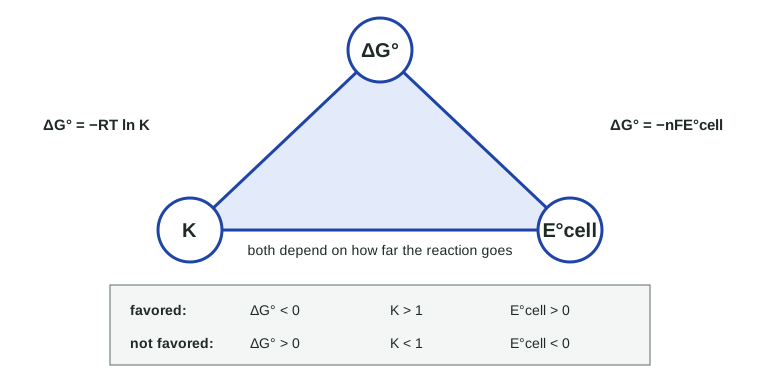
Combining ΔG° = −nFE° with ΔG° = −RT ln K (topic 9.5) links all three (Figure 1). Given any one, you can find the others. For Cu + 2 Ag+ → Cu2+ + 2 Ag, E° = +0.46 V and n = 2, so ΔG° = −(2)(96,485)(0.46) = −8.9 × 10⁴ J/mol, and ln K = 88,766 ÷ (8.314 × 298) = 35.8, so K = e35.8 ≈ 3.6 × 10¹⁵.
| E°cell | ΔG° | K | Cell type |
|---|---|---|---|
| > 0 | < 0 | > 1 | galvanic: runs on its own |
| < 0 | > 0 | < 1 | electrolytic: needs a power supply |
A negative calculated E°cell is not an error to fix by swapping numbers; it tells you the reaction as written is not favored and could be run only in an electrolytic cell.