Unit 7 described equilibrium with K, and topic 9.3 described favorability with ΔG°. These are two views of the same thing. A reaction with a strongly negative ΔG° runs far toward products before it settles, so its K is large. This page gives the exact link and shows how to use it.
The equation
ΔG° = −RT ln K
- ΔG° is the standard free energy change in J/mol (convert from kJ/mol by multiplying by 1000).
- R = 8.314 J/(mol·K), the energy form of the gas constant, not 0.08206 L·atm/(mol·K).
- T is in kelvin.
- ln is the natural logarithm (from the logarithms lesson before topic 5.3), not log.
Reading the signs
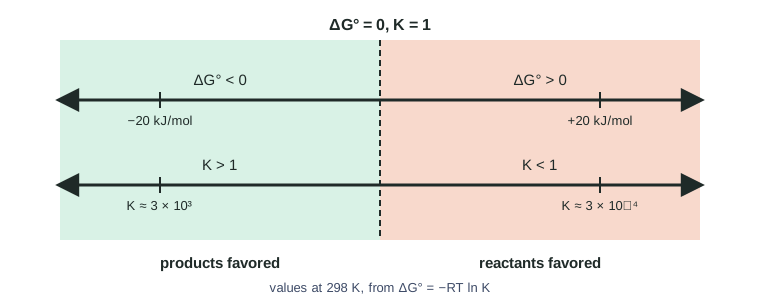
Since ln K is positive when K > 1 and negative when K < 1, the minus sign in the equation lines them up as in Figure 1:
| ΔG° | ln K | K | At equilibrium |
|---|---|---|---|
| negative | positive | > 1 | products favored |
| 0 | 0 | = 1 | neither side strongly favored |
| positive | negative | < 1 | reactants favored |
Because K depends on ΔG° exponentially, small changes in ΔG° make big changes in K. At 298 K, RT = 2.48 kJ/mol, so each 5.7 kJ/mol of ΔG° changes K by a factor of 10. A ΔG° within a few kJ/mol of zero gives K between about 0.1 and 10: both reactants and products are present in large amounts. A ΔG° of −40 kJ/mol already gives K ≈ 107.
A positive ΔG° does not mean "no reaction". It means K < 1: some product still forms, but reactants dominate the equilibrium mixture.
From ΔG° to K
Rearrange: ln K = −ΔG°/RT, so K = e−ΔG°/RT.
Worked example. For N2(g) + 3 H2(g) ⇌ 2 NH3(g), ΔG° = −33.2 kJ/mol at 298 K. Find K.
Units first: ΔG° = −33.2 kJ/mol × 1000 J/kJ = −33,200 J/mol.
ln K = −ΔG°/RT = −(−33,200 J/mol) ÷ [(8.314 J/(mol·K))(298 K)] = 33,200 ÷ 2477.6 = 13.40.
K = e13.40 = 6.6 × 10⁵.
Check: ΔG° < 0, so K > 1. It is. (ΔG° has three significant figures, which leaves about two in K after the exponential.)
From K to ΔG°
Worked example. Acetic acid has Ka = 1.8 × 10⁻⁵ at 298 K. Find ΔG° for its ionization.
ΔG° = −RT ln K = −(8.314 J/(mol·K))(298 K) × ln(1.8 × 10⁻⁵)
ln(1.8 × 10⁻⁵) = −10.93, so ΔG° = −(2477.6 J/mol)(−10.93) = +2.7 × 10⁴ J/mol = +27 kJ/mol.
Check: K < 1, so ΔG° > 0. A weak acid is mostly un-ionized at equilibrium, which fits.
Changing the equation changes both
- Reverse the reaction: ΔG° changes sign and K becomes 1/K.
- Multiply the coefficients by n: ΔG° is multiplied by n and K is raised to the power n.
- Add two reactions: their ΔG° values add and their K values multiply (topic 7.6, and topic 9.7).
ΔG versus ΔG°
ΔG° describes the reaction with every species at standard conditions. A real mixture is usually not standard; its drive is ΔG, which depends on Q. You can predict the direction from Q and K alone: if Q < K, ΔG < 0 and the net reaction goes forward; if Q > K, it goes in reverse; if Q = K, the mixture is at equilibrium and ΔG = 0. ΔG° itself never changes at a given temperature. So "at equilibrium ΔG° = 0" is wrong: at equilibrium ΔG = 0, and ΔG° = −RT ln K.