In Unit 4 you started from a position function and differentiated: velocity , acceleration . Now run the film backward. Given the velocity, integrals recover how far the particle moved and where it is. Two different questions hide here, and the exam asks both: how far did it end up from its start, and how far did it actually travel?
Displacement: the integral of velocity
Because is the derivative of , the Fundamental Theorem gives
This net change in position is the displacement on . On a velocity graph it is the signed area: area above the -axis (moving right, or up, or forward) counts as positive, area below (moving left) counts as negative. So a trip right followed by an equal trip left has displacement 0.
Total distance: the integral of speed
A car's odometer does not subtract when you drive back home. Speed is , and the total distance traveled is
On the graph, that is the sum of the areas, every one counted as positive.
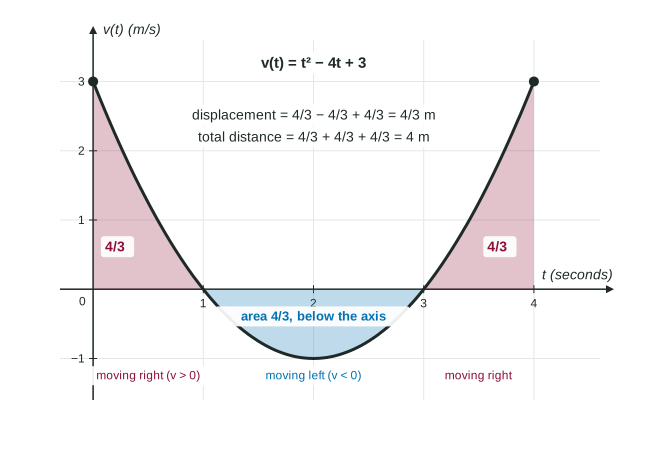
Worked example 1 (no calculator). A particle moves with meters per second for . Find its displacement and its total distance.
Displacement:
Distance: changes sign at and , so split there. ;
Add the sizes: meters. The particle traveled 4 m but ended only m to the right of where it began.
Without a calculator you cannot integrate directly. Find where changes sign, integrate on each piece, and add the absolute values. Check every zero, not just whole-number times.
Position from a starting point
Displacement tells you the change. To know the position itself, you need one known position, then add the change:
Worked example 2 (graph). A particle's velocity is made of segments through , , , and , in m/s, and . Find , the total distance, and the time it is farthest right.
Areas: 4 on , 12 on , 4 on (where reaches 0), then 1 and 4 below the axis on and .
The particle moves right while and left after changes sign at , so it is farthest right at : m.
The same idea gives velocity from acceleration:
With a calculator
When the velocity has no easy antiderivative, the calculator does the integral, and it can integrate directly. Write the setup every time, then the value to three decimal places:
- Displacement:
feet. - Total distance:
feet. - Position, if :
feet.
Radian mode, and keep full precision until the final answer.
Displacement or distance?
| Question asks for | Integral | Can it be negative? |
|---|---|---|
| displacement, change in position, net distance | yes | |
| total distance traveled | no | |
| position at time | yes |
Common slips
- Giving the displacement when the question asks for total distance, or the reverse.
- Forgetting the initial position, or starting the integral at 0 when the known position is at another time.
- Putting the absolute value outside: is the size of the displacement, not the distance.
- Units: the integral of feet per second over seconds is feet.