Many exam questions are about a container: a tank, a reservoir, a museum, a pile of gravel, a driveway under snow. Something comes in at one rate and goes out at another. The questions are always the same few. How much is there at a given time? Is it going up or down right now? When is there the most? This page gives one equation that answers all of them.
Rate in, rate out
Call the rate in (water entering, people arriving, snow falling) and the rate out (water draining, people leaving, snow melting). The amount changes at the difference:
So at any moment, the amount is increasing when and decreasing when . Notice what does not matter: whether itself is rising, or how big is on its own. Only the comparison counts.
The amount at a time
Integrate the net rate and add what was there at the start:
The integral is the net change; the first term is the starting amount. Leaving out the starting amount is the most common lost point in these questions.
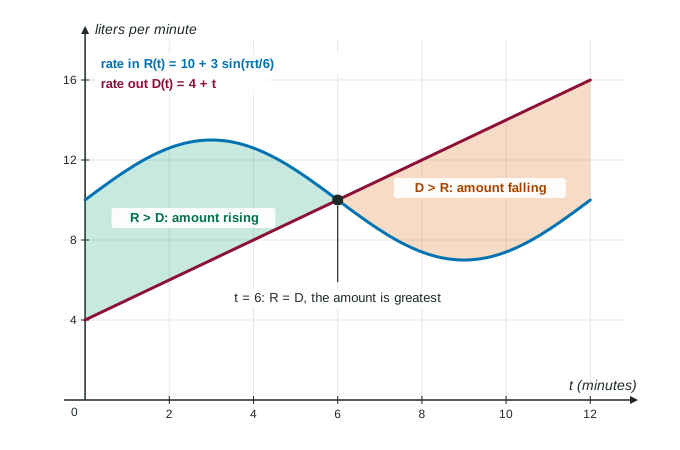
Worked example 1 (calculator). A tank holds 50 liters at . Water enters at and leaves at liters per minute, . (a) How much water is in the tank at ? (b) Is the amount increasing or decreasing at ? (c) What is the greatest amount?
(a)
(b)
(c) on only at , where changes from positive to negative. Candidates: , , . The greatest amount is about 79.459 liters, at .
In (c), the sign change alone shows a relative maximum at . For the absolute maximum on the closed interval, compare with the endpoints: the candidates test.
From a table
When the rate is only known at a few times, estimate the integral with a Riemann or trapezoidal sum, using the table's own widths. They are often unequal.
Worked example 2 (no calculator). Visitors enter a museum at the rates in the table. 25 visitors are inside at , and visitors leave at a constant 70 people per hour. Estimate the number inside at .
| (hours) | 0 | 2 | 3 | 5 | 8 |
|---|---|---|---|---|---|
| (people per hour) | 60 | 110 | 150 | 90 | 30 |
Trapezoidal sum:
Leaving:
Amount: people inside at (an estimate).
Units and interpretations
An integral of a rate carries the accumulated unit. Gallons per hour integrated over hours gives gallons; people per hour over hours gives people. The derivative of an amount carries the rate unit; the derivative of a rate carries "per hour per hour".
When asked what an integral means, name three things: the quantity, its units and the interval. For example,
| Expression | Meaning | Units (rates in liters per minute) |
|---|---|---|
| how fast the amount changes at time | liters per minute | |
| amount that comes in from to | liters | |
| net change in the amount from to | liters | |
| amount at time | liters |
Common slips
- Dropping the starting amount.
- Adding the rate out instead of subtracting it.
- Deciding "increasing" from instead of from .
- Finding the time of the maximum and stopping: the question may ask for the amount.
- Rate units on an amount: an integral of a rate is never "per minute".