Accumulation in Context
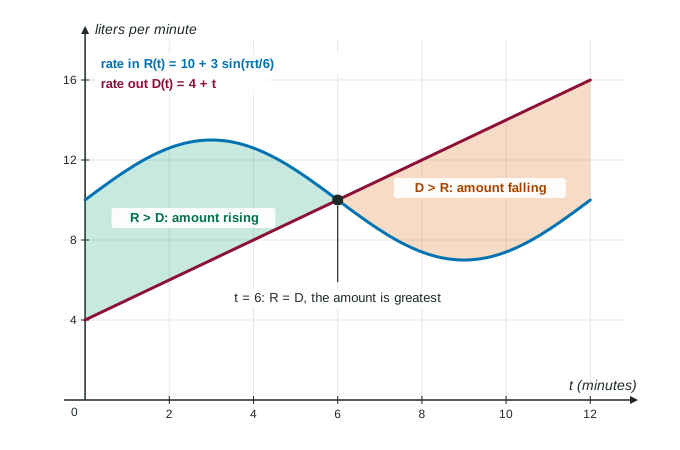
With a rate in R and a rate out D , the amount satisfies A′(t) = R(t) − D(t) and A(t) = A(a) +∫ from a to t of (R − D) .
Part 1 · Hook
Why this matters
Part 2 · Before you start
What this builds on
Part 3 · Prerequisite check
Quick check before you start
1. If is continuous,
Show the answer
The integral of a rate of change is the net change.
- Correct: :
- :
- :
- :
2. A trapezoidal sum on a subinterval of width 3 with endpoint values 4 and 10 adds
- 21
- 42
- 30
- 14
Show the answer
.
- Correct: 21:
- 42:
- 30:
- 14:
Part 4 · See it
See it first
Part 5 · Step by step
How it works, step by step
- A quantity gains at a rate in and loses at a rate outits net rate of change is
- Integrate the net rate over an intervalthe net change in the amount:
- Add the amount at the start
- changes signthe amount has a relative extremum there; compare it with the endpoints to find the absolute one
Part 6 · Key ideas
Key ideas
- Amount now = amount at the start + (rate in − rate out). The initial amount is part of the answer.
- : the amount increases when the rate in is larger and decreases when the rate out is larger.
- An integral of a rate has the accumulated unit: gallons per hour integrated over hours gives gallons.
- An interpretation names the quantity, its units and the time interval.
- For the greatest or least amount on a closed interval: find where R − D changes sign, then compare with the endpoints (candidates test).
Part 7 · Misconception
A common mistake
The wrong idea: The tank holds 50 L at , so at it holds liters.
What actually happens: That integral is the change in the amount. The amount itself is
Part 8 · Check yourself
Check yourself
Exam-style questions. Anything you miss goes into your review queue.
Table
Visitors entering a museum
| (hours) | 0 | 2 | 3 | 5 | 8 |
|---|---|---|---|---|---|
| (people per hour) | 60 | 110 | 150 | 90 | 30 |
1. Use a right Riemann sum with the table's subintervals to estimate .
No calculator. Type the exact value (a fraction, π, e or a root is fine), in people.
Show the answer
- Answer: 640 people
2. Use a trapezoidal sum with the table's subintervals to estimate .
No calculator. Type the exact value (a fraction, π, e or a root is fine), in people.
Show the answer
- Answer: 720 people
3. What does mean in this context?
- The number of visitors inside the museum at t = 8 hours
- The number of visitors who enter the museum in the first 8 hours after opening
- The average rate at which visitors enter during the 8 hours
- The rate at which visitors enter at t = 8 hours
Show the answer
is a rate in people per hour, so is the number of people who enter from to .
- The number of visitors inside the museum at t = 8 hours: Visitors also leave, and some may have been there before.
- Correct: The number of visitors who enter the museum in the first 8 hours after opening: The integral of the rate in is the number who came in over the interval.
- The average rate at which visitors enter during the 8 hours: That would be the integral divided by 8.
- The rate at which visitors enter at t = 8 hours: That is people per hour.
4. A pond holds gallons at . Water enters at and leaves at gallons per day. Which gives the amount at time ?
Show the answer
- : The starting amount is missing.
- : Rates are added to an amount without integrating; the units do not match.
: Water leaving is subtracted. - Correct:
: Start amount plus net change.
5. Snow falls on a driveway at cm per hour while melting removes it at 3 cm per hour, for . At the snow is 10 cm deep. Find the depth .
Type an expression for .
Show the answer
- Answer:
6. Water enters a tank at and leaves at . When is the amount of water increasing at ?
- When
- When
- When
- When
Show the answer
The amount's rate of change is ; it is increasing at when .
- When : The rate in growing does not mean it beats the rate out.
- When : The rate out might be larger than .
- When : That says the amount is larger than at the start, not that it is rising at t = 4.
- Correct: When : .
Part 9 · Summary
Summary
Part 10 · Up next
What comes next
Part 11 · Connections