Same discs, a different center
In the last topic every solid spun around the -axis or the -axis. Nothing in the disc method needs the axis of rotation to be one of the coordinate axes. A region can be revolved about the line , or , or . The slices perpendicular to that line are still discs, as long as the region touches the line all the way across. What changes is the radius.
The radius of a disc is the distance from its center, on the axis, to its edge, on the curve. When the axis was the -axis, that distance happened to be , the curve's height. When the axis is the line , the distance is the gap between the heights and :
Always subtract the smaller height from the larger, so the radius is positive. (Since the radius is squared, a sign slip does not change the volume, but it is a sign you have lost track of the picture.)
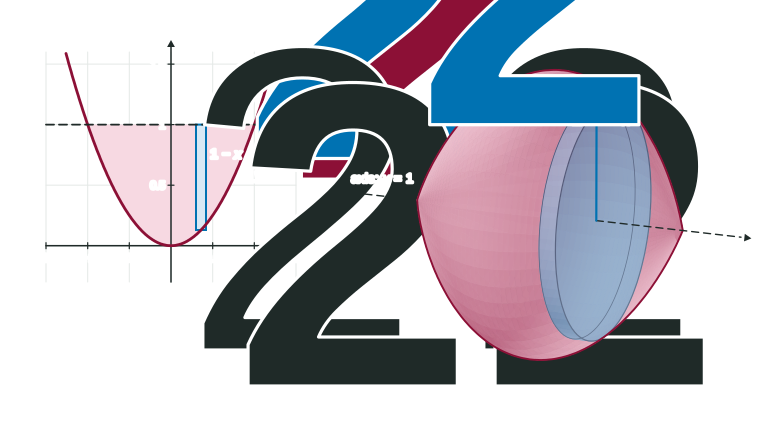
Worked example. The region between and is revolved about the line . Find the volume.
Limits. at .
Radius. The axis is above the parabola, so .
Volume.
Two ways to get it wrong
Measuring from the wrong place. Using in the example measures from the -axis. That would spin the region under the parabola about the -axis, a different solid ().
Squaring each term. is not the same as . The first gives . It looks tempting because it resembles a formula you will meet next topic, but for a solid disc the radius is one quantity: square the whole difference.
Negative . About , the radius to the curve is . Write the subtraction with parentheses before simplifying.
Vertical lines
When the axis is a vertical line , the slices perpendicular to it are horizontal, stacked in . Write the curve as in terms of ; the radius is the horizontal gap between and .
Worked example. The region bounded by , and is revolved about the line . Find the volume.
Slices. Horizontal, from to . At height the region runs from the line to the axis .
Radius. .
Volume.
The solid is a cone with radius 3 and height 3, and agrees.
The radius at a glance
| Axis | Where it is | Radius | Integrate in |
|---|---|---|---|
| above the curve | |||
| below the curve | |||
| right of the curve | |||
| left of the curve |
A quick check: the radius is 0 where the curve meets the axis, and largest where the curve is farthest from it. If your formula says otherwise, you are measuring from the wrong line.
With a calculator, find any crossing with the axis line numerically, store it, write the setup with the radius in parentheses, for example , and report three decimal places.