Disc Method About Other Lines
To revolve a region about a line y = k or x = h that it touches all the way across, use discs whose radius is the distance from that line to the curve: V = π∫ from a to b of (k − f(x))² dx (or the mirror image).
Part 1 · Hook
Why this matters
Part 2 · Before you start
What this builds on
Part 3 · Prerequisite check
Quick check before you start
1. The region under , , is revolved about the -axis. Which integral gives the volume?
Show the answer
Radius , so each disc has area , from to .
- Correct: :
- :
- :
- :
2. How far is the point from the line ?
Show the answer
A vertical distance is the larger minus the smaller: .
- Correct: :
- :
- :
- :
Part 4 · See it
See it first
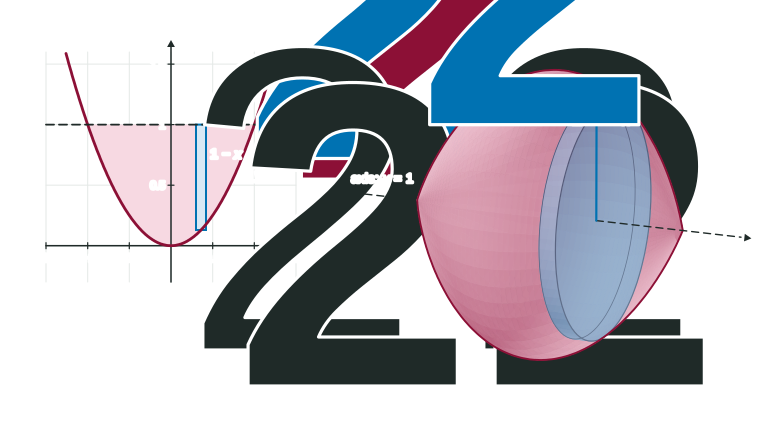
Part 5 · Step by step
How it works, step by step
- The axis of rotation is the line (or )every slice is a disc centered on that line
- The region touches that line all the way acrosseach rectangle reaches from the line to the curve and sweeps out a solid disc
- The radius is the distance from the line to the curve if the line is above the curve, if it is below
- Square the whole radius and multiply by
Part 6 · Key ideas
Key ideas
- Revolving about a line: the disc method still applies; only the radius changes.
- The radius is a distance from the axis: larger value minus smaller value. With the line above the curve, ; below it, .
- With a negative , subtract carefully: about ,
. - A vertical line gives horizontal discs: or , integrated in .
- Square as a whole; is a different number.
Part 7 · Misconception
A common mistake
The wrong idea: The radius is always the curve's height , whatever the axis.
What actually happens: is the distance from the -axis. When the axis is , measure from that line: . For the region between and about , the radius is , not .
Part 8 · Check yourself
Check yourself
Exam-style questions. Anything you miss goes into your review queue.
Graph
The region bounded by , and the -axis
1. is revolved about the line . Write the radius of the disc at , for .
Type an expression for .
Show the answer
The axis is above the curve, so the radius is (axis) minus (curve): .
- Answer:
2. Which integral gives the volume of the solid formed when is revolved about the line ?
Show the answer
touches the line all the way across, so the slices are discs of radius , for .
- Correct: : Square the distance from the axis to the curve.
- : This squares each height separately. It measures from the -axis, which is not the axis here.
- : That radius is measured from the -axis.
- : The disc's thickness is , so the limits are -values, 0 to 4.
3. Find the volume of the solid formed when is revolved about the line .
No calculator. Type the exact value (a fraction, π, e or a root is fine).
Show the answer
, so
- Answer: ≈ 8.378
4. Instead, is revolved about the -axis. Find the volume.
No calculator. Type the exact value (a fraction, π, e or a root is fine).
Show the answer
About the -axis the discs are horizontal. At height the region reaches from to , so
- Answer: ≈ 20.106
5. When is revolved about the line , where is the largest disc?
- At , where the radius is 2
- At , where
- At , where
- At , halfway across
Show the answer
The radius is largest where is smallest, at : .
- Correct: At , where the radius is 2: , the farthest the curve gets from the axis.
- At , where : At the curve meets the axis, so the radius there is 0.
- At , where : There the radius is , smaller than at .
- At , halfway across : There the radius is .
6. The region bounded by and is revolved about the line . Find the volume.
No calculator. Type the exact value (a fraction, π, e or a root is fine).
Show the answer
Radius for :
- Answer: ≈ 3.351
7. The region between and the line is revolved about the line . What is the radius of the disc at ?
Show the answer
The curve is above the axis: radius
- Correct: : Curve minus axis, with the minus sign on handled.
- : That is : subtracting adds 2.
- : That is measured from the -axis, not from .
- : That is axis minus curve, which is negative here.
Part 9 · Summary
Summary
Part 10 · Up next
What comes next
Part 11 · Connections