Spinning a region
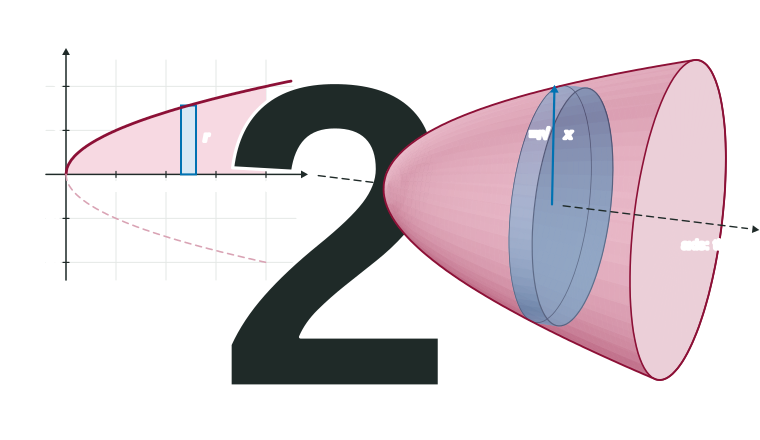
Take a flat region, such as the area under from to , and spin it all the way around the -axis. It sweeps out a solid shaped like a horn. A solid made this way is called a solid of revolution, and the line it spins around is the axis of rotation.
Now slice that solid perpendicular to the axis. Every slice is a circle filled in: a disc. That is the key fact. You already know how to find a volume from slices,
The radius is a distance from the axis
Picture one thin vertical rectangle in the region, standing on the axis and reaching up to the curve. When the region spins, that rectangle sweeps out a thin disc. The disc's radius is the rectangle's height: the distance from the axis to the curve. About the -axis, that is just . So
This is the disc method. It works whenever the region touches the axis all along its length, so that every slice is solid all the way to the center.
Worked example. The region under for is revolved about the -axis. Find the volume.
Radius. From the axis up to the curve: .
Disc area. .
Volume.
About the -axis
When the axis of rotation is the -axis, the slices perpendicular to it are horizontal. Each one sits at a height , has thickness , and reaches from the -axis out to the curve. So the radius is a horizontal distance, the curve's -value written in terms of , and the integral is in :
Worked example. The region bounded by , and the -axis is revolved about the -axis. Find the volume.
Slices. Horizontal, from up to .
Radius. At height the region reaches from to the curve. Solve for : .
Volume.
Writing instead would spin a different region (the one under the parabola) about a different axis.
Checking with shapes you know
| Region revolved about the -axis | Solid | Disc method | Geometry |
|---|---|---|---|
| Under , | cylinder | ||
| Under , | cone | ||
| Under | ball |
The cone formula's comes straight out of .
Where points are lost
- Missing . Every disc has area . Write the in your setup, not just in your answer.
- Radius not squared. adds up lengths, not areas.
- Squaring term by term.
, not . On a calculator, type the whole radius in parentheses and square it. - Wrong variable about the -axis. Horizontal discs need in terms of and limits in .
With a calculator, write the setup first, for example , then evaluate it in radian mode and report three decimal places with units of volume.