Disc Method About the Axes
A region that touches the axis of rotation along its whole length makes a solid whose slices are discs.
Part 1 · Hook
Why this matters
Part 2 · Before you start
What this builds on
Part 3 · Prerequisite check
Quick check before you start
1. A solid has cross sections perpendicular to the -axis with area for . Its volume is
Show the answer
Volume is the integral of the cross-sectional area along the axis.
- Correct: :
- :
- :
- :
2. Solve , , for .
Show the answer
Take the square root of both sides, keeping the nonnegative root.
- Correct: :
- :
- :
- :
Part 4 · See it
See it first
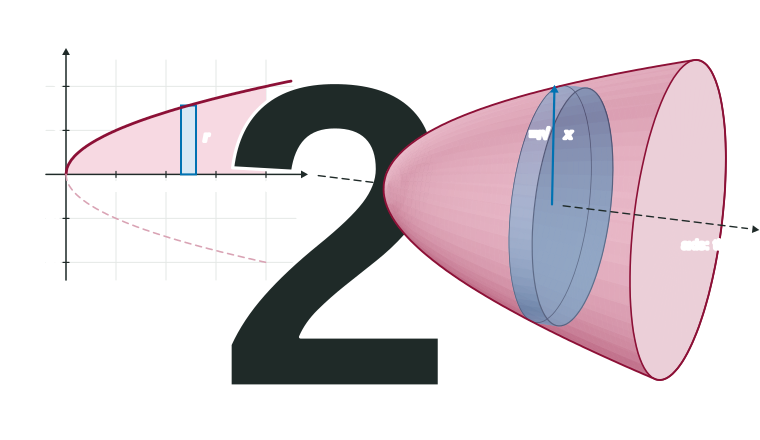
Part 5 · Step by step
How it works, step by step
- Revolve a region that touches the axis all along its lengthevery slice perpendicular to the axis is a solid disc
- The rectangle at reaches from the axis to the curveit sweeps out a disc whose radius is that distance,
- A disc of radius and thickness has volume
- Add the discs and let them get thin
- About the -axis the discs are horizontalwrite the radius as in terms of and integrate in
Part 6 · Key ideas
Key ideas
- Disc method:
, the cross-section method with . - The radius runs from the axis of rotation to the curve. About the -axis, .
- About the -axis, slices are horizontal: is the curve's written in , and the limits are -values.
- Do not forget , and square the radius inside the integral.
- Checks: a cylinder gives , a cone , a ball .
Part 7 · Misconception
A common mistake
The wrong idea: The volume of a solid of revolution is , or .
What actually happens: Each slice is a disc, and a disc's area is : both the and the square are needed. Without the square you are adding up lengths; without you are stacking squares, not discs.
Part 8 · Check yourself
Check yourself
Exam-style questions. Anything you miss goes into your review queue.
Graph
The region bounded by , and the -axis
1. is revolved about the -axis. Which integral gives the volume of the solid?
Show the answer
Revolving about the -axis makes horizontal discs. At height the radius reaches from the axis to the curve, , so the disc's area is .
- Correct: : with , stacked from to .
- : That revolves the region under about the -axis: a different region and a different axis.
- : The radius was not squared. A disc's area is .
- : That uses as the radius. The radius is the horizontal distance .
2. Find the volume of the solid formed when is revolved about the -axis.
No calculator. Type the exact value (a fraction, π, e or a root is fine).
Show the answer
- Answer: ≈ 25.133
3. When is revolved about the -axis, write the radius of the disc at height .
Type an expression for .
Show the answer
The radius is the distance from the axis () to the curve at height : .
- Answer:
4. The solid from revolving about the -axis is cut by the plane . Find the area of that cross section.
No calculator. Type the exact value (a fraction, π, e or a root is fine).
Show the answer
At the cross section is a disc of radius , with area .
- Answer: ≈ 9.425
5. When is revolved about the -axis, each thin slice of the solid is
- a horizontal disc with radius and thickness
- a vertical disc with radius and thickness
- a horizontal disc with radius and thickness
- a vertical disc with radius and thickness
Show the answer
Slices are perpendicular to the axis of rotation. For the -axis they are horizontal, stacked in , with radius from the axis to the curve, .
- Correct: a horizontal disc with radius and thickness : Perpendicular to the -axis, radius .
- a vertical disc with radius and thickness : Vertical slices belong to a horizontal axis. About the -axis the slices are horizontal.
- a horizontal disc with radius and thickness : is the height of the slice, not its radius.
- a vertical disc with radius and thickness : Vertical slices belong to a horizontal axis, and is a height, not a distance from the -axis.
6. The region under for is revolved about the -axis. Find the volume.
No calculator. Type the exact value (a fraction, π, e or a root is fine).
Show the answer
- Answer: ≈ 10.036
7. The triangle under for is revolved about the -axis. The solid is a cone with radius 3 and height 6. What volume does the disc method give?
Show the answer
- Correct: : It agrees with .
- :
: the radius was not squared. - : is the cylinder , three times the cone: the antiderivative of needs the division by 3.
- : comes from writing as : square the 2 as well, .
Part 9 · Summary
Summary
Part 10 · Up next
What comes next
Part 11 · Connections