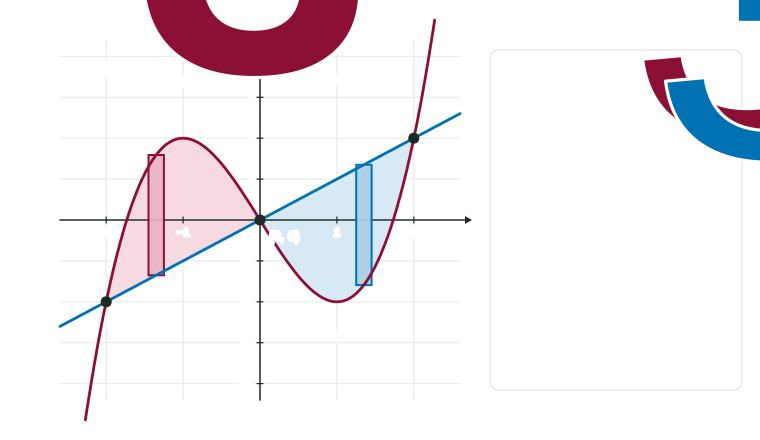
So far the region between two curves had one curve on top the whole way. Now look at and in the figure. They cross three times, at , and . Between and the cubic is on top. Between and the line is on top. Every crossing swaps the roles.
Figure 1. The cubic and the line enclose two pieces. Each has area 4, but a single integral of over is 0. LevlPrep original diagram.
Zero, for a region you can clearly see. On the right piece, is negative, so its rectangles have negative heights and cancel the left piece. A definite integral of is a net amount: area where is on top minus area where is on top. Area itself is never negative, so you have to stop the cancelling.
Splitting the integral
The fix uses a property you already know: integrals over touching intervals add, . Cut the interval at every crossing. On each piece one curve stays on top, so top minus bottom is positive there.
Find every crossing in the interval: solve . Keep only the solutions inside the interval.
Test each piece with one to see which curve is on top.
Integrate top minus bottom on each piece and add the results.
Doing this by hand is the same as integrating the absolute value of the difference:
On a calculator, that single setup is the quickest route, because the calculator handles the swaps for you.
Worked example. Find the area between and .
Crossings. gives , so .
Tests. At : and , so is on top. At : and , so is on top.
Pieces.
Area .
Net amount or area?
Expression
What it measures
For the example
net: -on-top area minus -on-top area
size of the net amount (pieces already canceled)
area
area, split by hand
The absolute value must go inside the integral. Outside, it comes too late.
Worked example. Find the area between and for .
Crossings. gives . Only is inside ; the ends and are given by the problem.
Tests. At : . At : .
Pieces. and .
Area . One integral of over would give the net value instead.
Traps to avoid
A crossing outside the interval does not make a piece. The interval's ends are limits, not crossings.
Do not assume the crossings are whole numbers. Factor, or use a calculator's solver and store the values.
The same idea works for horizontal strips: split where the right edge and the left edge trade places.
In context, the difference between net and total matters. Between two velocity graphs, is how far ahead runner 1 ends up; is the total of the gaps.