Unit 8 · Topic 8.6 Beta

Area Between Curves That Cross More Than Twice

When curves cross more than twice, top and bottom swap at each crossing.

Practice 1: Implementing Mathematical Processes

Question set for this topic

Part 1 · Hook

Why this matters

Two runners' speed graphs weave over and under each other during a race. The space between the graphs on a stretch where one runner is faster is real area, and so is the space where the other is faster. One integral would let those pieces cancel; to count all of the area, you have to cut the integral where the graphs cross.

Part 2 · Before you start

What this builds on

Part 3 · Prerequisite check

Quick check before you start

1. If ∫02h(x)dx\int_0^2 h(x)\,dx=5= 5 and ∫26h(x)dx\int_2^6 h(x)\,dx=−3= -3, what is ∫06h(x)dx\int_0^6 h(x)\,dx?

  1. 22
  2. 88
  3. −15-15
  4. −2-2
Show the answer

Integrals over touching intervals add: 5+(−3)=25 + (-3) = 2.

  • Correct: 22:
  • 88:
  • −15-15:
  • −2-2:

2. The line y=x+1y = x + 1 is above the parabola y=x2−1y = x^2 - 1 between their crossings. What is the height of a vertical strip between them?

  1. x+2−x2x + 2 - x^2
  2. x−x2x - x^2
  3. x2−x−2x^2 - x - 2
  4. x2+xx^2 + x
Show the answer

Top minus bottom: (x+1)−(x2−1)(x + 1) - (x^2 - 1)=x+2−x2= x + 2 - x^2.

  • Correct: x+2−x2x + 2 - x^2:
  • x−x2x - x^2:
  • x2−x−2x^2 - x - 2:
  • x2+xx^2 + x:

Part 4 · See it

See it first

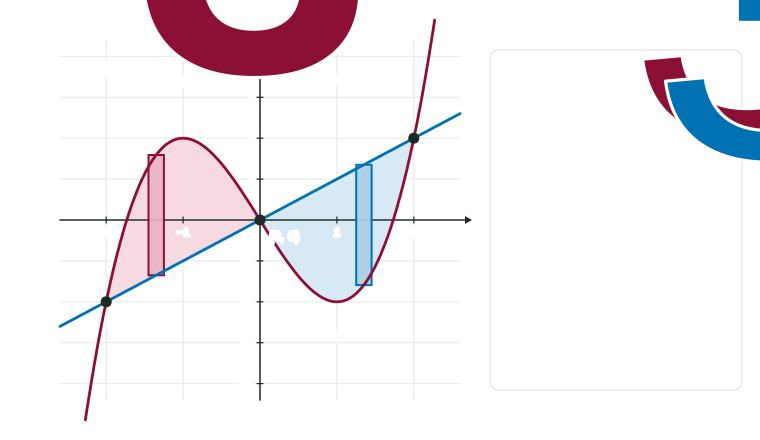
The cubic f(x) = x³ − 3x and the line g(x) = x cross at (−2, −2), (0, 0) and (2, 2). From −2 to 0 the cubic is on top (pink piece, rectangle height f − g); from 0 to 2 the line is on top (blue piece, rectangle height g − f). The side panel adds the pieces, 4 + 4 = 8, and warns that one integral of f − g from −2 to 2 is 0 because the pieces cancel.
Where f(x)=x3−3xf(x) = x^3 - 3x and g(x)=xg(x) = x cross, top and bottom swap. The two pieces have area 4 each, but one integral of f−gf - g from −2-2 to 22 gives 0. LevlPrep original diagram.

Part 5 · Step by step

How it works, step by step

  1. Two graphs cross inside the intervalthe curve on top changes at each crossing
  2. Where gg is on top, f(x)−g(x)<0f(x) - g(x) < 0one integral of f−gf - g counts that piece as negative and cancels area
  3. Split the integral at every crossing and use top minus bottom on each pieceevery piece is positive, and their sum is the area
  4. Top minus bottom on each piece is |f(x)−g(x)||f(x) - g(x)|the area is also ∫ab|f(x)−g(x)|dx\int_a^b |f(x) - g(x)|\,dx, which a calculator can evaluate in one step

Part 6 · Key ideas

Key ideas

  • Splitting the integral: find every crossing inside the interval by solving f(x)=g(x)f(x) = g(x), then integrate top minus bottom on each piece and add.
  • One integral ∫ab(f−g)dx\int_a^b (f - g)\,dx is a net value: areas where gg is on top are subtracted.
  • Area =∫ab|f(x)−g(x)|dx= \int_a^b |f(x) - g(x)|\,dx. On a calculator, this is the fastest setup.
  • Crossings outside the interval do not create pieces, and the interval's ends are not crossings.
  • The same rule holds in yy: split where the right and left edges swap.

Part 7 · Misconception

A common mistake

The wrong idea: If the integral of f−gf - g comes out negative or zero, take its absolute value to get the area.

What actually happens: By the time you take the absolute value, the pieces have already canceled. Split at each crossing first (or put the absolute value inside the integral), then add the positive pieces.

Part 8 · Check yourself

Check yourself

Exam-style questions. Anything you miss goes into your review queue.

Graph

The graphs of f(x)=x3−3x2f(x) = x^3 - 3x^2 and g(x)=−2xg(x) = -2x for 0≤x≤30 \le x \le 3

0.511.522.53−7−6−5−4−3−2−11xyx = 3fg(1, −2)(2, −4)

1. Solve f(x)=g(x)f(x) = g(x) to find where the graphs cross on [0,3][0, 3].

  1. x=0x = 0, x=1x = 1 and x=2x = 2
  2. x=0x = 0 and x=3x = 3
  3. x=0x = 0 and x=2x = 2
  4. x=1x = 1, x=2x = 2 and x=3x = 3
Show the answer

x3−3x2=−2xx^3 - 3x^2 = -2x gives x3−3x2x^3 - 3x^2+2x+ 2x=x(x−1)(x−2)= x(x - 1)(x - 2)=0= 0.

  • Correct: x=0x = 0, x=1x = 1 and x=2x = 2: All three roots of x(x−1)(x−2)x(x - 1)(x - 2) lie in [0,3][0, 3].
  • x=0x = 0 and x=3x = 3: At x=3x = 3, f(3)=0f(3) = 0 and g(3)=−6g(3) = -6: the graphs do not meet there. x=3x = 3 is a boundary of the region, not a crossing.
  • x=0x = 0 and x=2x = 2: This misses x=1x = 1, where f(1)=−2=g(1)f(1) = -2 = g(1).
  • x=1x = 1, x=2x = 2 and x=3x = 3: x=3x = 3 is not a crossing, and x=0x = 0 is: f(0)=g(0)=0f(0) = g(0) = 0.

2. On which interval is g(x)≥f(x)g(x) \ge f(x)?

  1. [1,2][1, 2]
  2. [0,1][0, 1]
  3. [2,3][2, 3]
  4. [0,2][0, 2]
Show the answer

Test x=1.5x = 1.5: f(1.5)f(1.5)=3.375−6.75= 3.375 - 6.75=−3.375= -3.375 and g(1.5)=−3g(1.5) = -3, so gg is on top between the crossings at 1 and 2.

  • Correct: [1,2][1, 2]: Between 1 and 2 the line is above the cubic.
  • [0,1][0, 1]: At x=0.5x = 0.5, f=−0.625f = -0.625 and g=−1g = -1, so ff is on top there.
  • [2,3][2, 3]: At x=2.5x = 2.5, f=−3.125f = -3.125 and g=−5g = -5, so ff is on top there.
  • [0,2][0, 2]: The graphs swap at x=1x = 1, so gg is not on top over all of [0,2][0, 2].

3. Which expression gives the area of the region between the graphs for 0≤x≤30 \le x \le 3?

  1. ∫01(f−g)dx\int_0^1 (f - g)\,dx+∫12(g−f)dx+ \int_1^2 (g - f)\,dx+∫23(f−g)dx+ \int_2^3 (f - g)\,dx
  2. ∫03(f(x)−g(x))dx\int_0^3 \left(f(x) - g(x)\right)\,dx
  3. |∫03(f(x)−g(x))dx|\left|\int_0^3 \left(f(x) - g(x)\right)\,dx\right|
  4. ∫01(f−g)dx−∫12(g−f)dx\int_0^1 (f - g)\,dx - \int_1^2 (g - f)\,dx+∫23(f−g)dx+ \int_2^3 (f - g)\,dx
Show the answer

Split at each crossing and use top minus bottom on each piece, so every piece adds a positive amount.

  • Correct: ∫01(f−g)dx\int_0^1 (f - g)\,dx+∫12(g−f)dx+ \int_1^2 (g - f)\,dx+∫23(f−g)dx+ \int_2^3 (f - g)\,dx: Top minus bottom on each piece: ff on top, then gg, then ff.
  • ∫03(f(x)−g(x))dx\int_0^3 \left(f(x) - g(x)\right)\,dx: One integral counts the middle piece, where gg is on top, as negative.
  • |∫03(f(x)−g(x))dx|\left|\int_0^3 \left(f(x) - g(x)\right)\,dx\right|: The absolute value is taken after the pieces have already canceled.
  • ∫01(f−g)dx−∫12(g−f)dx\int_0^1 (f - g)\,dx - \int_1^2 (g - f)\,dx+∫23(f−g)dx+ \int_2^3 (f - g)\,dx: ∫12(g−f)dx\int_1^2 (g - f)\,dx is already positive; subtracting it removes that area.

4. Find the area of the region between the graphs for 0≤x≤30 \le x \le 3.

No calculator. Type the exact value (a fraction, π, e or a root is fine).

Show the answer

With f−g=x3−3x2+2xf - g = x^3 - 3x^2 + 2x and antiderivative F(x)=x44−x3+x2F(x) = \frac{x^4}{4} - x^3 + x^2: ∫01=14\int_0^1 = \frac{1}{4}, ∫12(g−f)dx\int_1^2 (g - f)\,dx=14= \frac{1}{4}, ∫23=94\int_2^3 = \frac{9}{4}. The area is 14+14+94=114\frac{1}{4} + \frac{1}{4} + \frac{9}{4} = \frac{11}{4}.

  • Answer: 114\frac{11}{4} ≈ 2.750

5. Find the area of the region between y=2sin⁡xy = 2\sin x and y=1y = 1 for 0≤x≤π0 \le x \le \pi.

No calculator. Type the exact value (a fraction, π, e or a root is fine).

Show the answer

2sin⁡x=12\sin x = 1 at x=π6x = \frac{\pi}{6} and 5π6\frac{5\pi}{6}. Pieces: ∫0π/6(1−2sin⁡x)dx\int_0^{\pi/6} (1 - 2\sin x)\,dx=π6= \frac{\pi}{6}+3−2+ \sqrt{3} - 2, ∫π/65π/6(2sin⁡x−1)dx\int_{\pi/6}^{5\pi/6} (2\sin x - 1)\,dx=23−2π3= 2\sqrt{3} - \frac{2\pi}{3}, ∫5π/6π(1−2sin⁡x)dx\int_{5\pi/6}^{\pi} (1 - 2\sin x)\,dx=π6= \frac{\pi}{6}+3−2+ \sqrt{3} - 2. Area =43−4−π3= 4\sqrt{3} - 4 - \frac{\pi}{3}.

  • Answer: 43−4−π34\,\sqrt{3} - 4 - \frac{\pi}{3} ≈ 1.881

6. On [a,c][a, c] the graphs of ff and gg cross once, at x=bx = b, with ff on top on [a,b][a, b]. Which expressions give the area between them on [a,c][a, c]? Select all that apply.

  1. ∫ac|f(x)−g(x)|dx\int_a^c \left|f(x) - g(x)\right|\,dx
  2. ∫ab(f−g)dx\int_a^b (f - g)\,dx+∫bc(g−f)dx+ \int_b^c (g - f)\,dx
  3. |∫ac(f(x)−g(x))dx|\left|\int_a^c \left(f(x) - g(x)\right)\,dx\right|
  4. ∫ac(f(x)−g(x))dx\int_a^c \left(f(x) - g(x)\right)\,dx
Show the answer

The absolute value inside the integral makes every height positive, which is what splitting at bb does by hand.

  • Correct: ∫ac|f(x)−g(x)|dx\int_a^c \left|f(x) - g(x)\right|\,dx: True: |f−g||f - g| is the height of every strip, whichever curve is on top.
  • Correct: ∫ab(f−g)dx\int_a^b (f - g)\,dx+∫bc(g−f)dx+ \int_b^c (g - f)\,dx: True: top minus bottom on each side of the crossing.
  • |∫ac(f(x)−g(x))dx|\left|\int_a^c \left(f(x) - g(x)\right)\,dx\right|: False: the pieces cancel before the absolute value is taken.
  • ∫ac(f(x)−g(x))dx\int_a^c \left(f(x) - g(x)\right)\,dx: False: the piece where gg is on top counts as negative.

Part 9 · Summary

Summary

When curves cross more than twice, top and bottom swap at each crossing. Find the crossings, split the integral there, use top minus bottom on each piece, and add: the area is ∫ab|f(x)−g(x)|dx\int_a^b |f(x) - g(x)|\,dx. A single integral of f−gf - g gives a net amount, not the area.

Part 10 · Up next

What comes next

Part 11 · Connections

Connections