Volumes with Square and Rectangle Cross Sections
A solid with known cross sections has volume ∫ from a to b of A(x) dx .
Part 1 · Hook
Why this matters
Part 2 · Before you start
What this builds on
Part 3 · Prerequisite check
Quick check before you start
1. A box has a square face of side 3 cm and a depth of 0.5 cm. What is its volume?
- cubic centimeters
- cubic centimeters
- cubic centimeters
- cubic centimeters
Show the answer
Volume = area of the face times thickness: .
- Correct: cubic centimeters:
- cubic centimeters:
- cubic centimeters:
- cubic centimeters:
2. The region between (top) and (bottom) has what height at ?
Show the answer
Top minus bottom: .
- Correct: :
- :
- :
- :
Part 4 · See it
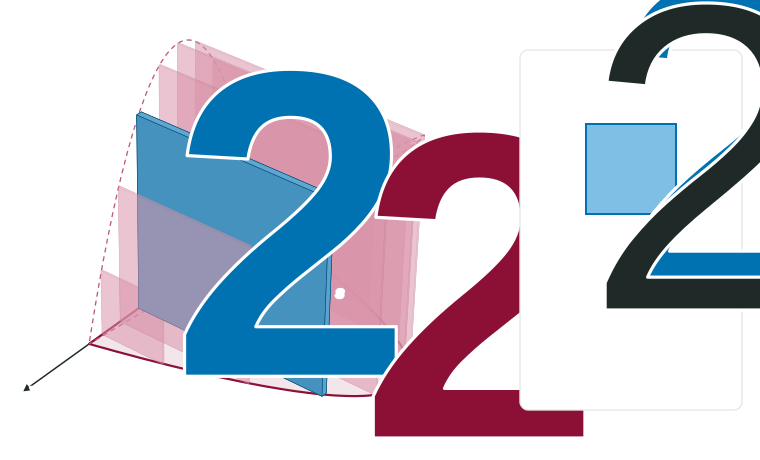
See it first
Part 5 · Step by step
How it works, step by step
- Slice the solid perpendicular to the -axiseach slice is a thin slab: a cross section of area with thickness
- A slab's volume is about adding the slabs is a Riemann sum for
- Let the slabs get thinthe volume is
- For a square cross section, the side is the length of the base across the slice
Part 6 · Key ideas
Key ideas
- Volume by cross sections:
, where is the area of the slice at . - For squares standing on the base, the side is top minus bottom of the base: , and .
- Square the whole difference: is not .
- Rectangles work the same way: , with given (a number, or a multiple of ).
- Slices perpendicular to the -axis use right minus left and .
Part 7 · Misconception
A common mistake
The wrong idea: To get the square's area, square the top function and the bottom function and subtract: .
What actually happens: The square's side is the gap between the curves, , so its area is . Squaring each curve first gives a different, wrong number.
Part 8 · Check yourself
Check yourself
Exam-style questions. Anything you miss goes into your review queue.
Graph
The base: the region between and
1. The shaded region is the base of a solid. Cross sections perpendicular to the -axis are squares. Write the area of the cross section at .
Type an expression for .
Show the answer
The side is the height of the base at : . So
- Answer:
2. Which integral gives the volume of the solid with this base and square cross sections perpendicular to the -axis?
Show the answer
Volume is the integral of cross-sectional area: with and .
- Correct: : Square the side, then integrate from to .
- : This squares each curve separately. is not .
- : This is the area of the base, not the volume.
- : A square's area is , with no .
3. Find the volume of the solid with this base and square cross sections perpendicular to the -axis.
No calculator. Type the exact value (a fraction, π, e or a root is fine).
Show the answer
- Answer: ≈ 8.100
4. What is the area of the square cross section at ?
Show the answer
At the side is , so the area is .
- Correct: : Side , squared.
- : is the side, a length; the area is its square.
- : squares each height separately instead of the gap.
- : uses the height of the line above the -axis; the base starts at the parabola, not the axis.
5. The base of a solid is the disk . Cross sections perpendicular to the -axis are squares. Find the volume.
No calculator. Type the exact value (a fraction, π, e or a root is fine).
Show the answer
At , the disk runs from to , so and .
- Answer: ≈ 42.667
6. The volume of a solid with square cross sections has no , even when its base has a curved edge. Why?
- Each slice is a square with area , and has no in it
- cancels out when the integral is evaluated
- is left out because the base lies flat in the -plane
- is needed when the base region has a curved edge
Show the answer
The volume is , and is whatever the shape of a slice gives. A square's area is . A curved edge only changes how depends on .
- Correct: Each slice is a square with area , and has no in it: The slice's area formula decides; for a square it is .
- cancels out when the integral is evaluated: There is no to cancel: it never enters.
- is left out because the base lies flat in the -plane: Every base lies in the -plane; that does not decide whether appears.
- is needed when the base region has a curved edge: A curved edge changes , not the area formula of a square.
Part 9 · Summary
Summary
Part 10 · Up next
What comes next
Part 11 · Connections