Volumes with Triangle and Semicircle Cross Sections
Triangle and semicircle cross sections use the same integral as squares, V = ∫ from a to b of A(x) dx , with s = f(x) − g(x) across the base.
Part 1 · Hook
Why this matters
Part 2 · Before you start
What this builds on
Part 3 · Prerequisite check
Quick check before you start
1. The base of a solid is the region under for , and its cross sections perpendicular to the -axis are squares. What is ?
Show the answer
The side is , so .
- Correct: :
- :
- :
- :
2. What is the area of a semicircle of radius ?
Show the answer
Half of a circle's area .
- Correct: :
- :
- :
- :
Part 4 · See it
See it first
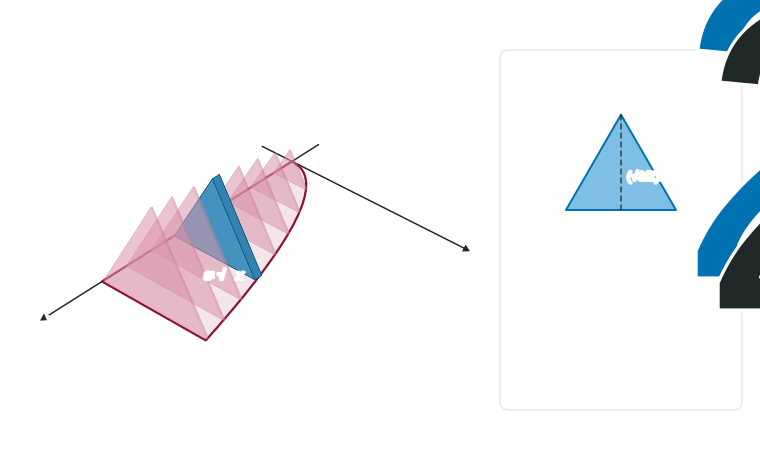
Part 5 · Step by step
How it works, step by step
- Each slice stands on a segment of the base of length the segment is a side of the triangle, or the diameter of the semicircle
- Every slice is the same kind of shapeits area is a fixed number times
- Equilateral triangle: height
- Semicircle: radius
- Volume is each volume is its constant times
Part 6 · Key ideas
Key ideas
- Triangular and semicircular cross sections: same method as squares,
, with a new area formula. - Equilateral triangle with side : .
- Isosceles right triangle: leg in the base gives ; hypotenuse in the base gives .
- Semicircle with diameter in the base: radius , so .
- On one base, every volume is a constant times : squares , equilateral , semicircles , right isosceles or .
Part 7 · Misconception
A common mistake
The wrong idea: For semicircles, the segment across the base is the radius, so .
What actually happens: The segment across the base is the diameter. The radius is , and . Using as the radius makes the volume four times too big.
Part 8 · Check yourself
Check yourself
Exam-style questions. Anything you miss goes into your review queue.
Graph
The base: the region between and
1. The shaded region is the base of a solid whose cross sections perpendicular to the -axis are equilateral triangles. Given
No calculator. Type the exact value (a fraction, π, e or a root is fine).
Show the answer
and , so
- Answer: ≈ 0.462
2. A solid on the same base has semicircular cross sections perpendicular to the -axis, each with its diameter in the base. Find the volume.
No calculator. Type the exact value (a fraction, π, e or a root is fine).
Show the answer
- Answer: ≈ 0.419
3. A solid on the same base has cross sections perpendicular to the -axis that are isosceles right triangles with one leg in the base. What is its volume?
Show the answer
Both legs have length , so and .
- Correct: : Half of .
- : is the area when the hypotenuse, not a leg, lies in the base.
- : That is the volume with squares; a right triangle with legs is half a square.
- : That doubles the square's area instead of halving it.
4. For the solid with equilateral triangle cross sections, write the area of the cross section at .
Type an expression for .
Show the answer
and
- Answer:
5. What is the area of an equilateral triangle with side ?
Show the answer
Its height is (from the Pythagorean theorem with half the base, ), so its area is .
- Correct: : Half of base times height.
- : That forgets the in a triangle's area.
- : That uses as the height; the height is shorter, .
- : An area needs .
6. A semicircle has its diameter in the base. What is its area?
Show the answer
The radius is : .
- Correct: : Half a circle of radius .
- : That uses as the radius.
- : That is a full circle of diameter .
- : That is a full circle of radius .
7. The base of a solid is the disk . Cross sections perpendicular to the -axis are equilateral triangles. Find the volume.
No calculator. Type the exact value (a fraction, π, e or a root is fine).
Show the answer
, so
- Answer: ≈ 62.354
Part 9 · Summary
Summary
Part 10 · Up next
What comes next
Part 11 · Connections