A definite integral is the limit of Riemann sums, and sums obey simple rules: you can split them, reorder them and pull out common factors. Those rules carry over to integrals. They let you compute new integrals from ones you already know, without ever finding a formula.
Adjacent intervals add
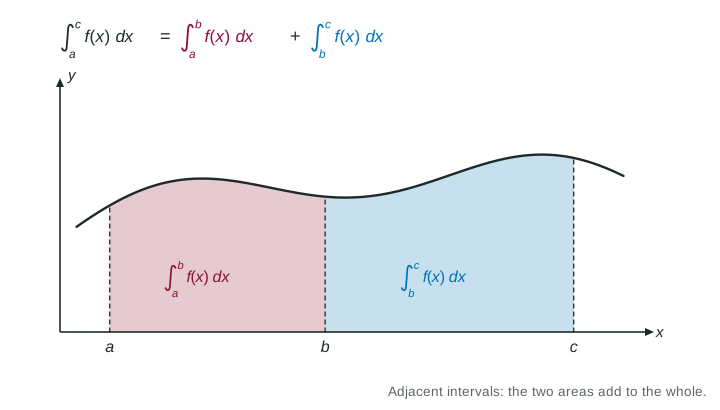
Figure 1. The area from a to c is the area from a to b plus the area from b to c. LevlPrep original diagram.
If you accumulate from to and then from to , you have accumulated from to :
This additivity is the property used most. It works in reverse too: .
Worked example 1. Given and , find .
, so and .
Reversed limits and equal limits
runs from to . Writing the limits the other way runs the interval backward, so every width is negative and the value changes sign:
With reversal, additivity holds for any order of , and . This matters for accumulation functions. If and is to the left of the lower limit, then . A positive there gives a negative . The exam tests this every few years.
Constants and sums
A constant factor and a sum pass through every Riemann sum, so they pass through the integral:
A constant by itself is a rectangle: .
Worked example 2. Also given . Find and .
First, the integral from 3 to 7: . The limits are reversed, so .
Second: . The constant is integrated over the interval of width 4; writing is the classic slip.
Products do not split: is not the product of the two integrals. Try on : the integral of the product is 2, the product of the integrals is 4.
Integrals from geometry, including breaks
When the graph is made of segments and circular arcs, split the interval where the pieces change, find each signed area, and add. Half a disc of radius has area ; a quarter disc, .
A function with a jump or a removable discontinuity can still be integrated, as long as it stays bounded: split at the break. A single point has no width, so the value of the function at the jump does not change the integral. For when and when :