Unit 6 · Topic 6.14 Beta

Choosing an Antidifferentiation Technique

3 min read · freeNot practiced

You now know every antidifferentiation technique on the AB exam: the basic rules, substitution, long division and completing the square. The hard part is no longer doing them; it is recognizing which one an integral wants. This page gives a reliable order of questions, then practice with the look-alikes that trip students up.

Ask the questions in order

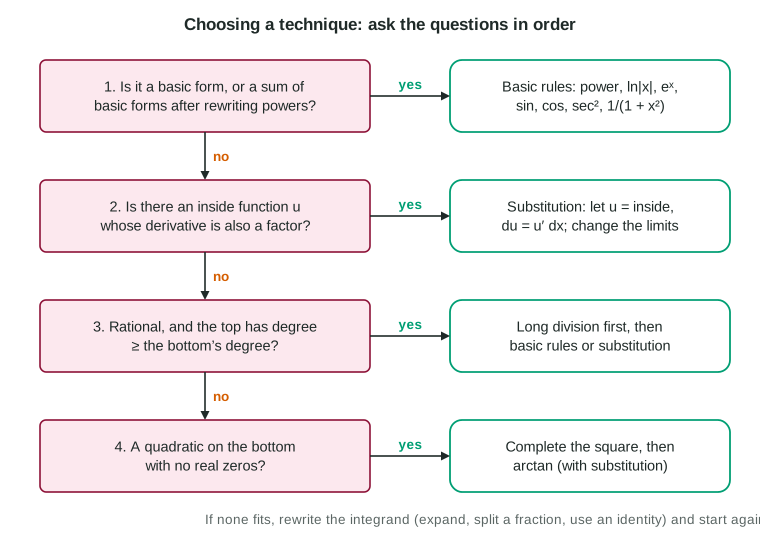
A flowchart of four questions in order, each with a yes arrow to a technique: basic form after rewriting? basic rules. Inside function whose derivative is a factor? substitution, with new limits. Rational with top degree at least bottom degree? long division first. Quadratic on the bottom with no real zeros? complete the square, then arctan. If none fits, rewrite and start again.
Figure 1. Four questions, in order. Most integrals are settled by the first two. LevlPrep original diagram.
  1. Is it a basic form, or a sum of them after rewriting? Rewrite roots as powers (x+1x\frac{x + 1}{\sqrt{x}}=x1/2+x−1/2= x^{1/2} + x^{-1/2}), expand products, and split a fraction whose bottom is a single term (x3+2x=x2+2x\frac{x^3 + 2}{x} = x^2 + \frac{2}{x}).
  2. Is there an inside function whose derivative is also a factor? Then substitute: ∫xex2dx\int x e^{x^2}\,dx with u=x2u = x^2. A constant factor can be fixed; a missing variable factor cannot.
  3. Is it a fraction whose top has degree at least the bottom's? Divide first: x2+1x−1\frac{x^2 + 1}{x - 1}=x= x+1+ 1+2x−1+ \frac{2}{x - 1}.
  4. Is it a constant over a quadratic with no real zeros? Complete the square and use ∫duu2+a2\int \frac{du}{u^2 + a^2}=1aarctan⁡ua= \frac{1}{a}\arctan\frac{u}{a}+C+ C.

Then check by differentiating. It takes ten seconds and catches sign errors and missing factors.

Look-alikes

Small changes in an integrand change the method completely. Compare:

IntegralMethodResult
∫1x2+1dx\int \frac{1}{x^2 + 1}\,dxbasic (arctan)arctan⁡x+C\arctan x + C
∫xx2+1dx\int \frac{x}{x^2 + 1}\,dxsubstitution, u=x2+1u = x^2 + 112ln⁡(x2+1)+C\frac{1}{2}\ln(x^2 + 1) + C
∫x2x2+1dx\int \frac{x^2}{x^2 + 1}\,dxdivisionx−arctan⁡x+Cx - \arctan x + C
∫11+4x2dx\int \frac{1}{1 + 4x^2}\,dxsubstitution, u=2xu = 2x12arctan⁡(2x)+C\frac{1}{2}\arctan(2x) + C
∫xex2dx\int x e^{x^2}\,dxsubstitution, u=x2u = x^212ex2+C\frac{1}{2}e^{x^2} + C
∫ex2dx\int e^{x^2}\,dxnone: no elementary antiderivativea calculator for definite integrals

Worked example 1. Find ∫xx−1dx\int x\sqrt{x - 1}\,dx.

Basic? No: a product. Inside function: x−1x - 1, with derivative 1, so u=x−1u = x - 1 and du=dxdu = dx. But an extra xx remains. Write it in terms of uu: x=u+1x = u + 1.

∫(u+1)u1/2du\int (u + 1)u^{1/2}\,du=∫(u3/2+u1/2)du= \int \left(u^{3/2} + u^{1/2}\right)du=25u5/2= \frac{2}{5}u^{5/2}+23u3/2+ \frac{2}{3}u^{3/2}+C+ C.

Back to xx: 25(x−1)5/2\frac{2}{5}(x - 1)^{5/2}+23(x−1)3/2+ \frac{2}{3}(x - 1)^{3/2}+C+ C. Every xx must be replaced, including the one outside the root.

Worked example 2. Find ∫1e1+ln⁡xxdx\int_1^e \frac{1 + \ln x}{x}\,dx.

The factor 1x\frac{1}{x} is the derivative of ln⁡x\ln x, so let u=1+ln⁡xu = 1 + \ln x, du=1xdxdu = \frac{1}{x}dx.

Limits: x=1→u=1x = 1 \to u = 1; x=e→u=2x = e \to u = 2.

∫12udu\int_1^2 u\,du=u22|12= \frac{u^2}{2}\Big|_1^2=2−12= 2 - \frac{1}{2}=32= \frac{3}{2}.

Reading someone else's work

The exam sometimes shows work and asks you to find the error. Check each line against its rule: Is dudu right? Does the constant factor match? Were the limits changed? Is the antiderivative right (differentiate it)? In ∫016xx2+1dx\int_0^1 \frac{6x}{x^2 + 1}\,dx, writing 3∫01duu3\int_0^1 \frac{du}{u} keeps the xx-limits; the correct line is 3∫12duu3\int_1^2 \frac{du}{u}=3ln⁡2= 3\ln 2.

Integrals that need integration by parts, partial fractions or an infinite limit of integration belong to the BC course. If an AB integral seems to need one of those, look again for a substitution or a rewrite, or check whether it is a calculator question.
Spot a mistake on this page?