To use the Fundamental Theorem you need antiderivatives, and lots of them. This page collects the basic rules, introduces the notation for "all the antiderivatives at once," and shows how a single known point picks out the function you want.
A family, not a single function
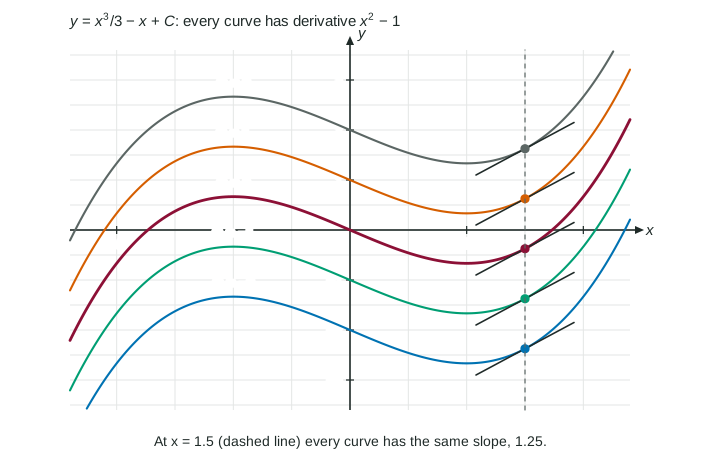
Figure 1. y = x³/3 - x + C for five values of C. Same slope at every x; different heights. LevlPrep original diagram.
has derivative . So does , and : a constant has derivative 0. On an interval, these are the only antiderivatives; two functions with the same derivative differ by a constant. Graphically they are vertical shifts of one curve, as the figure shows.
The indefinite integral names the whole family:
is the constant of integration. Leaving it off says "this one function," which is wrong: the scoring guidelines take a point for a missing .
Constant factors come out and sums split: . Products and quotients do not split, so rewrite them first.
Worked example 1. Find .
Rewrite as powers: and .
. . .
Answer: . Check: differentiating gives back .
Two more rewrites: expand a power of a sum, , and split a fraction over a single term, . Never integrate the top and bottom of a fraction separately.
Picking one function: use a known point
Worked example 2. and . Find .
Antidifferentiate: .
Substitute the point right away: , so .
.
With a second derivative, antidifferentiate twice; each step brings its own constant, and each needs its own piece of information, such as and then .
Some functions have no formula for an antiderivative
Every continuous function has antiderivatives (the accumulation function is one), but some cannot be written with familiar functions: and are examples. On the exam, integrals of such functions appear on calculator questions, and the calculator evaluates them numerically.