Unit 6 · Topic 6.8 Beta
Antiderivatives and Indefinite Integrals
Every derivative rule read backward gives an antidifferentiation rule.
Practice 1: Implementing Mathematical ProcessesPractice 4: Communication and Notation
Question set for this topic
Part 1 · Hook
Why this matters
Tell someone a car's
speed at every moment and ask where it is. They cannot say, not without knowing where it started. Knowing a
derivative pins a
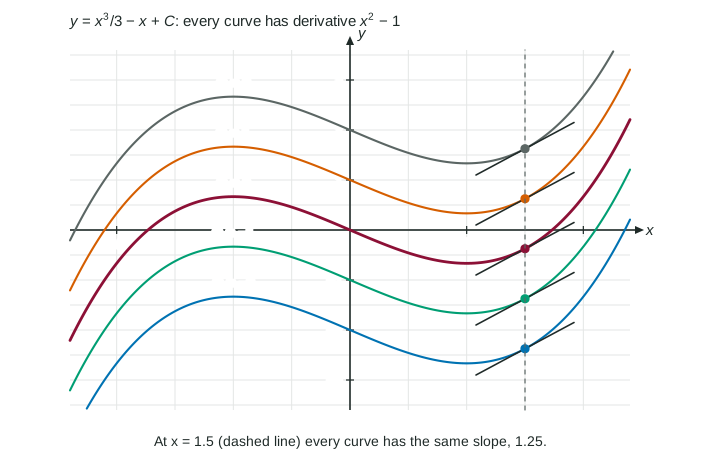
function down only up to a starting value, and that missing piece is the
that students lose points for forgetting.
Part 2 · Before you start
What this builds on
Part 3 · Prerequisite check
Quick check before you start
1. What is the derivative of ?
Show the answer
.
- Correct: :
- :
- :
- :
2. Write as a power of .
Show the answer
, and .
- Correct: :
- :
- :
- :
3. If , what is ?
Show the answer
The Fundamental Theorem, part 2.
- Correct: :
- :
- :
- :
Part 5 · Step by step
How it works, step by step
- A constant has derivative 0→if , then for every constant
- Two antiderivatives of f on an interval→differ by a constant, so the whole family is F(x) + C
- Write the family as →: an indefinite integral always ends in
- You also know one point on the graph→substitute it to find and pick out the one function
Part 6 · Key ideas
Key ideas
- Indefinite integral: , the family of all antiderivatives. No limits, a family, never a number.
- Power rule backward: for ; and .
- Rewrite before integrating: roots as powers, products expanded, a fraction over a single term split up.
- Check every answer by differentiating it. Find from a known point by substituting it.
Part 7 · Misconception
A common mistake
The wrong idea: , because sine and cosine go together.
What actually happens: , so . Differentiate your answer to check the sign.
Part 8 · Check yourself
Check yourself
Exam-style questions. Anything you miss goes into your review queue.
Table
A function known from its derivative and one value
A function
has derivative
, and its graph passes through
.
What is known about f| Given | Value |
|---|
| |
|---|
| 5 |
|---|
1. Find . Include the constant: write .
Type an expression for .
Show the answer
Term by term: , , . So . Check: the derivative is .
- Answer:
2. . Find the value of that makes the graph pass through .
No calculator. Type the exact value (a fraction, π, e or a root is fine).
Show the answer
, so .
3. Write .
Type an expression for .
Show the answer
. Check: and .
- Answer:
4. Using the function you found, evaluate it at the origin: what is ?
No calculator. Type the exact value (a fraction, π, e or a root is fine).
Show the answer
.
5. Rewrite as a power of , then antidifferentiate: . Include the constant: write .
Type an expression for .
Show the answer
.
- Answer:
6. Which is ?
Show the answer
For , ; for , too. So .
- Correct: : Correct: for .
- : The power rule needs ; for it would divide by 0. The antiderivative is .
- : That is the derivative of , the wrong direction.
- : The derivative of is , not .
Part 9 · Summary
Summary
Every derivative rule read backward gives an antidifferentiation rule. The indefinite integral
is the whole family of antiderivatives, so it always carries
. Rewrite the integrand into basic forms first, check by differentiating, and use a known point to find
.
Part 10 · Up next
What comes next
Part 11 · Connections
Connections