The basic rules handle and , but not or . Those integrands came from the chain rule, and u-substitution is the chain rule run backward.
Spotting the chain rule in an integrand
By the chain rule, . So
The pattern: an inside function , an outside function applied to it, and the inside's derivative as a factor. Whenever you see , the answer is , where is an antiderivative of .
The method
Choose : an inside function whose derivative is also in the integrand (up to a constant factor).
Find .
Rewrite the whole integral in . No may remain.
Integrate in , then substitute back.
Check by differentiating.
Worked example 1. Find .
Inside: , so and .
Rewrite: .
Back to : (no absolute value needed: ).
Check: .
A missing constant factor is fine: multiply and divide by it, as with the above. A missing variable factor is not: has no to match , so substitution fails (expand the power instead).
Linear inside functions
When the inside is or , , so the rule is just "divide by ":
Check by differentiating: the chain rule puts the back.
Definite integrals: change the limits
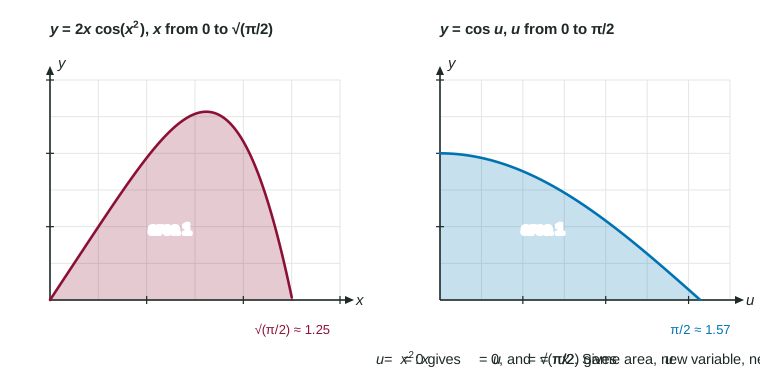
Figure 1. Same area, new variable, new limits. LevlPrep original diagram.
In a definite integral, the limits are values of the variable. When the variable changes from to , the limits must change too: becomes and becomes . The figure shows the idea: the region under on and the region under on have the same area.
Worked example 2. Evaluate .
, , so .
Limits: ; .
.
The common wrong answer, , comes from evaluating at the old limits 0 and 1.
Write the -limits on the integral sign as soon as you change variables. Mixing a -integrand with -limits is a linkage error the scoring guidelines penalize.
Substitution with tables
The same idea works with functions given only by values. Since ,
Read and from the table first, then at those inputs.