Unit 6 · Topic 6.9 Beta

Integrating by Substitution

Substitution undoes the chain rule.

Practice 1: Implementing Mathematical Processes

Question set for this topic

Part 1 · Hook

Why this matters

The chain rule turns sin⁡(x2)\sin(x^2) into 2xcos⁡(x2)2x\cos(x^2). Going backward, an integral like ∫2xcos⁡(x2)dx\int 2x\cos(x^2)\,dx looks impossible until you spot the inside function x2x^2 and its derivative 2x2x sitting right there. Substitution is the art of spotting that pair, and it is the most used technique on the exam.

Part 2 · Before you start

What this builds on

Part 3 · Prerequisite check

Quick check before you start

1. If y=(1+x2)4y = (1 + x^2)^4, then dydx=\frac{dy}{dx} =

  1. 8x(1+x2)38x(1 + x^2)^3
  2. 4(1+x2)34(1 + x^2)^3
  3. 4x(1+x2)34x(1 + x^2)^3
  4. 8x(1+x2)48x(1 + x^2)^4
Show the answer

Chain rule: 4(1+x2)3⋅2x4(1 + x^2)^3 \cdot 2x.

  • Correct: 8x(1+x2)38x(1 + x^2)^3:
  • 4(1+x2)34(1 + x^2)^3:
  • 4x(1+x2)34x(1 + x^2)^3:
  • 8x(1+x2)48x(1 + x^2)^4:

2. ∫u3du=\int u^3\,du =

  1. u44+C\frac{u^4}{4} + C
  2. 3u2+C3u^2 + C
  3. u4+Cu^4 + C
  4. u33+C\frac{u^3}{3} + C
Show the answer

Power rule backward.

  • Correct: u44+C\frac{u^4}{4} + C:
  • 3u2+C3u^2 + C:
  • u4+Cu^4 + C:
  • u33+C\frac{u^3}{3} + C:

Part 4 · See it

See it first

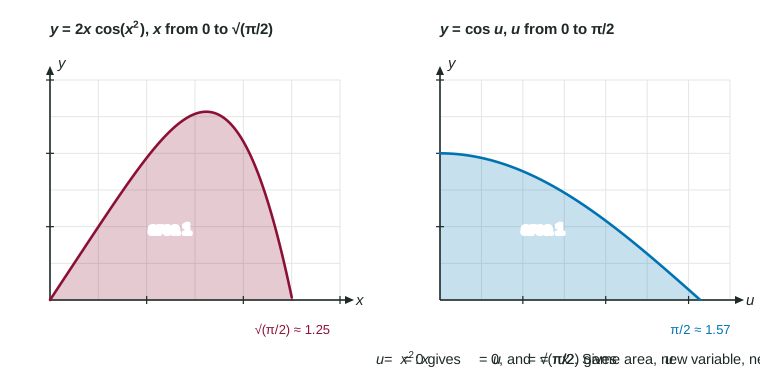
Left: the graph of y = 2x cos(x squared) from x = 0 to the square root of pi/2, about 1.25, with the region under it shaded; its area is 1. Right: the graph of y = cos u from u = 0 to pi/2, with the region under it shaded; its area is also 1. With u = x squared, the x-limits become the u-limits.
With u = x², the region under 2x cos(x²) on [0, √(π/2)] and the region under cos u on [0, π/2] have the same area, 1. LevlPrep original diagram.

Part 5 · Step by step

How it works, step by step

  1. The chain rule gives ddxF(g(x))\frac{d}{dx}F(g(x))=F′(g(x))g′(x)= F'(g(x))\,g'(x)so ∫f(g(x))g′(x)dx\int f(g(x))\,g'(x)\,dx=F(g(x))+C= F(g(x)) + C when F′=fF' = f
  2. Let u=g(x)u = g(x); then du=g′(x)dxdu = g'(x)\,dxthe integral becomes ∫f(u)du\int f(u)\,du, a basic form
  3. A constant factor is missing or extraadjust it: xdx=12dux\,dx = \frac{1}{2}du when du=2xdxdu = 2x\,dx
  4. The integral is definitechange the limits to u=g(a)u = g(a) and u=g(b)u = g(b) and never go back to xx

Part 6 · Key ideas

Key ideas

  • Look for an inside function u=g(x)u = g(x) whose derivative g′(x)g'(x) is also a factor, up to a constant.
  • Write du=g′(x)dxdu = g'(x)\,dx, rewrite the whole integral in uu (no xx left), integrate, then substitute back.
  • Definite integrals: new limits u=g(a)u = g(a) and u=g(b)u = g(b); keeping the xx-limits is the classic slip.
  • Linear inside: ∫f(kx)dx\int f(kx)\,dx=1kF(kx)+C= \frac{1}{k}F(kx) + C, such as ∫e3xdx=13e3x+C\int e^{3x}\,dx = \frac{1}{3}e^{3x} + C.

Part 7 · Misconception

A common mistake

The wrong idea: ∫01x(1+x2)3dx\int_0^1 x(1 + x^2)^3\,dx=12∫01u3du= \frac{1}{2}\int_0^1 u^3\,du: the limits stay the same.

What actually happens: The limits belong to the variable. In uu they are u(0)=1u(0) = 1 and u(1)=2u(1) = 2: 12∫12u3du\frac{1}{2}\int_1^2 u^3\,du=158= \frac{15}{8}.

Part 8 · Check yourself

Check yourself

Exam-style questions. Anything you miss goes into your review queue.

Table

Substitution in a definite integral

Evaluate ∫01x(1+x2)3dx\int_0^1 x(1 + x^2)^3\,dx with the substitution u=1+x2u = 1 + x^2.
The integral and the chosen substitution
PieceHere
integral∫01x(1+x2)3dx\int_0^1 x(1 + x^2)^3\,dx
substitutionu=1+x2u = 1 + x^2
limits in xx=0x = 0 to x=1x = 1

1. With u=1+x2u = 1 + x^2, what does xdxx\,dx become?

  1. 12du\frac{1}{2}\,du
  2. dudu
  3. 2du2\,du
  4. dux\frac{du}{x}
Show the answer

u=1+x2u = 1 + x^2 gives dudx=2x\frac{du}{dx} = 2x, so du=2xdxdu = 2x\,dx and xdx=12dux\,dx = \frac{1}{2}\,du.

  • Correct: 12du\frac{1}{2}\,du: Correct: du=2xdxdu = 2x\,dx, so xdx=12dux\,dx = \frac{1}{2}du.
  • dudu: du=2xdxdu = 2x\,dx, which is twice xdxx\,dx. Divide by 2.
  • 2du2\,du: du=2xdxdu = 2x\,dx gives xdx=du2x\,dx = \frac{du}{2}, not 2du2\,du.
  • dux\frac{du}{x}: du=2xdxdu = 2x\,dx; solving for xdxx\,dx (not dxdx) gives 12du\frac{1}{2}du, with no xx left over.

2. What are the limits of integration in terms of uu?

  1. u=0u = 0 to u=1u = 1
  2. u=1u = 1 to u=4u = 4
  3. u=0u = 0 to u=2u = 2
  4. u=1u = 1 to u=2u = 2
Show the answer

Substitute each xx-limit into u=1+x2u = 1 + x^2: x=0→u=1x = 0 \to u = 1, x=1→u=2x = 1 \to u = 2.

  • u=0u = 0 to u=1u = 1: Those are the xx-limits. Put each into u=1+x2u = 1 + x^2.
  • u=1u = 1 to u=4u = 4: At x=1x = 1, u=1+12=2u = 1 + 1^2 = 2, not 4.
  • u=0u = 0 to u=2u = 2: At x=0x = 0, u=1+02=1u = 1 + 0^2 = 1; the constant 1 in uu matters.
  • Correct: u=1u = 1 to u=2u = 2: Correct: x=0x = 0 gives u=1+0=1u = 1 + 0 = 1 and x=1x = 1 gives u=2u = 2.

3. Which integral in uu equals ∫01x(1+x2)3dx\int_0^1 x(1 + x^2)^3\,dx?

  1. ∫12u3du\int_1^2 u^3\,du
  2. 12∫12xu3du\frac{1}{2}\int_1^2 x\,u^3\,du
  3. 12∫12u3du\frac{1}{2}\int_1^2 u^3\,du
  4. 12∫01u3du\frac{1}{2}\int_0^1 u^3\,du
Show the answer

∫01(1+x2)3⋅xdx\int_0^1 (1 + x^2)^3 \cdot x\,dx=∫12u3⋅12du= \int_1^2 u^3 \cdot \frac{1}{2}\,du=12∫12u3du= \frac{1}{2}\int_1^2 u^3\,du.

  • ∫12u3du\int_1^2 u^3\,du: The factor 12\frac{1}{2} from xdx=12dux\,dx = \frac{1}{2}du is missing.
  • 12∫12xu3du\frac{1}{2}\int_1^2 x\,u^3\,du: Everything must be in uu: the xx was absorbed into du=2xdxdu = 2x\,dx.
  • Correct: 12∫12u3du\frac{1}{2}\int_1^2 u^3\,du: Correct: (1+x2)3=u3(1 + x^2)^3 = u^3, xdx=12dux\,dx = \frac{1}{2}du, limits 1 to 2.
  • 12∫01u3du\frac{1}{2}\int_0^1 u^3\,du: The limits are still the xx-limits. In terms of uu they are 1 and 2.

4. Find the value of ∫01x(1+x2)3dx\int_0^1 x(1 + x^2)^3\,dx.

No calculator. Type the exact value (a fraction, π, e or a root is fine).

Show the answer

12∫12u3du\frac{1}{2}\int_1^2 u^3\,du=12⋅u44|12= \frac{1}{2}\cdot\frac{u^4}{4}\Big|_1^2=18(16−1)= \frac{1}{8}(16 - 1)=158= \frac{15}{8}.

  • Answer: 158\frac{15}{8} ≈ 1.875

5. Find ∫2xcos⁡(x2)dx\int 2x\cos(x^2)\,dx. Include +C+ C.

Type an expression for ∫2xcos⁡(x2)dx=\int 2x\cos(x^2)\,dx =.

Show the answer

u=x2u = x^2, du=2xdxdu = 2x\,dx: ∫cos⁡udu\int \cos u\,du=sin⁡u= \sin u+C+ C=sin⁡(x2)= \sin(x^2)+C+ C.

  • Answer: ∫2xcos⁡(x2)dx=\int 2x\cos(x^2)\,dx = sin⁡(x2)+C\sin(x^{2}) + C

6. Find ∫e3xdx\int e^{3x}\,dx. Include +C+ C.

Type an expression for ∫e3xdx=\int e^{3x}\,dx =.

Show the answer

u=3xu = 3x, du=3dxdu = 3\,dx: ∫e3xdx\int e^{3x}\,dx=13∫eudu= \frac{1}{3}\int e^u\,du=13e3x= \frac{1}{3}e^{3x}+C+ C.

  • Answer: ∫e3xdx=\int e^{3x}\,dx = 13e3x+C\frac{1}{3}e^{3x} + C

Part 9 · Summary

Summary

Substitution undoes the chain rule. Choose uu as an inside function whose derivative is a factor of the integrand, replace g′(x)dxg'(x)\,dx by dudu, fix any constant factor, and integrate in uu. In a definite integral, change the limits to values of uu.

Part 10 · Up next

What comes next

Part 11 · Connections

Connections