Unit 6 · Topic 6.10 Beta

Integrating by Long Division and Completing the Square

Rewrite before integrating.

Practice 1: Implementing Mathematical Processes

Question set for this topic

Part 1 · Hook

Why this matters

Some integrands look hopeless only because they are written badly. x2+3x+5x+1\frac{x^2 + 3x + 5}{x + 1} is really a straight line plus a small correction; 1x2−2x+10\frac{1}{x^2 - 2x + 10} is an arctangent in disguise. Two pieces of algebra you already know, long division and completing the square, uncover them.

Part 2 · Before you start

What this builds on

Part 3 · Prerequisite check

Quick check before you start

1. ddxarctan⁡x=\frac{d}{dx}\arctan x =

  1. 11+x2\frac{1}{1 + x^2}
  2. 11−x2\frac{1}{\sqrt{1 - x^2}}
  3. sec2⁡x\sec^2 x
  4. −11+x2\frac{-1}{1 + x^2}
Show the answer

The inverse tangent derivative.

  • Correct: 11+x2\frac{1}{1 + x^2}:
  • 11−x2\frac{1}{\sqrt{1 - x^2}}:
  • sec2⁡x\sec^2 x:
  • −11+x2\frac{-1}{1 + x^2}:

2. ∫1x+1dx=\int \frac{1}{x + 1}\,dx =

  1. ln⁡|x+1|+C\ln|x + 1| + C
  2. −1(x+1)2+C\frac{-1}{(x + 1)^2} + C
  3. ln⁡|x|+1+C\ln|x| + 1 + C
  4. xx+1+C\frac{x}{x + 1} + C
Show the answer

With u=x+1u = x + 1, du=dxdu = dx: ∫duu=ln⁡|u|\int \frac{du}{u} = \ln|u|.

  • Correct: ln⁡|x+1|+C\ln|x + 1| + C:
  • −1(x+1)2+C\frac{-1}{(x + 1)^2} + C:
  • ln⁡|x|+1+C\ln|x| + 1 + C:
  • xx+1+C\frac{x}{x + 1} + C:

Part 4 · See it

See it first

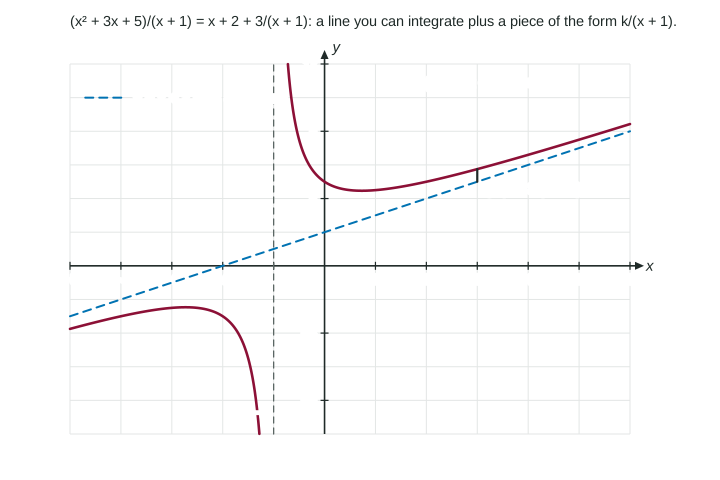
The graph of y = (x squared + 3x + 5)/(x + 1) in two branches on either side of the vertical asymptote x = -1, with the dashed line y = x + 2. The curve hugs the line far from x = -1; at x = 3 a vertical segment marks the gap 3/(x + 1). Long division gives x + 2 + 3/(x + 1).
Long division splits (x² + 3x + 5)/(x + 1) into the line x + 2 and the small piece 3/(x + 1). LevlPrep original diagram.

Part 5 · Step by step

How it works, step by step

  1. The top of a fraction has degree at least the bottomdivide: a polynomial plus a remainder over the bottom
  2. The remainder sits over a linear factor such as x+1x + 1it integrates to a logarithm, kln⁡|x+1|k\ln|x + 1|
  3. The bottom is a quadratic with no real zeros and the top is a constantcomplete the square: (x−h)2+a2(x - h)^2 + a^2
  4. Substitute u=x−hu = x - h∫duu2+a2\int \frac{du}{u^2 + a^2}=1aarctan⁡ua= \frac{1}{a}\arctan\frac{u}{a}+C+ C

Part 6 · Key ideas

Key ideas

  • Long division first when the top's degree is at least the bottom's: x2+3x+5x+1\frac{x^2 + 3x + 5}{x + 1}=x= x+2+ 2+3x+1+ \frac{3}{x + 1}.
  • Completing the square: x2x^2+bx+ bx+c+ c=(x+b2)2= \left(x + \frac{b}{2}\right)^2+(c−b24)+ \left(c - \frac{b^2}{4}\right).
  • ∫1u2+a2du\int \frac{1}{u^2 + a^2}\,du=1aarctan⁡ua= \frac{1}{a}\arctan\frac{u}{a}+C+ C: the factor 1a\frac{1}{a} is easy to drop.
  • If the top is the derivative of the bottom, skip both: substitute and get ln⁡\ln.

Part 7 · Misconception

A common mistake

The wrong idea: ∫1x2+9dx\int \frac{1}{x^2 + 9}\,dx=arctan⁡x3+C= \arctan\frac{x}{3} + C.

What actually happens: With x=3ux = 3u, dx=3dudx = 3\,du and x2+9=9(u2+1)x^2 + 9 = 9(u^2 + 1), so a factor 39=13\frac{3}{9} = \frac{1}{3} remains: 13arctan⁡x3+C\frac{1}{3}\arctan\frac{x}{3} + C. Differentiate to check.

Part 8 · Check yourself

Check yourself

Exam-style questions. Anything you miss goes into your review queue.

Graph

The integrand x2+3x+5x+1\frac{x^2 + 3x + 5}{x + 1}

Consider ∫x2+3x+5x+1dx\int \frac{x^2 + 3x + 5}{x + 1}\,dx for x>−1x > -1. The graph shows the integrand and the line y=x+2y = x + 2.
−11234524681012xyintegrandy = x + 2

1. Which is x2+3x+5x+1\frac{x^2 + 3x + 5}{x + 1} after long division?

  1. x+2+3x+1x + 2 + \frac{3}{x + 1}
  2. x+4+1x+1x + 4 + \frac{1}{x + 1}
  3. x+2+5x+1x + 2 + \frac{5}{x + 1}
  4. x+3+5xx + 3 + \frac{5}{x}
Show the answer

x2+3x+5x^2 + 3x + 5=(x+1)(x+2)+3= (x + 1)(x + 2) + 3, so x2+3x+5x+1\frac{x^2 + 3x + 5}{x + 1}=x= x+2+ 2+3x+1+ \frac{3}{x + 1}. The graph shows it: the curve approaches the line y=x+2y = x + 2.

  • Correct: x+2+3x+1x + 2 + \frac{3}{x + 1}: Correct: (x+1)(x+2)(x + 1)(x + 2)=x2+3x+2= x^2 + 3x + 2, which leaves a remainder of 3.
  • x+4+1x+1x + 4 + \frac{1}{x + 1}: A sign slip: subtracting x(x+1)=x2+xx(x + 1) = x^2 + x from x2+3xx^2 + 3x leaves 2x2x, not 4x4x.
  • x+2+5x+1x + 2 + \frac{5}{x + 1}: The constant 5 is not the remainder: 5−2=35 - 2 = 3 is left after subtracting 2(x+1)2(x + 1).
  • x+3+5xx + 3 + \frac{5}{x}: That divides each term by xx, not by x+1x + 1.

2. Find ∫x2+3x+5x+1dx\int \frac{x^2 + 3x + 5}{x + 1}\,dx for x>−1x > -1. Include +C+ C.

Type an expression for ∫x2+3x+5x+1dx=\int \frac{x^2 + 3x + 5}{x + 1}\,dx =.

Show the answer

∫(x+2+3x+1)dx\int \left(x + 2 + \frac{3}{x + 1}\right)dx=x22= \frac{x^2}{2}+2x+ 2x+3ln⁡|x+ 3\ln|x+1|+ 1|+C+ C.

  • Answer: ∫x2+3x+5x+1dx=\int \frac{x^2 + 3x + 5}{x + 1}\,dx = x22+2x+3ln⁡(|x+1|)+C\frac{x^{2}}{2} + 2x + 3\,\ln(\left|x + 1\right|) + C

3. Using the division above, evaluate the definite integral ∫02x2+3x+5x+1dx\int_0^2 \frac{x^2 + 3x + 5}{x + 1}\,dx.

No calculator. Type the exact value (a fraction, π, e or a root is fine).

Show the answer

(x22+2x+3ln⁡(x+1))|02\left(\frac{x^2}{2} + 2x + 3\ln(x + 1)\right)\Big|_0^2=(2+4+3ln⁡3)−(0+0+3ln⁡1)= (2 + 4 + 3\ln 3) - (0 + 0 + 3\ln 1)=6= 6+3ln⁡3+ 3\ln 3.

  • Answer: 6+3ln⁡(3)6 + 3\,\ln(3) ≈ 9.296

4. Why is long division the right first step for this integrand?

  1. The top and bottom can each be integrated on their own
  2. The top's degree, 2, is at least the bottom's, 1
  3. The top is the derivative of the bottom
  4. The bottom has no real zeros, so arctan applies
Show the answer

When the numerator's degree is at least the denominator's, divide first. Here x2+3x+5x+1\frac{x^2 + 3x + 5}{x + 1}=x= x+2+ 2+3x+1+ \frac{3}{x + 1}, whose pieces are a polynomial and 3x+1\frac{3}{x + 1}.

  • The top and bottom can each be integrated on their own: A quotient never splits that way; the integral of a quotient is not the quotient of the integrals.
  • Correct: The top's degree, 2, is at least the bottom's, 1: Correct: division leaves a polynomial plus a remainder over x+1x + 1, and both pieces are basic forms.
  • The top is the derivative of the bottom: The derivative of x+1x + 1 is 1, not x2+3x+5x^2 + 3x + 5. That pattern calls for ln⁡|u|\ln|u|, and it does not occur here.
  • The bottom has no real zeros, so arctan applies: x+1x + 1 is zero at x=−1x = -1. Arctan forms need an irreducible quadratic on the bottom.

5. Find ∫1x2+9dx\int \frac{1}{x^2 + 9}\,dx. Include +C+ C.

Type an expression for ∫1x2+9dx=\int \frac{1}{x^2 + 9}\,dx =.

Show the answer

∫dxx2+9\int \frac{dx}{x^2 + 9}: let x=3ux = 3u, dx=3dudx = 3\,du: ∫3du9u2+9\int \frac{3\,du}{9u^2 + 9}=13arctan⁡u= \frac{1}{3}\arctan u+C+ C=13arctan⁡x3= \frac{1}{3}\arctan\frac{x}{3}+C+ C.

  • Answer: ∫1x2+9dx=\int \frac{1}{x^2 + 9}\,dx = 13arctan⁡x3+C\frac{1}{3}\arctan\frac{x}{3} + C

6. Which integral is best started by completing the square?

  1. ∫1x2+6x+13dx\int \frac{1}{x^2 + 6x + 13}\,dx
  2. ∫2x+6x2+6x+13dx\int \frac{2x + 6}{x^2 + 6x + 13}\,dx
  3. ∫x2x+3dx\int \frac{x^2}{x + 3}\,dx
  4. ∫1(x+3)2dx\int \frac{1}{(x + 3)^2}\,dx
Show the answer

Complete the square when the bottom is a quadratic with no real zeros and the top is a constant: x2+6x+13x^2 + 6x + 13=(x+3)2+4= (x + 3)^2 + 4, giving 12arctan⁡x+32+C\frac{1}{2}\arctan\frac{x + 3}{2} + C.

  • Correct: ∫1x2+6x+13dx\int \frac{1}{x^2 + 6x + 13}\,dx: Correct: the quadratic has no real zeros and the top is constant: (x+3)2+4(x + 3)^2 + 4.
  • ∫2x+6x2+6x+13dx\int \frac{2x + 6}{x^2 + 6x + 13}\,dx: The top is exactly the derivative of the bottom: substitute u=x2+6x+13u = x^2 + 6x + 13 to get ln⁡\ln.
  • ∫x2x+3dx\int \frac{x^2}{x + 3}\,dx: The top's degree is higher than the bottom's: long division comes first.
  • ∫1(x+3)2dx\int \frac{1}{(x + 3)^2}\,dx: This is already a power of x+3x + 3: −(x+3)−1+C-(x + 3)^{-1} + C by substitution.

Part 9 · Summary

Summary

Rewrite before integrating. When the top's degree is at least the bottom's, divide to get a polynomial plus a remainder fraction. When the bottom is a quadratic with no real zeros and the top is constant, complete the square and use ∫duu2+a2\int \frac{du}{u^2 + a^2}=1aarctan⁡ua= \frac{1}{a}\arctan\frac{u}{a}+C+ C.

Part 10 · Up next

What comes next

Part 11 · Connections

Connections