Choosing an Antidifferentiation Technique
To choose a technique, ask in order: is it a basic form after rewriting?
Part 1 · Hook
Why this matters
Part 2 · Before you start
What this builds on
Part 3 · Prerequisite check
Quick check before you start
1. With , becomes
Show the answer
, so .
- Correct: :
- :
- :
- :
2.
Show the answer
Half of 6 is 3; .
- Correct: :
- :
- :
- :
Part 4 · See it
See it first
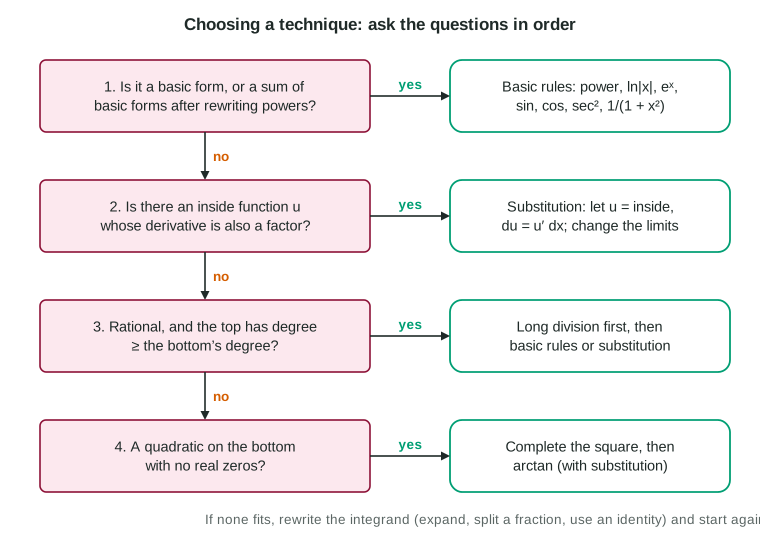
Part 5 · Step by step
How it works, step by step
- The integrand is a sum of powers, exponentials or trig functionsuse the basic rules, after rewriting roots as powers and splitting fractions over one term
- An inside function appears with its derivative as a factorsubstitute for the inside and change any limits
- A fraction has a top of degree at least the bottomdivide first, then integrate the pieces
- A constant sits over a quadratic with no real zeroscomplete the square and use the arctan form
Part 6 · Key ideas
Key ideas
- Rewrite first: roots as powers, products expanded, fractions over one term split.
- Substitution needs the inside's derivative as a factor (up to a constant). yes; no.
- For fractions, compare: top is a multiple of the bottom's derivative (); top degree too high (divide); constant over an irreducible quadratic (arctan).
- Always check by differentiating. If no method works, the definite integral may be a calculator question.
Part 7 · Misconception
A common mistake
The wrong idea:
What actually happens: The on top changes everything: it is a multiple of the bottom's derivative, so substitute and get . Arctan is for a constant on top.
Part 8 · Check yourself
Check yourself
Exam-style questions. Anything you miss goes into your review queue.
Table
Four integrals, four approaches
| Label | Integral |
|---|---|
| I | |
| II | , |
| III | |
| IV | , |
1. Which integral is set up for the substitution ?
- I
- II
- III
- IV
Show the answer
In I the inside function has derivative , and is a factor:
- Correct: I: Correct: and the factor is present: .
- II: Here dividing each term by gives basic forms, ; no inside function is needed.
- III: Its bottom is a quadratic with no real zeros and the top is constant: complete the square.
- IV: The top's degree is at least the bottom's: long division comes first.
2. Which integral should start with polynomial long division?
- II
- III
- I
- IV
Show the answer
Long division is for a fraction whose top has degree at least the bottom's degree, with a bottom of more than one term: IV.
- II: The bottom is the single term : just divide each term of the top by . No long division is needed.
- III: The top has degree 0, less than the bottom's 2; complete the square instead.
- I: There is no fraction to divide; substitute u = x squared.
- Correct: IV: Correct: degree 2 over degree 1.
.
3. Evaluate integral III, . Include .
Type an expression for .
Show the answer
- Answer:
4. Evaluate integral IV, for . Include .
Type an expression for .
Show the answer
- Answer:
5. Find .
Show the answer
. Let , :
- Correct: : Correct: , , so .
- : Its derivative is , twice the integrand.
- : The form needs on top; and cannot be pulled out of an integral.
- : ; with , , so the factor is .
6. Which of these has no antiderivative that can be written with the functions of this course, so a definite integral of it is found with a calculator?
Show the answer
has antiderivatives (such as ), but none built from polynomials, roots, exponentials, logs and trig functions. Definite integrals of it are found numerically.
- : Substitute : .
- Correct: : Correct: no elementary function has derivative ; without the factor , substitution does not apply.
- : Substitute : .
- : Its antiderivative is .
Part 9 · Summary
Summary
Part 10 · Up next
What comes next
Part 11 · Connections