Writing Differential Equations
A differential equation states how fast a quantity changes.
Part 1 · Hook
Why this matters
Part 2 · Before you start
What this builds on
Part 3 · Prerequisite check
Quick check before you start
1. is a number of cells and is in hours. In what units is measured?
- cells per hour
- cells
- hours per cell
- cells per hour per hour
Show the answer
A derivative is a rate: the units of the output per unit of the input.
- Correct: cells per hour:
- cells:
- hours per cell:
- cells per hour per hour:
2. A function is increasing on an interval where its derivative is
- positive
- negative
- zero
- increasing
Show the answer
If on an interval, is increasing there.
- Correct: positive:
- negative:
- zero:
- increasing:
Part 4 · See it
See it first
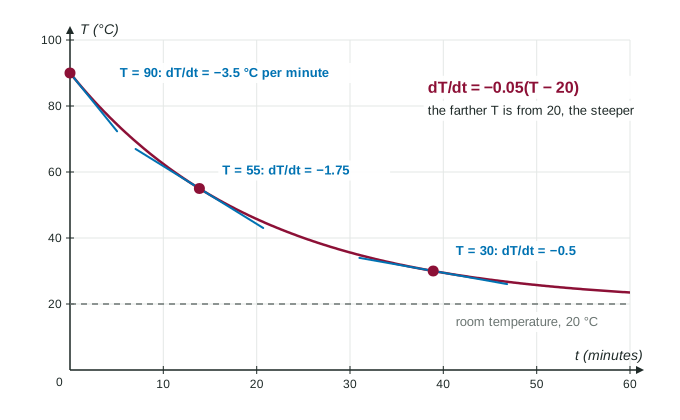
Part 5 · Step by step
How it works, step by step
- A quantity changes at a rate that depends on its current valuewrite the rate as a derivative and the dependence as a formula:
- "Proportional to" means "a constant times"
; "inversely proportional" puts the quantity in the denominator - The signs of and of the other factor are knownthe sign of is known, so you know where the quantity grows and where it shrinks
- One rate and the matching value are givensolve for , then predict the rate at any other value
Part 6 · Key ideas
Key ideas
- A differential equation relates a derivative to the variables: .
- "The rate of change of is proportional to " is . The derivative is on the left; the quantity is on the right.
- "Proportional to the difference between and 20" is .
- The sign of says where increases or decreases; you can read it before knowing any formula for .
- has units: for with in hours, is "per hour".
Part 7 · Misconception
A common mistake
The wrong idea: "A population grows at a rate proportional to its size" means .
What actually happens: The rate is proportional: . The sentence is about , and the size it mentions is , not .
Part 8 · Check yourself
Check yourself
Exam-style questions. Anything you miss goes into your review queue.
Table
A growing culture of cells
| (cells) | 200 | 350 | 500 | 800 |
|---|---|---|---|---|
| (cells per hour) | 52 | 91 | 130 | 208 |
1. Which differential equation is consistent with every column of the table?
Show the answer
Divide each rate by its population: every ratio is , so the rate is proportional to with .
- Correct: :
: the rate is always times the size. - : A constant rate would give one rate for every column, but the rate grows with P.
- : The table gives no times; the rate is tied to the number of cells, not to the clock.
- : The ratio is upside down: , not 200.
2. The table fits . Find the constant of proportionality .
No calculator. Type the exact value (a fraction, π, e or a root is fine).
Show the answer
- Answer: ≈ 0.260
3. What does the entry 91 in the table mean?
- After 350 hours, there are 91 cells.
- When there are 350 cells, the population is growing at 91 cells per hour.
- From now on, the population grows by 91 cells each hour.
- The population has grown by 91 cells since the first measurement.
Show the answer
The second row is : at the moment cells, the population increases at 91 cells per hour.
- After 350 hours, there are 91 cells.: The 350 is a number of cells, not a time, and 91 is a rate, not a count.
- Correct: When there are 350 cells, the population is growing at 91 cells per hour.: It is the derivative, a rate, at the moment P = 350.
- From now on, the population grows by 91 cells each hour.: The rate changes as P changes; 91 holds only at that moment.
- The population has grown by 91 cells since the first measurement.: It grew by 150 cells between the first two columns; 91 is a rate, not a change in size.
4. The rate of change of y with respect to x is inversely proportional to the square of y. Which equation says this?
Show the answer
"Inversely proportional to " means ; "the rate of change of with respect to " is .
- : That is directly proportional to the square of y.
- : The sentence is about the square of y, not of x.
- : The sentence describes the rate of change, so a derivative belongs on the left.
- Correct: : Inversely proportional to : a constant divided by .
5. A quantity satisfies . Find when .
No calculator. Type the exact value (a fraction, π, e or a root is fine).
Show the answer
- Answer: 8
6. Water drains from a tank. The depth , in feet, changes at a rate equal to times the square root of the depth. Write in terms of .
Type an expression for .
Show the answer
: negative because the depth falls, and proportional to .
- Answer:
Part 9 · Summary
Summary
Part 10 · Up next
What comes next
Part 11 · Connections