Verifying Solutions to Differential Equations
To verify a solution to a differential equation, differentiate the function, substitute into both sides and show they agree for every x in an interval.
Part 1 · Hook
Why this matters
Part 2 · Before you start
What this builds on
Part 3 · Prerequisite check
Quick check before you start
1. What is ?
Show the answer
Chain rule: the derivative of the inside, 3, multiplies .
- Correct: :
- :
- :
- :
2. If , what is ?
Show the answer
, then .
- Correct: :
- :
- :
- :
Part 4 · See it
See it first
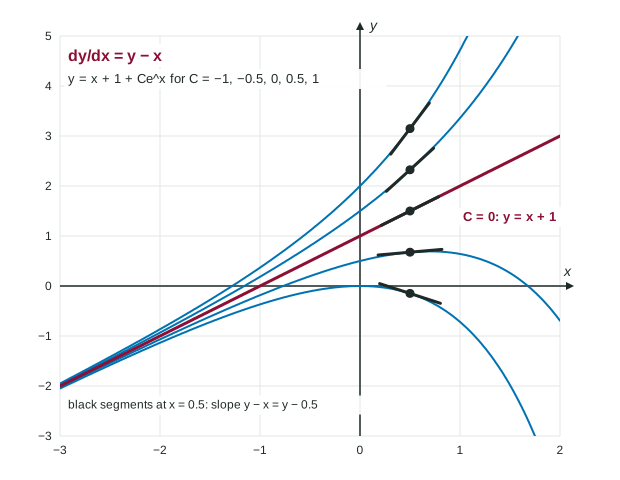
Part 5 · Step by step
How it works, step by step
- A function is proposed for a differential equationcompute every derivative the equation uses
- Substitute the function and its derivatives into both sidessimplify each side separately, never moving terms across the sign
- The two sides agree for every in an intervalthe function is a solution on that interval
- They disagree for even one value of x in the intervalthe function is not a solution there
- An added constant has derivative 0one differential equation usually has infinitely many solutions
Part 6 · Key ideas
Key ideas
- A solution to a differential equation is a function, not a number. It makes the equation true for every in an interval.
- To verify a solution: differentiate, substitute into both sides, simplify each side, compare.
- Checking a single point is not enough: two different expressions can agree at one .
- One equation can have a whole family of solutions, such as for .
- A solution may live on an interval only: solves on and on , not across .
Part 7 · Misconception
A common mistake
The wrong idea: solves because at both sides equal 3.
What actually happens: One matching point proves nothing. Compare the sides as functions: and for every . That is the verification.
Part 8 · Check yourself
Check yourself
Exam-style questions. Anything you miss goes into your review queue.
Table
Four candidate functions
| Name | ||||
|---|---|---|---|---|
| Formula |
1. Which functions in the table satisfy ? Select all that apply.
Show the answer
Differentiate each function and compare with ; only and match for every .
- Correct: : and : equal.
- Correct: : and : equal.
- : but : not equal.
- : but : not equal.
2. Why does fail to satisfy ?
- Its derivative is , which is not .
- At , , and 3 is not a rate.
- It has the same derivative as , so it is the same function.
- Its derivative is , but .
Show the answer
while ; the sides differ by 6 for every .
- Its derivative is , which is not .: The derivative of the constant 2 is 0, not 2.
- At , , and 3 is not a rate.: Values and rates are both numbers; the test is whether the two sides agree.
- It has the same derivative as , so it is the same function.: Equal derivatives mean the functions differ by a constant, here 2.
- Correct: Its derivative is , but .: The constant 2 drops out of the derivative but is tripled on the right side.
Graph
Three curves
3. Which work verifies that every curve satisfies ?
- At , and .
. - and , so they differ by 1.
- and , equal for every .
Show the answer
Differentiate: . Substitute:
- At , and .: Agreement at one point does not show agreement for every x.
.: This chain writes between unequal things: . - and , so they differ by 1.: The derivative of is 1, which was dropped.
- Correct: and , equal for every .: Both sides are computed separately and agree as functions.
4. The curve through is . Find at .
No calculator. Type the exact value (a fraction, π, e or a root is fine).
Show the answer
From the differential equation,
- Answer: 3
5. Is a solution to for ?
- No: , which is not .
- Yes: at both sides equal 2.
- No: an on the left side is not allowed.
- Yes: and .
Show the answer
Left: . Right: . They agree for every , so is a solution.
- No: , which is not .: The left side is , not .
- Yes: at both sides equal 2.: The conclusion is right, but one point does not verify it.
- No: an on the left side is not allowed.: A differential equation may contain x anywhere.
- Correct: Yes: and .: Both sides simplify to the same function.
6. For which positive constant does satisfy ?
No calculator. Type the exact value (a fraction, π, e or a root is fine).
Show the answer
, . Then , and , so : .
- Answer: 3
Part 9 · Summary
Summary
Part 10 · Up next
What comes next
Part 11 · Connections