A differential equation such as does something remarkable: it tells you the slope of a solution curve at every point of the plane, before you know a single solution. Pick the point and the equation says any solution passing there has slope . A slope field turns that information into a picture.
What a slope field is
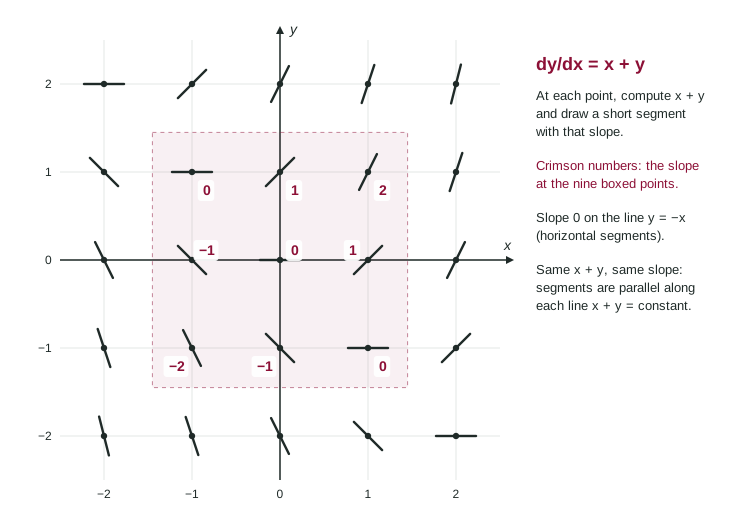
At each point of a grid, draw a short segment centered on the point, tilted to the slope the differential equation gives there. That is all. The collection of segments is the slope field (also called a direction field). It is a map of directions: a solution curve passing through a point must run along the little segment there.
How to sketch one
- List the points you are asked about. A point is : the first number is .
- Substitute each point into the right side to get a number, the slope there.
- Draw a short segment through the point with that slope. Positive slopes rise to the right, negative slopes fall, slope 0 is horizontal. If the slope is undefined (a division by 0), draw a vertical segment.
- Make the size of the slope visible: a slope of 3 looks steeper than a slope of 1, and a slope of looks gentle. Exact angles are not needed; the sign and the rough steepness are.
Worked example. Sketch the slope field of at the nine points with and in .
Compute at each point and organize the results in a grid, with going up the page:
| 0 | 1 | 2 | |
| 0 | 1 | ||
| 0 |
Now draw: flat segments on the diagonal from to , gentle rises of slope 1 at and , a steeper rise of slope 2 at , and the mirror-image falls below the diagonal. The figure above shows the result.
Shortcuts that save time
Before computing 9 or 25 slopes, look at the equation's form. Three patterns cover most exam questions.
| If depends on | then | Example |
|---|---|---|
| alone | segments in each vertical column are parallel | |
| alone | segments in each horizontal row are parallel | |
| both | look for lines where the slope is 0 or constant |
Find where the slope is 0 first. For that is the rows and : every segment there is flat. For it is the slanted line . For it is both the row and the column , because a product is 0 when either factor is.
Then look for undefined slopes. In , every point on the -axis (except the origin) has in the denominator, so the segments there are vertical.
Matching an equation to a field
To decide which equation produced a given field, test a few easy points. Points on the axes make the arithmetic quick: at and most expressions are one short computation. Check the sign first, then the steepness. Also check where the field is flat: if the flat segments lie on , the right side must be 0 whenever .
Common slips
- Swapping coordinates: at the value of is 0, not 2.
- Drawing a segment that is not centered on its point, or that runs into the next one: keep segments short.
- Getting the sign right but ignoring steepness, so slopes of 0.5 and 4 look the same.
- Forgetting that a factor of 0 makes the whole slope 0.