Separation of variables hands you a general solution: a family of curves with a constant in it. A real question usually wants one curve. The coffee was 90 °C at noon; the population was 200 at the start; the curve passes through . That one fact is an initial condition, and the single curve it selects is a particular solution. A differential equation together with an initial condition is called an initial value problem.
The procedure
- Separate and integrate, adding (exactly as before).
- Substitute the initial condition immediately. An initial condition means: replace by and by . Solve for .
- Put the value of back and solve for . If a square root or an absolute value appears, keep the sign that matches .
- State the domain of the solution (below).
Why substitute before solving for ? Because the equation right after integrating is the simplest place to find . Solving for first means exponentiating or taking roots with still unknown, where most sign and algebra slips happen.
Worked example 1. Solve with .
Separate and integrate: , so .
Use the condition now: , so .
Solve: , so . The point has a negative , so take the negative root: .
Check: at , . Good.
Worked example 2. Coffee cools by , with . Find .
Separate and integrate: , so .
Use the condition: , so .
Solve:
The domain of a particular solution
A solution must be differentiable at every point where you claim it works, and it must be one connected piece. So the domain of a particular solution is the largest open interval that contains and on which the formula is defined and differentiable (and makes the differential equation meaningful).
Worked example 3. Solve with , and give the domain.
Separate and integrate: , so .
Condition: , so . Then , and .
The formula breaks at . The interval containing is , so the particular solution is for .
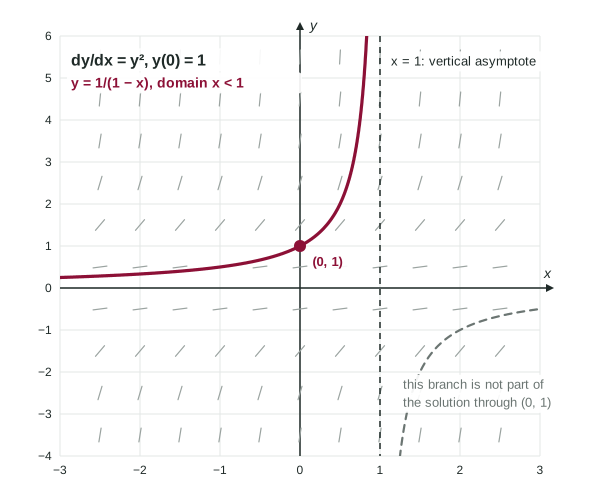
Notice what happened. The equation looks harmless, yet the solution through shoots to infinity at . You could not have seen that from the equation alone; the formula shows it.
Watch for three ways a formula breaks: a division by 0, an even root of a negative number, and a logarithm of a number that is not positive. Also look at the differential equation itself: for with , the solution reaches at , where divides by 0. So the domain is the open interval .
Common slips
- Adding the constant after solving: from , writing . Exponentiating gives .
- Substituting the condition the wrong way round: means and .
- Keeping the wrong sign after a square root.
- Giving the formula without its domain, or a domain that does not contain .