You can now write a differential equation, check a proposed solution and sketch solutions from a slope field. This page finds solutions by formula. The method, separation of variables, works whenever the variables can be pulled apart. On the AP® Calculus AB exam it is the only solving method you need.
When an equation is separable
A differential equation is separable when the right side is a product of a function of alone and a function of alone:
| Equation | Separable? | Why |
|---|---|---|
| yes | ||
| yes | , by an exponent rule | |
| yes | ||
| no | a sum cannot be written as |
The method in four steps
- Separate. Multiply and divide so that every is on the side with and every is on the side with : . Both and stay in numerators.
- Integrate both sides.
. - Add the constant now. Each side has its own constant, but is just one constant, so write a single , usually on the side. Do it in this step, not later.
- Solve for if you can. The result, with still in it, is the general solution: a whole family of curves.
Worked example 1. Find the general solution of .
Separate: divide by and multiply by : .
Integrate: , so .
Solve: take reciprocals and change the sign: .
Check one case: with , and
Look at what would happen if you waited to add the constant: gives , and then "" gives . That family is different, and for it does not satisfy the equation. The constant must go in when you integrate.
Logarithms and the absolute value
Many separable equations put on the left. Its antiderivative is , with the absolute value. Keep it; it decides which solutions you find.
Worked example 2. Find the general solution of .
Separate: (this assumes ; see below).
Integrate: .
Exponentiate both sides:
Remove the absolute value: . The number can be any nonzero constant; call it . So .
Finally, also satisfies (both sides are 0), but dividing by hid it. Allowing brings it back. General solution: for any constant .
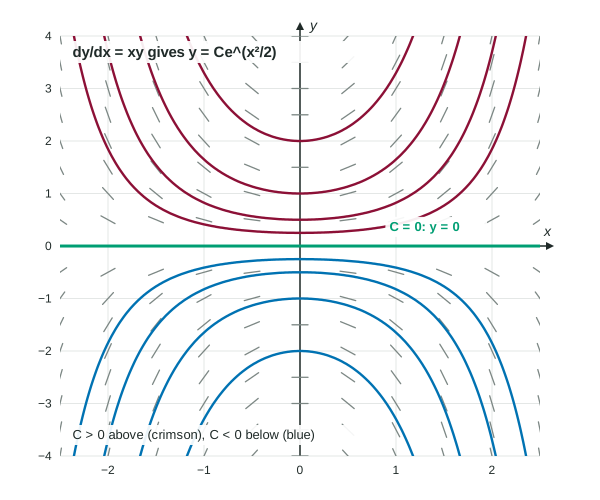
Two algebra facts do most of the work here. First, , which turns into a constant times ; it is not . Second, means ; you undo a logarithm by exponentiating the whole other side.
Shifted variables
The cooling equation separates as . The whole quantity stays together in the denominator, and its antiderivative is :
Common slips
- Leaving an on the side or a on the side. If the variables will not separate, the method does not apply.
- Missing , or adding it only after solving for .
- Writing instead of , which loses the negative solutions.
- Writing . It is , a constant times .