General Solutions by Separation of Variables
For a separable equation, put y with dy and x with dx , integrate both sides, and add one constant immediately.
Part 1 · Hook
Why this matters
Part 2 · Before you start
What this builds on
Part 3 · Prerequisite check
Quick check before you start
1.
Show the answer
The derivative of is for ; the absolute value keeps negative allowed.
- Correct: :
- :
- :
- :
2.
Show the answer
With , : .
- Correct: :
- :
- :
- :
Part 4 · See it
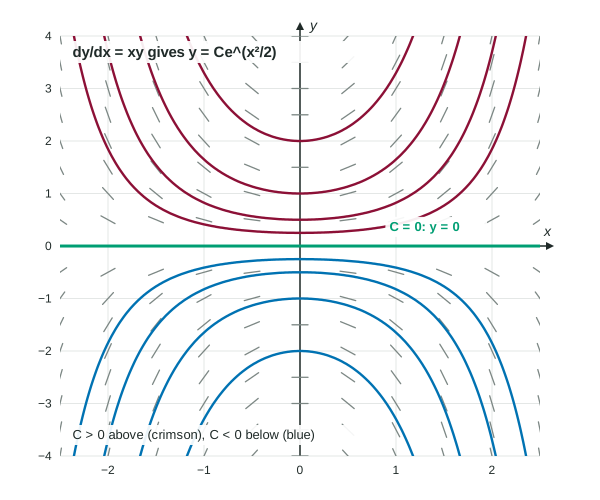
See it first
Part 5 · Step by step
How it works, step by step
- The right side factors as the equation is separable:
- Integrate both sideseach side becomes an antiderivative; the two constants combine into one C
- An antiderivative of is keep the absolute value; exponentiating gives , so with any constant
- Solve for when you canthe general solution: a family of curves, one for each constant
Part 6 · Key ideas
Key ideas
- Separable means the right side is a product (or quotient) of a function of and a function of . is not separable.
- Separate completely: only and on one side, only and on the other. and stay in the numerators.
- Integrate both sides and write once, right away. Adding it after solving for gives a different, wrong family.
- . Then , and becomes a constant that may be any sign.
Part 7 · Misconception
A common mistake
The wrong idea: Solve : , so .
What actually happens: The constant belongs in the integration step: , so . Adding at the end gives functions that do not satisfy the equation.
Part 8 · Check yourself
Check yourself
Exam-style questions. Anything you miss goes into your review queue.
Table
Four differential equations
| Label | I | II | III | IV |
|---|---|---|---|---|
| Equation |
1. Which equations in the table are separable? Select all that apply.
- I
- II
- III
- IV
Show the answer
Separable means the right side is . I and III factor that way; II and IV do not.
- Correct: I: , a product of a function of and a function of .
- II: is a sum; it cannot be written as .
- Correct: III: , a product.
- IV: is a difference of a function of and a function of , not a product of one with the other.
2. Which is a correct separation of equation III?
Show the answer
, so .
- : is on the right side of the equation; moving it to the left divides by it, giving .
- : is still on the side: not separated.
- : The factor stays as it is; only the factor moves.
- Correct: : ; multiply both sides by .
3. What is the general solution of equation I?
Show the answer
gives , so .
- : The constant was added after solving for ; it belongs right after integrating.
- Correct: : , then take reciprocals and change the sign.
- : ; the minus sign was lost.
- : From , is the reciprocal, not the negative.
4. Which is a correct first step in separating ?
Show the answer
has only with and only with .
- : is in the denominator on the right; moving it multiplies, giving .
- : is in the numerator; it stays there.
- : is still on the side: not separated.
- Correct: : Multiply both sides by .
5. Separate and integrate .
Show the answer
, so , and .
- : multiplies ; it must be divided across before integrating.
- Correct: : .
- : An antiderivative of is .
- : The constant of integration is missing.
6. A student writes: ", so ." What is wrong?
- is a sum, so dividing by leaves : the equation is not separable.
- Nothing: dividing by is allowed when .
- The student should have written .
- The student forgot .
Show the answer
Separation needs . A sum such as cannot be split that way.
- Correct: is a sum, so dividing by leaves : the equation is not separable.: Dividing by does not leave .
- Nothing: dividing by is allowed when .: , not .
- The student should have written .: That would also be wrong: the right side is not a product.
- The student forgot .: No integration has happened yet; the separation itself is wrong.
Part 9 · Summary
Summary
Part 10 · Up next
What comes next
Part 11 · Connections