Particular Solutions from Initial Conditions
A particular solution satisfies the differential equation and an initial condition.
Part 1 · Hook
Why this matters
Part 2 · Before you start
What this builds on
Part 3 · Prerequisite check
Quick check before you start
1. The general solution of is
Show the answer
, so .
- Correct: :
- :
- :
- :
2.
Show the answer
Raise the power by one and divide by the new power; add C.
- Correct: :
- :
- :
- :
Part 4 · See it
See it first
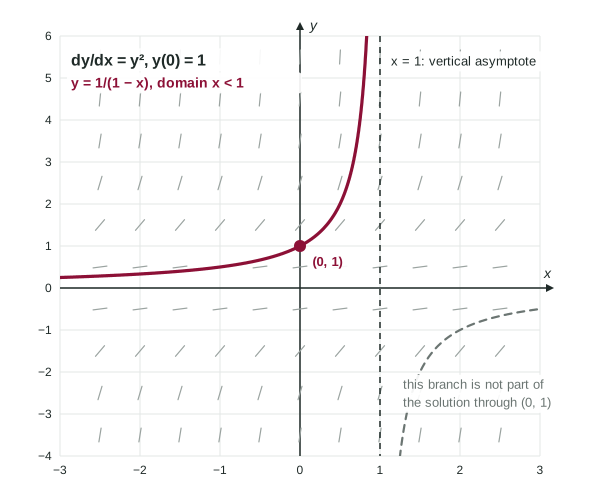
Part 5 · Step by step
How it works, step by step
- Separate and integratean equation with one constant
- Substitute the initial condition right awaya number for , before any rearranging
- Solve for , choosing the sign or branch that passes through the given pointone function, the particular solution
- The formula breaks somewhere (division by 0, a negative under a root, a log of 0)the domain is the largest open interval around the initial x where the solution is defined and differentiable
Part 6 · Key ideas
Key ideas
- An initial condition says the solution passes through . Put in for and in for .
- Use it as soon as appears. Solving for first invites algebra slips and wrong constants.
- After a square root, keep the sign that matches : needs the negative root.
- State the domain: an open interval containing on which the formula is defined and its derivative exists.
Part 7 · Misconception
A common mistake
The wrong idea: From : , and gives , so .
What actually happens: Exponentiating gives , not . Better, use the condition first: , so and
Part 8 · Check yourself
Check yourself
Exam-style questions. Anything you miss goes into your review queue.
Table
A student solves an initial value problem
| Step | 1 | 2 | 3 | 4 |
|---|---|---|---|---|
| Work | , so |
1. Which step contains an error?
- Step 4: since , the root must be negative.
- Step 3: should be .
- Step 2: the constant belongs on the left side.
- Step 1: should be in the denominator.
Show the answer
has two roots. The initial condition picks the negative one: .
- Correct: Step 4: since , the root must be negative.: gives , not .
- Step 3: should be .: ; step 3 is right.
- Step 2: the constant belongs on the left side.: One constant on either side is fine.
- Step 1: should be in the denominator.: Multiplying by gives ; step 1 is right.
2. Write the correct particular solution for with .
Type an expression for .
Show the answer
, so and, since , .
- Answer:
3. What is the domain of the particular solution ?
- All real numbers
Show the answer
is never below 7, so is defined and never 0, and exists for every real .
- : The initial point is inside the domain; the domain is not cut off there.
- Correct: All real numbers: , so the root is defined and for every .
- : is positive for every , so nothing is cut off.
- : That would need ; here the sign is .
4. When is the best moment to use the initial condition in separation of variables?
- Before integrating, to choose which antiderivative to use.
- At the end, after solving for and then adding .
- It is not needed for a separable equation.
- As soon as appears: substitute the point, find , then solve for .
Show the answer
Substituting right after integrating finds in the simplest form and avoids sign and algebra slips.
- Before integrating, to choose which antiderivative to use.: You cannot find C before it exists.
- At the end, after solving for and then adding .: A added after solving gives the wrong family.
- It is not needed for a separable equation.: Without it you have a family, not one solution.
- Correct: As soon as appears: substitute the point, find , then solve for .: is found in the simplest equation, before rearranging.
5. Find the particular solution of with .
Type an expression for .
Show the answer
; at , . So
- Answer:
6. The particular solution of with is . What is its domain?
Show the answer
and require , an open interval containing .
- Correct: : At , and is undefined, so the endpoints are out.
- : At , and the differential equation divides by 0.
- : The solution is defined for negative too, back to .
- : For the root is not real.
Part 9 · Summary
Summary
Part 10 · Up next
What comes next
Part 11 · Connections