Exponential Models
When the rate of change is proportional to the amount, dy/dt = ky and y = y_0e^kt .
Part 1 · Hook
Why this matters
Part 2 · Before you start
What this builds on
Part 3 · Prerequisite check
Quick check before you start
1. The general solution of is
Show the answer
, so .
- Correct: :
- :
- :
- :
2. For with , the constant in is
- 5
- 2
- 10
Show the answer
At , , so .
- Correct: 5:
- 2:
- 10:
- :
Part 4 · See it
See it first
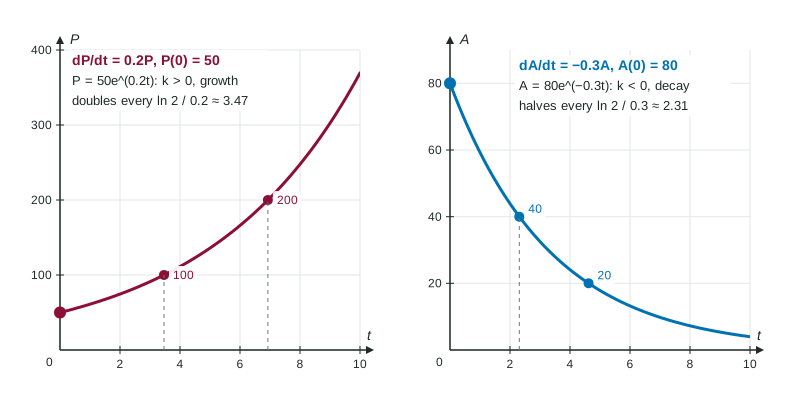
Part 5 · Step by step
How it works, step by step
- A quantity changes at a rate proportional to its size
- Separate, integrate and use y(0), the exponential model
- or growth or decay; is the rate as a fraction of the amount, per unit time
- A second data point is known, so
Part 6 · Key ideas
Key ideas
- and give . You may quote this result.
- : the rate of change as a fraction of the current amount, in "per unit time" (per hour, per year).
- Doubling time () and half-life () are both ; they do not depend on the starting amount.
- To find from two values, divide first: , then take .
- Cooling toward room temperature is exponential in , not in .
Part 7 · Misconception
A common mistake
The wrong idea: A population goes from 400 to 1200 in 3 hours, so .
What actually happens: That is an average rate, measured in cells per hour: a linear idea. For : , so and per hour.
Part 8 · Check yourself
Check yourself
Exam-style questions. Anything you miss goes into your review queue.
Table
A bacteria culture
| (hours) | 0 | 3 |
|---|---|---|
| (bacteria) | 400 | 1200 |
1. . Find the growth constant , exactly.
No calculator. Type the exact value (a fraction, π, e or a root is fine).
Show the answer
, so , and per hour.
- Answer: ≈ 0.366
2. Write for the culture.
Type an expression for .
Show the answer
, which can also be written .
- Answer:
3. What does per hour mean for this culture?
- At each moment, the population grows at about 36.6% of its current size per hour.
- The population grows by about 0.366 bacteria each hour.
- The population triples each hour.
- It is the starting population, in hundreds.
Show the answer
means the growth rate is times the current size: about 0.366 of the population per hour.
- Correct: At each moment, the population grows at about 36.6% of its current size per hour.: , the rate as a fraction of the amount.
- The population grows by about 0.366 bacteria each hour.: is a fraction of the amount, not a count of bacteria.
- The population triples each hour.: It triples every 3 hours.
- It is the starting population, in hundreds.: The starting population is .
4. Which differential equation has the solution ?
Show the answer
For , ; here .
- : 7 is the starting amount, not the constant k.
- : The rate is proportional to y, not to t.
- : , seven times too big.
- Correct: : .
5. A town's population satisfies , with in years. What are the units of ?
- people per year
- per year
- years
- people
Show the answer
: (people per year) ÷ people = per year.
- people per year: That is the unit of ; dividing by removes "people".
- Correct: per year: is people per year and is people, so is .
- years: must have no units, so is per year.
- people: k multiplies P to give a rate, so it carries "per year".
6. A pie at 90 °F cools in a 20 °F freezer: , in minutes. After 10 minutes it is at 55 °F. Find exactly.
No calculator. Type the exact value (a fraction, π, e or a root is fine).
Show the answer
, so and
- Answer: ≈ -0.069
Part 9 · Summary
Summary
Part 10 · Up next
What comes next
Part 11 · Connections