So far you have been handed a function and asked for its derivative. Many real questions run the other way. A biologist cannot write down the size of a bacteria culture for every hour, but she can say how fast it grows: the bigger the culture, the faster it grows. A cook cannot predict the temperature of soup minute by minute, but he knows hot soup cools faster than warm soup. Each of these is a statement about a rate. Written with a derivative, it becomes a differential equation. This page is about writing and reading them; later topics solve them.
What a differential equation is
A differential equation is an equation that contains the derivative of an unknown function. Here are three:
Read the first one aloud: "the rate of change of with respect to equals 0.26 times ." It does not tell you what is at any time. It tells you how fast changes once you know . If cells, then is growing at cells per hour. If , it is growing at 208 cells per hour.
That is the big shift. An ordinary equation such as gives values. A differential equation gives rates, and the rate usually depends on the current value.
Translating "proportional to"
Most word problems use one phrase: proportional to. " is proportional to " means for some constant , called the constant of proportionality. When is a rate, it goes on the left as a derivative.
| Words | Differential equation |
|---|---|
| The rate of change of is proportional to . | |
| The rate of change of is proportional to the square root of . | |
| The rate of change of is inversely proportional to . | |
| The temperature changes at a rate proportional to the difference between and 20. | |
| The rate of change of with respect to is proportional to the product of and . |
Two checks catch most mistakes. First, the sentence talks about a rate, so a derivative must appear. "Grows proportionally to its size" is , never . Second, look at the variable after "proportional to". If it says the population, the right side uses , not .
The sign of the rate
Words like "decreases" or "decays" fix a sign. "The amount of medicine decreases at a rate proportional to the amount present" is with . You could also write and say ; both are correct if you state the sign.
The sign of the right side tells you where the function rises or falls, before you know any formula. For , the rate is positive when and negative when . So climbs toward 50 from below and falls toward 50 from above. That is a lot of information from one line.
Finding the constant
Worked example. Coffee at 90 °C sits in a 20 °C room. It cools at a rate proportional to the difference between its temperature and the room's. At 90 °C it is cooling at 3.5 °C per minute. Write the differential equation, then find the rate when the coffee is at 55 °C.
Name the quantity: , the temperature in °C, at time in minutes. "Proportional to the difference" gives .
Use the known rate. Cooling means when : , so per minute.
Now predict: at ,
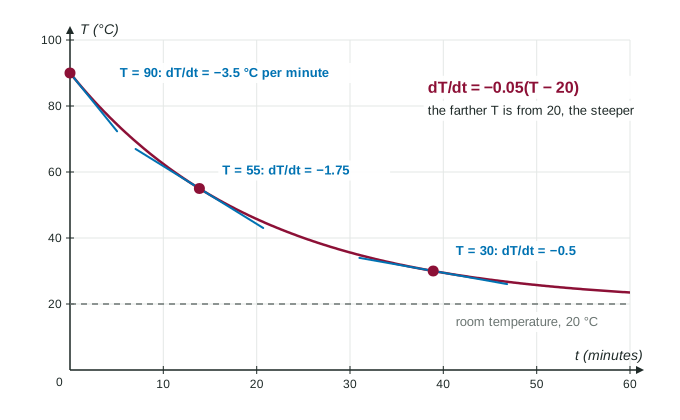
Notice the units of . The left side is in °C per minute and is in °C, so is in "per minute". In with in hours, per hour.
Reading a model from data
A table can tell you which model fits. If a table lists and and the ratio is the same in every column, the rate is proportional to , and that ratio is . If the rate were the same in every column, the model would be , a constant rate, and the graph would be a line.
Common slips
- Writing the quantity instead of its rate: or for "grows at a rate proportional to its size".
- Using instead of in a cooling problem: the coffee cools toward room temperature, not toward 0 °C.
- Losing the sign: "decreases" needs a negative rate.
- Mixing up "proportional" () and "inversely proportional" ().