One differential equation appears in more places than any other: . It says the rate of change is proportional to the amount present. Bacteria with room to grow, an account earning continuous interest, a medicine cleared by the kidneys, a radioactive sample: each changes faster when there is more of it. This page solves the equation once, so you can quote the result, and shows how to read and fit the model.
The solution, once and for all
Separate: . Integrate: . Exponentiate: . At , , so the constant is the starting amount :
This is the exponential model. You may quote it on the exam when a problem says the rate of change is proportional to the amount.
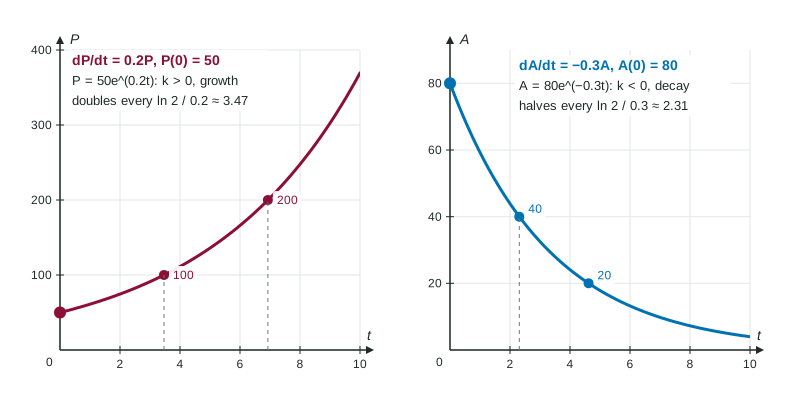
What means
Rearrange the equation: . So is the rate of change as a fraction of the current amount. If per year, the quantity grows at 5% of its current size per year, at every moment. If per hour, it shrinks at 12% of its current size per hour. That is why is called the growth constant () or the decay constant ().
Units follow from the fraction: is in "amount per hour" and in "amount", so is in "per hour". The product has no units, as an exponent must.
| Growth, | Decay, | |
|---|---|---|
| Graph | rises ever faster | falls ever more slowly toward 0, never reaching it |
| Rate of change | grows with | shrinks in size with |
| Fixed time to | double: | halve (half-life): |
Finding from data
Worked example 1. A culture grows at a rate proportional to its size. There are 400 bacteria at and 1200 at hours. Find , the model, and the population at .
The model is . Use the second count: .
Divide first: . Take natural logs: , so per hour.
Model: . Then
Notice the pattern: 3 hours multiplies the population by 3, so 6 hours multiplies it by 9. A linear guess (add 800 every 3 hours, giving 2000) is the trap.
Worked example 2 (calculator). A medicine leaves the blood by , with mg and in hours. Find the half-life and the time when 50 mg remain.
The model is . Half-life: , so and hours.
50 mg: , so and hours.
Keep full precision in the calculator and round to three decimal places only at the end.
Cooling and warming
Newton's law of cooling, with room temperature , is an exponential model for the difference , not for . So
Common slips
- Thinking linearly: an exponential multiplies by the same factor in equal times; it does not add the same amount.
- Taking the log before dividing: from , divide by 400 first.
- Losing the sign of for decay, or using the rate at when a later rate is asked: changes with time.
- Applying the model to instead of in a cooling problem.