A differential equation is a rule about rates. A solution to a differential equation is a function that obeys the rule. Before you learn to find solutions, you need to be able to check one. The good news: checking uses nothing new. You differentiate, substitute and compare.
What "solution" means here
In algebra, a solution of is a number. Here a solution is a whole function. The function is a solution of because, for every , its slope equals twice its height:
The two sides are the same function of . That is what you must show: equality for every in an interval, not at one lucky point.
The three-step check
- Differentiate. Find every derivative the equation uses: , and if it appears.
- Substitute. Put the function and its derivatives into the left side and into the right side. Work on each side separately.
- Compare. Simplify both sides. If they are identical on an interval, the function is a solution there. If they differ anywhere in the interval, it is not.
Keep the two sides apart while you simplify. Writing a long chain like
Worked example 1. Show that is a solution of .
Differentiate: . (The derivative of is 1, of the constant 1 is 0.)
Right side:
Compare: both sides are for every . So the function is a solution on .
Worked example 2. Is a solution of for ?
Left side: . Right side: .
These differ by , which is never 0. So is not a solution. (Try instead: then the right side is , and it works.)
Equations with a second derivative
The same check works when appears. For : and . So is a solution of .
Worked example 3. Find the positive constant for which satisfies .
Differentiate: and .
Substitute:
Since is never 0, the left side is 0 for every exactly when , that is . The positive value is .
Many solutions, not one
An added constant has derivative 0. So if solves , so do and : a differential equation usually has infinitely many solutions. The same happens with multiplied constants: every satisfies , because .
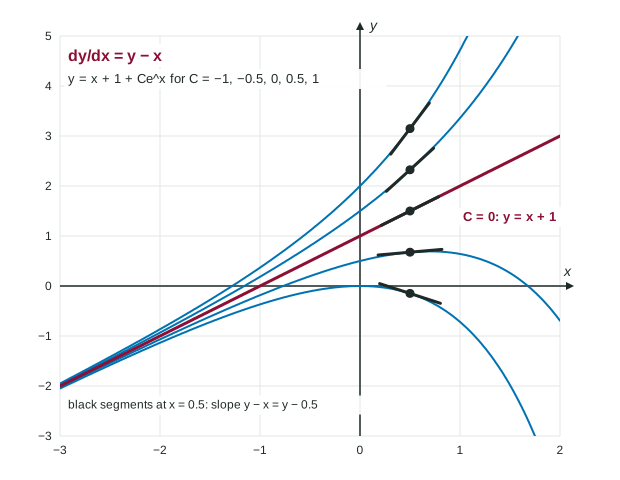
Picking one member of the family needs one more fact, such as a point the graph passes through. That comes in a later topic.
Solutions live on intervals
A solution must be differentiable wherever you claim it works. The function satisfies , since . But it is undefined at , so it is a solution on and, separately, on . When you state that a function is a solution, name the interval.
Common slips
- Checking only one value of . Agreement at one point proves nothing.
- Dropping a derivative: the derivative of is 1, and the chain rule factor in is 3.
- Comparing with the wrong side: in the left side includes the factor .
- Chaining unequal expressions with instead of simplifying each side on its own.