Sketching Slope Fields
A slope field draws dy/dx as a short segment at each point.
Part 1 · Hook
Why this matters
Part 2 · Before you start
What this builds on
Part 3 · Prerequisite check
Quick check before you start
1. At a point where , the tangent line to the graph
- falls 2 units for each unit to the right
- rises 2 units for each unit to the right
- is horizontal
- falls 1 unit for each 2 units to the right
Show the answer
The derivative is the slope of the tangent line: rise over run is -2.
- Correct: falls 2 units for each unit to the right:
- rises 2 units for each unit to the right:
- is horizontal:
- falls 1 unit for each 2 units to the right:
2. Which function satisfies ?
Show the answer
The derivative of is .
- Correct: :
- :
- :
- :
Part 4 · See it
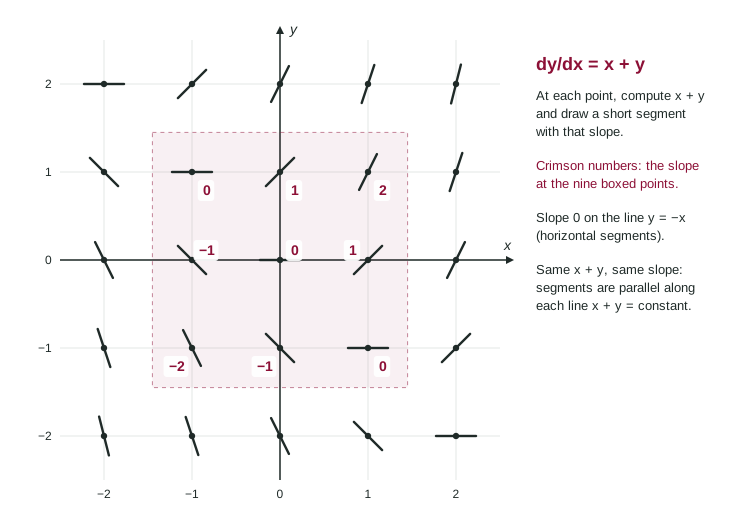
See it first
Part 5 · Step by step
How it works, step by step
- A differential equation gives in terms of and each point of the plane gets a slope
- Substitute the coordinates of a pointyou get the number the segment through that point must have as its slope
- Draw a short segment with that slope, centered on the pointpositive slopes rise to the right, negative ones fall, zero is flat
- Repeat at every grid pointthe field shows how every solution curve bends
Part 6 · Key ideas
Key ideas
- At each point, compute and draw a short segment with that slope, centered on the point.
- Slope 0 gives a horizontal segment; a slope that is undefined (division by 0) gives a vertical one.
- If depends only on , segments in each vertical column are parallel. If it depends only on , segments in each horizontal row are parallel.
- Find where the slope is 0 first: those lines organize the whole field.
- Make steep slopes look steep and gentle ones gentle; the sign matters most.
Part 7 · Misconception
A common mistake
The wrong idea: At the point , use and .
What actually happens: A point is written : means , . For the slope there is , not .
Part 8 · Check yourself
Check yourself
Exam-style questions. Anything you miss goes into your review queue.
Graph
A slope field
1. Which differential equation has this slope field?
Show the answer
Test easy points: at the segment falls with slope , at it rises with slope 2. Only gives both.
- Correct: : It gives slope at and at , as drawn, and 0 along .
- : At this gives slope , but the segment there falls.
- : At this gives , but the segment there rises steeply.
- : At this gives 1, but the drawn slope is steeper; its zero line is , not .
2. The field is drawn for . Find the slope of the segment at .
No calculator. Type the exact value (a fraction, π, e or a root is fine).
Show the answer
.
- Answer: -1
3. For , where are the segments of the slope field horizontal?
- Along the line
- Along the -axis
- Along the line
- Along the -axis
Show the answer
Horizontal means slope 0: on the line .
- Along the line : On , , which is 0 at the origin alone.
- Along the -axis: At the slope is .
- Correct: Along the line : Slope 0 means , so .
- Along the -axis: At the slope is 2.
4. The slope field of has which feature?
- The segments in each horizontal row are parallel.
- The segments share one slope everywhere.
- The segments are horizontal on the x-axis.
- The segments in each vertical column are parallel.
Show the answer
When depends on alone, moving up or down a column does not change the slope.
- The segments in each horizontal row are parallel.: Along a row changes, so changes.
- The segments share one slope everywhere.: varies from to .
- The segments are horizontal on the x-axis.: On the -axis the slope is , 0 at but 1 at .
- Correct: The segments in each vertical column are parallel.: The slope depends on alone, so it is the same for every in a column.
5. Which statements about the slope field of are true? Select all that apply.
- Segments are vertical at points on the -axis with .
- Segments are horizontal at points on the -axis with .
- Slopes are positive at points with and .
- The slope at is 2.
Show the answer
Zero numerator gives slope 0; zero denominator gives an undefined, vertical slope.
- Correct: Segments are vertical at points on the -axis with .: There and the slope is undefined.
- Correct: Segments are horizontal at points on the -axis with .: There the slope is .
- Slopes are positive at points with and .: A negative over a positive is negative.
- The slope at is 2.: ; the fraction was flipped.
6. For , a student draws a segment rising with slope 3 at . What is wrong?
- The slope there is , so the segment should fall gently.
- The slope there is , so the segment should fall.
- Nothing: .
- The slope there is .
Show the answer
At : . The student added instead of subtracting .
- The slope there is , so the segment should fall gently.: is squared: .
- Correct: The slope there is , so the segment should fall.: .
- Nothing: .: The equation subtracts ; it does not add .
- The slope there is .: The coordinates were swapped and was not squared.
Part 9 · Summary
Summary
Part 10 · Up next
What comes next
Part 11 · Connections