Reasoning with Slope Fields
Trace a solution through a point by following the segments across the field.
Part 1 · Hook
Why this matters
Part 2 · Before you start
What this builds on
Part 3 · Prerequisite check
Quick check before you start
1. If changes from negative to positive at , then has
- a relative minimum at
- a relative maximum at
- a point of inflection at
- no critical point at
Show the answer
Decreasing then increasing: a relative minimum, by the First Derivative Test.
- Correct: a relative minimum at :
- a relative maximum at :
- a point of inflection at :
- no critical point at :
2. If on an interval, the graph of there is
- concave up
- concave down
- increasing
- decreasing
Show the answer
A positive second derivative means is increasing: concave up.
- Correct: concave up:
- concave down:
- increasing:
- decreasing:
Part 4 · See it
See it first
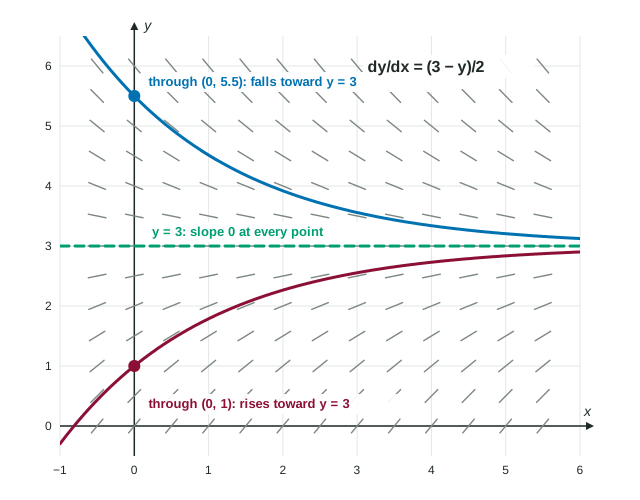
Part 5 · Step by step
How it works, step by step
- A solution curve passes through a given pointit runs along the segment there and keeps following the segments in both directions
- for every on a horizontal line is an equilibrium solution, a row of flat segments
- Solution curves of these equations do not cross one anothera curve that starts below an equilibrium line stays below it
- is found by differentiating with the chain rule and substituting its sign at a point tells the concavity of the solution there
Part 6 · Key ideas
Key ideas
- Sketch a solution through a point by following the segments both ways, all the way across the field; never cut across the segments.
- An equilibrium solution makes for every . Solve "right side " for .
- The sign of says where a solution rises or falls; long-run behavior shows whether curves approach an equilibrium or move away.
- Concavity: . Every is a function of , so ; then substitute the equation.
Part 7 · Misconception
A common mistake
The wrong idea: For , , because there is no in the formula.
What actually happens: depends on , so the chain rule applies:
Part 8 · Check yourself
Check yourself
Exam-style questions. Anything you miss goes into your review queue.
Graph
The slope field of
1. Which is an equilibrium solution of the differential equation?
Show the answer
Set the right side to 0: gives .
- Correct: : On , for every : a row of flat segments.
- : At the slope is , not 0.
- : An equilibrium solution is a horizontal line y = c; on x = 1 the slopes vary.
- : At the slope is .
2. Describe the solution curve through as increases.
- It falls and approaches .
- It levels off at .
- It rises and approaches .
- It rises ever more steeply, moving away from .
Show the answer
For , and grows as grows, so the curve climbs faster and faster.
- It falls and approaches .: Above , : the curve rises.
- It levels off at .: At the slope is , not 0.
- It rises and approaches .: Nothing is flat at ; the slope there is 1.
- Correct: It rises ever more steeply, moving away from .: Above the slopes are positive and grow with .
3. Find at the point for .
No calculator. Type the exact value (a fraction, π, e or a root is fine).
Show the answer
, so .
- Answer: ≈ 0.500
4. Which are equilibrium solutions of ? Select all that apply.
Show the answer
An equilibrium solution is a constant with for every : and .
- Correct: : The factor makes the slope 0 for every .
- Correct: : The factor makes the slope 0 for every .
- : The slope is 0 along , but a vertical line is not a function of .
- : At , , not 0 for every .
5. For , find at the point .
No calculator. Type the exact value (a fraction, π, e or a root is fine).
Show the answer
. At : , so
- Answer: 11
6. A solution curve of passes through . Near the curve is
- increasing and concave down
- decreasing and concave up
- decreasing and concave down
- increasing and concave up
Show the answer
;
- increasing and concave down: at , positive.
- decreasing and concave up: .
- decreasing and concave down: Both derivatives are positive at .
- Correct: increasing and concave up: and
.
Part 9 · Summary
Summary
Part 10 · Up next
What comes next
Part 11 · Connections