Unit 6 · Topic 6.6 Beta
Properties of Definite Integrals
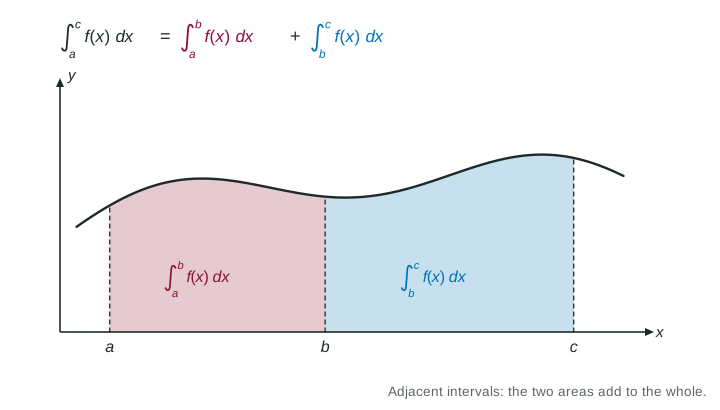
Definite integrals add over adjacent intervals, change sign when the limits are reversed, are 0 over a single point, and split over sums and constant multiples (but not products).
Practice 1: Implementing Mathematical ProcessesPractice 2: Connecting Representations
Question set for this topic
Part 1 · Hook
Why this matters
A free-response question gives you three
integrals in a table and asks for a fourth you were never told. No formula for
, no graph, just numbers. The
properties of definite integrals let you build the answer the way you would piece together a trip from its legs: adding, subtracting and reversing.
Part 2 · Before you start
What this builds on
Part 3 · Prerequisite check
Quick check before you start
1. The region between and the x-axis on gives
- 6
- 0
Show the answer
Signed area: the rectangle of area 6 lies below the axis.
- Correct: :
- 6:
- :
- 0:
2. Which limit of sums is ?
Show the answer
and .
- Correct: :
- :
- :
- :
Part 5 · Step by step
How it works, step by step
- Riemann sums are built by adding width times height→anything true of sums (splitting a sum, pulling out a constant) is true of integrals
- Two intervals meet end to end→their integrals add:
- An interval is run backward→every width is negative, so , and
- A constant k is integrated→the result is k times the width:
Part 6 · Key ideas
Key ideas
- Additivity: , for any order of , , .
- Reversed limits: , and .
- Linearity: , and .
- A bounded function with a jump or a hole can still be integrated: split at the break and use geometry on each piece.
Part 7 · Misconception
A common mistake
The wrong idea: .
What actually happens: The constant 4 is a height, so it is integrated over the interval too: .
Part 8 · Check yourself
Check yourself
Exam-style questions. Anything you miss goes into your review queue.
Table
Known values of definite integrals
The functions
and
are continuous. The table gives four definite integrals.
Definite integrals of f and g| Integral | Value |
|---|
| 5 |
|---|
| 12 |
|---|
| 4 |
|---|
| |
|---|
1. Find .
No calculator. Type the exact value (a fraction, π, e or a root is fine).
Show the answer
Additivity: , so .
2. Find .
No calculator. Type the exact value (a fraction, π, e or a root is fine).
Show the answer
. Reversing the limits changes the sign: .
3. Find .
No calculator. Type the exact value (a fraction, π, e or a root is fine).
Show the answer
.
4. Find .
No calculator. Type the exact value (a fraction, π, e or a root is fine).
Show the answer
.
5. For continuous functions and , which statement is not true in general?
Show the answer
Sums and constant multiples pass through an integral; products do not. On with : , but .
- : This is true: running the interval backward makes every width negative.
- Correct: : Correct, this is false: with on the left side is 2 and the right side is 4. Integrals split over sums, not over products.
- : This is true: every Riemann sum of f + g splits into a sum for f plus a sum for g.
- : This is true: a constant factor comes out of every Riemann sum, so it comes out of the integral.
6. is positive on , and the region between its graph and the x-axis there has area 3. Let . What is ?
- 3
- 0
Show the answer
. With the upper limit below the lower limit, a positive integrand gives a negative value.
- 3: The area is 3, but runs from 2 back to 0: reversed limits give .
- 0: is 0 at , its lower limit, not at .
- : Reversing the limits changes only the sign: -3.
- Correct: : Correct: .
Part 9 · Summary
Summary
Definite integrals add over adjacent intervals, change sign when the limits are reversed, are 0 over a single point, and split over sums and constant multiples (but not products). Use these with geometry, splitting at jumps, to find integrals from tables and graphs.
Part 10 · Up next
What comes next
Part 11 · Connections
Connections